

How to Generate PCD Franchise Enquiries for the Territories You Actually Have Available
Your campaign brings a new franchise enquiry. The prospect answers the call, asks about the range and wants to discuss the opportunity.
Then your salesperson asks which district they are interested in.
That territory is already committed.
Another enquiry requests a district your company is not currently opening. A third prospect lives in Delhi but wants to operate in Uttar Pradesh.
The campaign report shows leads, but the territory discussions tell a different story.
Useful PCD franchise lead generation connects advertising with current territory information and the applicant’s preferred business location. Your team needs to know where the person wants to operate—not simply where they live or saw the advertisement.
This starts before the campaign launches.
Why more franchise enquiries may not mean more workable opportunities
A franchise enquiry needs several things to align: the applicant’s requirement, the relevant range, territory availability and your company’s partnership process.
A low-cost enquiry can still create little opportunity if the requested district cannot be offered.
The opposite can also happen. Someone outside your usual campaign area may have a relevant plan for a territory you want to develop.
That is why location alone cannot establish suitability.
Your campaign should help attract relevant interest. Your form and sales process should confirm the actual requirement.

Start with a territory list your team can trust
Before deciding where to advertise, review the areas your business is prepared to discuss.
A salesperson’s memory or an old spreadsheet may not reflect recent commitments. Campaign planning needs a current reference.
A practical internal record can include:
| Information | Why it matters |
| State and district | Identifies the requested area clearly |
| Range or division, where relevant | Prevents a general availability label from hiding range-specific conditions |
| Current status | Shows whether enquiries can be considered |
| Important conditions | Explains what still needs review |
| Last checked date | Helps the team identify outdated information |
| Responsible person | Establishes who confirms the position |
Use status labels your team understands, such as “Open for discussion,” “Under review” and “Currently committed.”
An area being open for discussion does not mean every applicant will be accepted.
Assign responsibility for updates
Decide who updates the record when a territory’s position changes.
The marketing team and sales team should work from the same information. Otherwise, a campaign can continue attracting enquiries for an area that has already been committed.
Review the list before launch and when availability changes.
Check whether availability depends on the range
Do not assume that one district has the same status across every offering.
If your actual arrangements differ by range or division, record that distinction. Your form may need both the preferred district and range before the team can assess the request.
A prospect’s current location may not be their business territory
This is an important distinction in pharma franchise advertising.
A person may work in one city, live in another and plan to develop a business in their home district.
For example, someone searching from Delhi may want to discuss a franchise in Uttar Pradesh.
If your form asks only “City,” your salesperson may misunderstand the requirement.
Ask directly about the intended territory
Use a clear question:
“Which district and state would you like to discuss for your franchise?”
If the applicant’s current location is useful, collect it separately and label it accordingly.
Do not automatically use a device location, phone-number information or current address as the requested territory.
Treat campaign location as a planning input
Location targeting helps organise campaign delivery. It does not confirm where every respondent intends to do business.
Your campaign manager should review the location settings available for the campaign and compare the resulting enquiries with requested territories.
Use that feedback to refine the approach. Avoid assuming that every enquiry from outside a preferred area is irrelevant.
Did You Know? A prospect searching from Delhi may want a franchise in Uttar Pradesh. Reviewing requested districts alongside advertising locations helps your team distinguish where someone is searching from and where they want to operate.
Make the advertisement clearly about a business partnership
A product-box image may attract attention without explaining that your company is seeking franchise partners or distributors.
Someone should understand the type of opportunity before submitting their details.
Where accurate and eligible to advertise, the message should identify:
- That it concerns a PCD franchise or relevant business partnership.
- The range being discussed.
- The territory focus, if applicable.
- What the prospect should do next.
Avoid relying on “Contact us for details” to explain everything after the click.
Use territory wording that reflects the current position
If your company is considering enquiries for selected areas, say so.
For example:
“Explore our derma PCD franchise range. Share your preferred district in the areas currently under consideration so our team can review the opportunity with you.”
Adapt the wording to your actual offering and campaign.
Do not imply that submitting a form reserves a district or confirms exclusive rights.
Avoid advertising availability your team cannot maintain
A list of specific districts can be useful when it is accurate. It becomes misleading when the campaign continues after the situation changes.
If the business cannot keep a public list current, explain that availability will be reviewed after the prospect shares their requirement.
Clarity is more useful than a broad “all territories available” claim.
Ask the district question before the first sales call
Collecting only a name and phone number leaves the salesperson to discover every detail during the call.
A short form can provide enough context to prepare.
Useful starting questions include:
- Name and contact number.
- Preferred state.
- Preferred district.
- Product range of interest.
- Expected starting timeline.
Use clear choices where they help. Allow an applicant to request guidance if they have not selected a range.
Keep the form easy to complete
A longer application is not automatically a better enquiry form.
Collect the information needed for the initial review. Additional business details can be discussed when relevant.
If you use district selections, connect them correctly with the chosen state. Provide a suitable way to handle an area that is missing from the list.
A website form and a platform lead form may offer different controls. The implementation should match the tool without making the question ambiguous.
Did You Know? A campaign collecting phone numbers without territory requirements leaves your sales team doing the initial screening. Clear advertising and a preferred-district question help your team begin with more useful information.
Make the landing page continue the same opportunity
If an advertisement introduces a particular range or territory discussion, the page should continue that message.
The visitor should find:
- The relevant range.
- Actual support information.
- How territory requests are reviewed.
- What submitting an enquiry means.
- A clear form or callback option.
A general homepage may leave the prospect searching for the offer that attracted them.
Through a focused landing-page and website review, the page and form can be organised around the specific campaign.
Explain what happens after submission
Use a straightforward confirmation:
“Thank you for sharing your preferred territory. Our team will review the district and range details and contact you to discuss the next steps.”
This acknowledges the request without making an unverified commitment.
Make sure the enquiry reaches the person responsible for checking the territory.
Check territory fit before making promises
The first review should compare the requested district and range with the current internal record.
Record the outcome clearly:
- Relevant territory for further discussion.
- Territory position needs confirmation.
- Requested area is currently unavailable.
- Information is missing.
- Another requirement prevents progress.
Do not place all these outcomes under one “bad lead” label. They point to different actions.
Ask for clarification when the location is unclear
If a prospect writes only a city name, ask for the intended district and state.
If they mention several areas, clarify their first preference rather than choosing one for them.
Keep commercial confirmation with the authorised team
An automated message can acknowledge the enquiry or collect missing details. Final territory terms should follow your approved review and agreement process.
If you use AI-assisted enquiry qualification, configure it to record the applicant’s request and escalate uncertain availability rather than inventing an answer.
What should you do with an enquiry for an unavailable territory?
Explain the position clearly and respectfully.
The prospect may still be relevant to another available area, but ask whether they are interested before presenting alternatives.
If they only want the original district, record that preference. Where appropriate, ask permission to contact them if the verified position changes later.
Do not keep sending unrelated offers or suggest that availability is likely to change when you have no basis for that claim.
Use repeated mismatches to improve the campaign
If many enquiries request the same unavailable area, investigate why.
The advertisement may be too broad. The landing page may contain outdated wording. Your campaign geography or search messaging may need review.
Changing the campaign based on a repeated pattern is more useful than reacting to one unsuitable request.

Measure the cost of relevant territory enquiries
Cost per lead tells you how much you spent to collect a submission. It does not show whether the requested territory fits.
Review a second measure: cost per territory-matched enquiry.
Define this consistently—for example, an enquiry requesting a district and range currently open for further discussion.
Divide the relevant campaign spending by the number of enquiries meeting that definition during the same period.
Do not treat a territory match as final qualification. The applicant’s wider requirement and commercial suitability still need review.
A simple example of why this matters
Illustrative example: One campaign produces many inexpensive submissions, but most request committed districts. Another produces fewer submissions, with more requesting areas your team can discuss.
The second campaign may provide better territory opportunities even if its cost per submission is higher.
Compare the actual numbers and later sales progress before deciding where to increase spending.
Also track how many requests still lack a confirmed district. Otherwise, incomplete records can distort the comparison.
How Digital Mart Lab can help plan territory-focused pharma campaigns
Digital Mart Lab can help connect your available opportunities with campaign messaging, enquiry collection and sales feedback.
Through performance marketing services, the proposed work can include:
- Reviewing your current territory priorities.
- Planning relevant campaigns for eligible offers.
- Writing clear franchise and range messages.
- Improving district and range questions.
- Aligning advertisements with destination pages.
- Reviewing enquiry outcomes with your sales team.
- Adjusting campaigns as territory information changes.
Your company remains responsible for confirming availability and partnership terms. Marketing decisions should use that approved information.
For longer-term discovery, SEO services can support useful range and partnership pages. Public content should describe the opportunity accurately without creating unsupported location claims.
A practical checklist before launching the campaign
Before spending, confirm that:
- Your territory information is current.
- Range-specific conditions are recorded where relevant.
- The advertisement clearly describes a business opportunity.
- The form asks for the preferred district and state.
- Current location is not confused with intended territory.
- The destination page matches the offer.
- Someone owns the territory review.
- Sales outcomes return to the campaign manager.
These checks help your team work from the same information and make each enquiry easier to assess.
Frequently asked questions about PCD franchise territory campaigns
1. Should we advertise only to people living in available districts?
Not automatically. Some prospects may live elsewhere but want to operate in those districts. Review campaign delivery settings and ask for the intended business territory before judging relevance.
2. Should we mention district names in the advertisement?
It can help when the information is accurate and maintained. Make clear that availability and partnership terms require confirmation.
3. Is the prospect’s city enough to check territory fit?
No. Ask which district and state they want to discuss. Their current city may not represent their intended business area.
4. Should we reject enquiries from unavailable territories?
Explain the position first. Ask whether an alternative is relevant. If it is not, respect the stated preference and obtain permission before keeping the enquiry for future territory updates.
5. Can an AI assistant confirm availability?
Only through an authorised process using reliable, current information. Otherwise, it should collect the request and refer it to your team for confirmation.
6. How do we know whether the campaign is improving?
Track requested territories, confirmed matches, missing information and subsequent sales progress. Review cost per relevant enquiry alongside total lead volume.
Plan around the territory the buyer wants
The important location is not always where the prospect is sitting when they see your advertisement.
Ask where they want to operate, connect that answer with current territory information and make the next step clear.
That gives your sales team a more useful starting point and helps your campaign budget support opportunities the business can actually consider.
Want your PCD franchise campaigns to focus on more relevant territory enquiries?
Discuss Your PCD Franchise Lead Generation with Digital Mart Lab
Share your available-territory process, priority ranges and recent enquiry patterns. We can use them to plan clearer campaigns, forms and sales feedback.
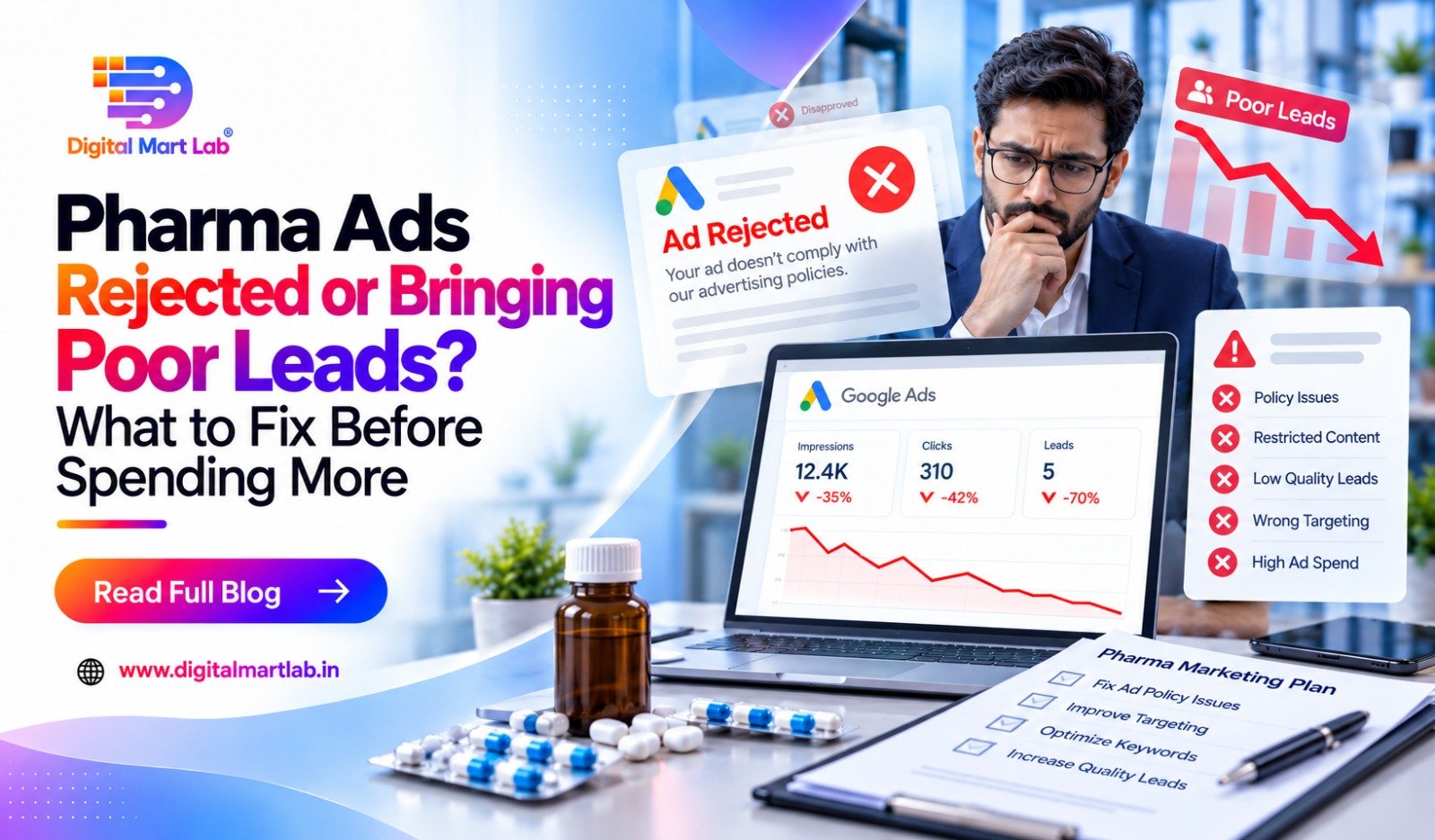
Pharma Ads Rejected or Bringing Poor Leads? What to Fix Before Spending More
“Another advertisement has been rejected.”
“The campaign is running, but the enquiries are unsuitable.”
“We are getting calls, but very few discussions move forward.”
These problems can feel similar because the business outcome is disappointing. But they need different solutions.
A rejected advertisement needs an eligibility and policy review. An active campaign attracting unsuitable enquiries needs a closer look at the audience, offer and destination page. Relevant enquiries that stall after contact may reveal a commercial or follow-up problem.
Before increasing spending on pharma ads, identify where the problem begins. Otherwise, a larger budget may repeat the same issue at a higher cost.
First, separate ad rejection from poor lead quality
An advertisement being allowed to run does not establish that it will attract suitable buyers.
Equally, changing the audience will not resolve a restriction involving the advertised offer or destination.
Start by identifying the situation you are facing.
| What is happening? | What to investigate first |
| The advertisement is disapproved | The exact policy reason and affected advertisement or destination |
| The account is restricted | The account-level notice and required review process |
| The campaign runs but attracts unrelated enquiries | Search intent, audience, message and enquiry expectations |
| Buyers request unsupported manufacturing work | Capability descriptions, quantities, packaging and campaign focus |
| Suitable prospects stop after receiving details | Portfolio fit, pricing, terms, support and follow-up |
| Reports show leads the team cannot find | Tracking, form delivery and duplicate records |
Several issues can exist at the same time. Keep them separate so your team knows which change is intended to solve which problem.

If your pharma advertisement is rejected, read the exact reason
Do not begin by changing the creative’s colours or replacing a few words.
Open the rejection details and record the policy cited. Identify whether the issue concerns the advertisement, its destination or a wider account restriction.
For Google Ads, the healthcare and medicines policy includes restrictions that depend on the content, category and location. Some advertising requires specific eligibility or certification; other content cannot be advertised.
Calling an offer “B2B” does not automatically establish eligibility.
Your campaign needs assessment against the rules that apply to the actual business, offer and destination.
Keep a clear record before making changes
Your campaign manager should retain:
- The rejection message and policy reference.
- The affected advertisement.
- Its destination URL.
- The intended offer and target location.
- Relevant account notices.
- A record of changes already made.
This helps the review focus on evidence instead of repeated guesses.
Correct the issue or use the appropriate review route
Where a correctable issue is identified, make the necessary change and check the full destination before requesting review.
If the decision appears incorrect, use the platform’s official appeal process with accurate supporting information. Google explains the relevant options in its guidance on fixing disapproved ads and appealing decisions.
Do not hide the real offering from reviewers or create replacement accounts to evade restrictions.
Did You Know? Repeated pharma ad rejection needs a proper diagnosis. A specialist review can examine the rejection, website and applicable restrictions to identify correctable issues and assess whether the proposed campaign is eligible.
Review the page behind the advertisement
The advertisement is only one part of what the buyer encounters.
Open the destination page and check whether it accurately explains the business and the advertised service.
A campaign mentioning a manufacturing capability should not send buyers to a page dominated by unrelated franchise offers. A distributor advertisement should clearly explain that it concerns a business partnership.
Check for inconsistent or unsupported claims
Review the page for statements about:
- Business identity and facility ownership.
- Supported products or capabilities.
- Certifications and their scope.
- Territory availability.
- Results, margins or commercial promises.
A different headline or image will not resolve an underlying issue with the offer.
Necessary changes should make the information accurate and understandable throughout the relevant journey.
Check the contact process
Make sure the page works on a phone, the form submits correctly and the enquiry reaches the responsible person.
Also check what the visitor believes they are requesting. A catalogue download and a request for a sales call should not be presented as though they are the same action.
A review of your website and landing-page design can help identify these gaps.
If the campaign is running, define what “poor lead” means
“The leads are bad” does not give your campaign manager enough information to make a useful change.
Ask the sales team to record the reason.
| Sales outcome | What it may indicate |
| Individual medicine purchase request | The message or traffic may be attracting consumers |
| Job enquiry | The opportunity may be unclear or search intent may be unrelated |
| Unsupported dosage form | The capability description or campaign focus may be too broad |
| Quantity below confirmed requirements | Order expectations need review |
| Relevant buyer, but commercial terms do not fit | The offer needs discussion; targeting may not be the main issue |
| No response after contact | The reason remains unconfirmed |
| Requirement still undecided | More clarification may be needed |
Do not mark every unanswered call as an unsuitable lead. The person may be unavailable, still researching or waiting to speak at another time.
A confirmed mismatch and an unknown outcome should remain separate in the report.
Review manufacturing enquiries by capability, quantity and packaging
Manufacturing lead quality becomes easier to assess when your team records the actual requirement.
For declined enquiries, note:
- The requested dosage form.
- Product or specification details provided.
- Estimated quantity and unit.
- Packaging preference.
- The reason the request could not progress.
This information can reveal a pattern that a basic campaign report misses.
Explain what you can actually support
If a campaign repeatedly attracts requests outside your capability, review the advertisement and landing page together.
Broad phrases such as “all manufacturing solutions” may create expectations your business cannot meet.
Describe the supported service and give buyers a clear way to share their requirement.
Clarify quantity requirements carefully
Where verified order requirements can be published, explain them with the correct unit and scope.
If they vary by product or packaging, say so and ask for an estimate.
Illustrative example: A manufacturer receives repeated requests for quantities below what the business can support for the advertised service. The team confirms the relevant requirement, explains it clearly on the page and adds a quantity-and-unit question to the form.
The next review should check whether suitable requests improve—not assume that fewer total enquiries automatically means the change succeeded.
Did You Know? More advertising will not fix repeated requests for unsupported manufacturing work. Reviewing declined enquiries by dosage form, quantity and packaging helps your campaign manager focus on relevant capabilities.
Check whether your advertisement clearly identifies the buyer
A product image may attract attention without explaining the intended business opportunity.
If you want distributors, say that clearly. If the offer concerns third-party manufacturing, describe the supported service. If it is a franchise enquiry, explain what the person will be contacting you about.
For both Google and Meta campaigns, review whether the creative and form prepare the visitor for a business conversation.
Review available search activity in Google Ads
Where search-term information is available, check what people searched before reaching the campaign.
Look for patterns involving jobs, individual purchases or requirements outside your offer. Review keyword choices and exclusions carefully so you do not remove relevant business searches along with unsuitable ones.
Review the message and form in Meta campaigns
If respondents repeatedly misunderstand the offer, examine the wording before assuming that a different audience selection will solve everything.
A clear range or partnership message, supported by relevant questions, can help people understand the contact they are requesting.
Platform settings should be chosen for the actual campaign. There is no single audience formula that guarantees suitable pharma leads.
Use sales feedback to separate targeting problems from offer problems
A relevant distributor may enquire, review your portfolio and decide it does not fit their business.
Another may like the range but be unable to proceed under the proposed commercial terms.
These are different from a patient asking for one strip of medicine.
If every unsuccessful conversation is reported as a targeting failure, your marketing team may keep changing campaigns while the underlying objection remains.
Record the buyer’s stated concern
Useful feedback might include:
- The requested range is unavailable.
- The territory does not fit.
- The proposed commercial terms are unsuitable.
- The expected support differs from what is offered.
- The buyer is planning for a later date.
- The quotation needs further clarification.
Record what the prospect actually said. Avoid guessing the reason for silence.
Review repeated objections together
The owner, sales team and campaign manager should look at patterns.
If suitable buyers repeatedly ask for support your company does not provide, the advertisement or website may be setting the wrong expectation.
If they understand the offer but reject the commercial terms, that may require a business decision rather than another creative.
Make sure the campaign report matches real enquiries
Check what your reporting system counts as a lead.
A button click, catalogue download and completed enquiry are different actions. Duplicate submissions can also make the number appear larger than the people your team can contact.
Agree on a simple definition of a relevant enquiry—for example, an identifiable business requirement that your team may be able to serve, subject to review.
Track both lead volume and suitability.
A useful measure is cost per relevant enquiry: the campaign spend divided by the enquiries meeting your agreed definition over the same period.
Use it alongside later sales progress. A relevant enquiry is not a confirmed order, and some buying decisions take longer than the reporting period.
What should you fix before increasing the budget?
Use the evidence to choose the next action.
| Finding | Priority action |
| The rejection reason is unresolved | Complete the eligibility and policy review |
| The destination misrepresents the offer | Correct the relevant website information |
| Requests are repeatedly outside capability | Narrow and clarify the advertised service |
| Visitors misunderstand the purpose of the form | Explain the contact request clearly |
| Suitable buyers raise the same commercial objection | Review the offer with the business team |
| Enquiries are not reaching sales | Repair delivery and assign ownership |
| Lead counts do not match actual contacts | Review tracking and duplicates |
After changes, review comparable results and note what else changed, including spending, audience or offer.
Avoid changing every part of the campaign at once unless necessary. Otherwise, it becomes difficult to understand which adjustment helped.
How Digital Mart Lab can help review your pharma campaigns
Digital Mart Lab can help assess the campaign from advertisement to sales feedback.
Through performance marketing services, the proposed work can include:
- Reviewing rejection notices and the relevant campaign context.
- Assessing the offer and destination against applicable requirements.
- Clarifying business messaging.
- Reviewing targeting and available search activity.
- Improving enquiry questions.
- Checking agreed conversion tracking.
- Using sales outcomes to guide campaign changes.
Website changes can support this work where the destination needs clearer content or a better enquiry process.
Where initial screening is taking significant time, AI-assisted enquiry qualification may help collect requirements and prepare summaries. It cannot resolve an ineligible offer or replace human technical and commercial assessment.
Your wider plan may also include SEO for relevant business discovery, giving buyers another route to your website over time.
The scope should follow the problem identified. Approval and business results cannot be guaranteed.
Frequently asked questions about pharma ads and lead quality
1. Does a rejected pharma ad mean our business cannot advertise?
Not necessarily. The exact reason, offer, location and applicable requirements need review. Some issues may be correctable; other proposed activity may not be eligible.
2. Will changing the creative design fix the rejection?
Only if the issue relates to something the change actually resolves. A different colour or image will not correct a restriction involving the offer or destination.
3. Are B2B pharma campaigns automatically allowed?
No. B2B positioning does not remove platform requirements. Assess the actual advertisement and website under the rules relevant to that platform and offer.
4. Why do suitable enquiries still fail to become orders?
Commercial terms, range fit, availability, timing and follow-up can affect the outcome. Review the conversation before classifying it as a targeting problem.
5. Should we increase spending when the cost per lead is low?
First check what those leads represent. A low submission cost is less useful if most requests do not fit your business. Review relevance and sales progress as well.
6. Can an agency guarantee ad approval or qualified leads?
No. An agency can review evidence, make appropriate improvements and manage campaigns, but it cannot control every platform decision or buyer response.
Find the reason before paying for more of the same
A rejected advertisement, an unsuitable requirement and a lost commercial discussion need different responses.
Read the policy reason, check the destination, classify enquiry outcomes and listen to what buyers tell your sales team.
Once the issue is clear, your next campaign decision can address it directly.
Pharma ads being rejected or generating enquiries your team cannot use?
Discuss Your Pharma Campaign with Digital Mart Lab
Share the campaign issue, destination page and a summary of recent enquiry outcomes. We can use that information to identify what needs attention before you commit more budget.
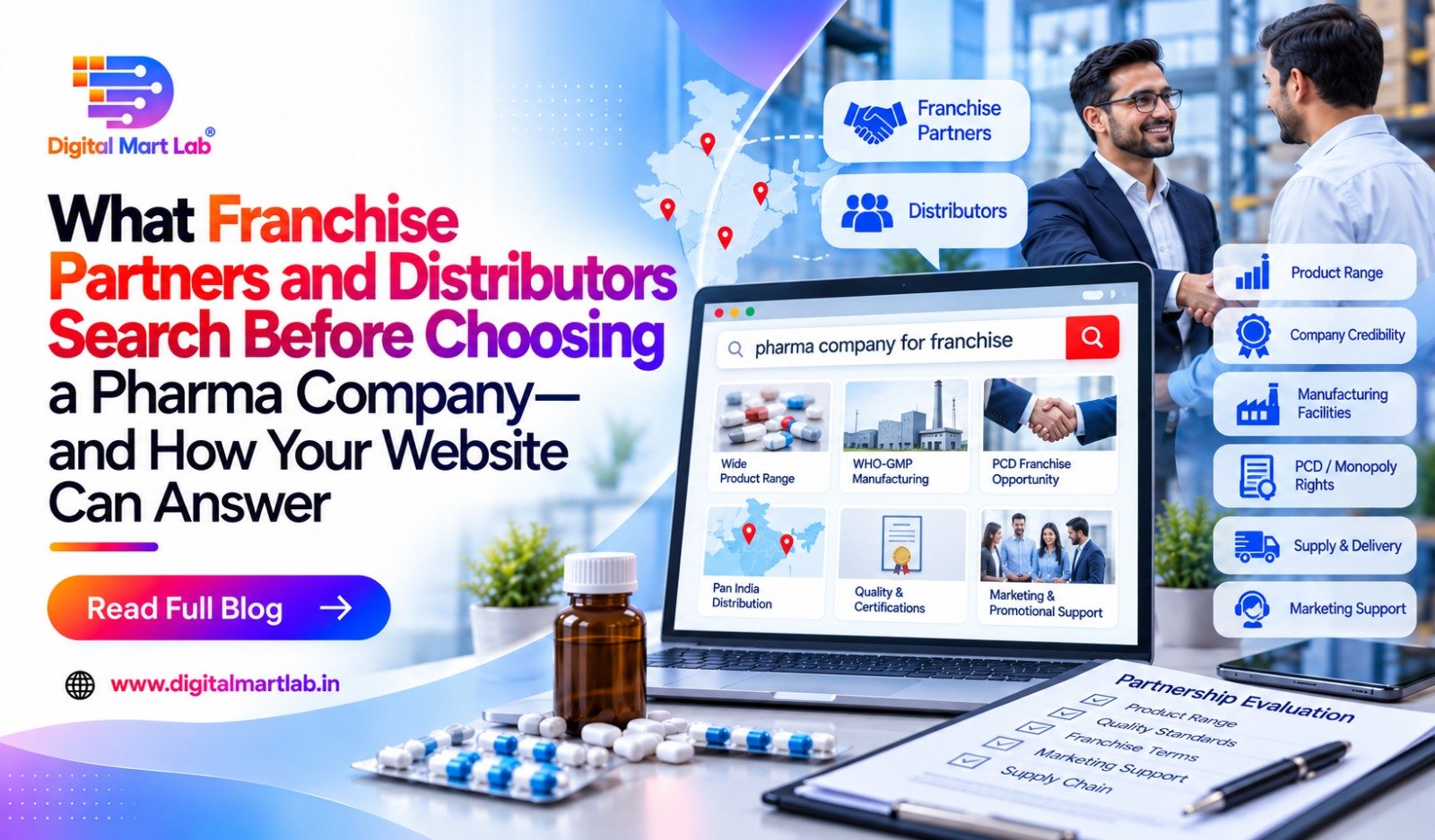
What Franchise Partners and Distributors Search Before Choosing a Pharma Company—and How Your Website Can Answer
A potential franchise partner receives your catalogue. Before replying, they open your website.
They want to know more than the product names and prices.
“What support does this company provide?”
“How will they check my preferred territory?”
“What will I be responsible for?”
“Who will help if I have an order-related question?”
If your website leaves these questions unanswered, the prospect may contact your team for clarification. They may also continue researching other companies.
A useful PCD pharma SEO strategy turns these business questions into clear website content. It helps prospects understand your offer, assess whether it fits their plans and prepare for a more informed sales discussion.
The starting point is knowing what they need to evaluate.
Buyers need to understand the relationship before discussing the price
A price list explains the commercial offer only in part.
A franchise applicant or distributor also needs to understand the company behind it: its actual business role, portfolio, support and way of working.
Without that information, there is little to compare beyond rates and product counts.
Your website can provide the missing context.
For a pharma marketing company, this may include its sourcing arrangements, portfolio management and partner support. For a manufacturer, it may include its facility and relevant capabilities.
Explain the role accurately. Do not make a prospect guess whether they are speaking with a manufacturer, a marketing company or another type of business.
Did You Know? When distributors receive only your price list, they have little else to compare. A clear company profile explains your actual sourcing arrangements, portfolio strengths and partner support before negotiations begin.

Which questions should your pharma website answer?
Start with questions your sales team already receives. Review enquiry messages, introductory calls and discussions that stop after the catalogue is shared.
Look for repeated uncertainty, rather than assuming every prospect has the same priorities.
| Buyer question | Useful website content |
| “Does your range fit my business?” | Organised range pages and current catalogue information |
| “What support do you provide?” | Specific support details and applicable conditions |
| “Can I work in my preferred district?” | A clear territory-review process |
| “What will I need to handle?” | An explanation of partner responsibilities |
| “Who do I contact after joining?” | Relevant communication and support routes |
| “Why should I consider your company?” | Accurate company information and evidence of actual business value |
| “What happens after I enquire?” | A simple explanation of the next steps |
These answers can support both visitors arriving from search and prospects checking your company after a referral, advertisement or sales call.
Explain your product range in the context of the partnership
A long catalogue can show what is available, but a range page should help the buyer understand where to begin.
Organise the portfolio into relevant categories and explain how a prospect can discuss the range that interests them.
A visitor considering a derma franchise should be able to find the relevant information without reviewing every unrelated category first.
Help undecided applicants ask a useful question
Not every applicant will know which range to choose.
Give them an option to request guidance. Ask about their preferred territory, existing business and interests without pretending the website can decide commercial suitability automatically.
For example:
“Not sure which range to discuss? Share your preferred district and whether you are starting or expanding a business. Our team can explain the available options.”
Use this wording only where your team provides that assistance.
Keep the catalogue and page consistent
Review both when products or range details change.
A prospect should not receive different information from the website, downloadable profile and salesperson. Consistent material gives your team a reliable reference during the discussion.
Replace “complete support” with a clear explanation
“Complete promotional support” sounds reassuring, but it can mean different things to different people.
One applicant may expect printed materials. Another may assume local advertising or regular field assistance is included.
Your website should explain what your company actually provides.
Depending on your offer, that might include:
- Guidance on reviewing the available range.
- Approved promotional materials.
- Assistance with the ordering process.
- A designated contact for relevant questions.
- Updates about products in the partner’s area of interest.
Include the conditions that affect the offer. Explain whether something is standard, available on request or agreed separately.
Show how support is accessed
Naming a service is only part of the answer.
If partners can request promotional materials, explain whom they contact or how the request is made. If order questions go to a particular team, identify the correct route.
This makes the support easier to understand and use.
Avoid promises your team cannot consistently deliver
Do not publish a fixed response time or an unlimited support promise unless it reflects your operation.
A practical explanation of what happens is more useful than an impressive phrase that creates the wrong expectation.
Did You Know? A franchise prospect may hesitate because your support is unclear. A practical partnership guide explains what your company provides and what the partner handles, helping them evaluate the relationship before discussing terms.
Explain territory conditions before prospects make assumptions
Territory questions can become a source of confusion if the website relies only on phrases such as “monopoly rights available.”
A prospect may assume their district is open, that approval is automatic or that the arrangement has no conditions.
Explain how the review actually works.
A useful description could be:
“Share your preferred district and state. Our team will review the request and explain the availability and applicable partnership terms.”
This invites the discussion without confirming rights that have not been agreed.
Ask about the intended business territory
The applicant’s current location may differ from where they want to operate.
Use a clear form label such as:
“Which district and state would you like to discuss?”
This gives your team more useful context than a general “City” field.
Keep final terms tied to the agreement
The website can summarise the process and the questions to discuss. It should not replace the agreed documentation.
Have the responsible person approve any public description of territory conditions. If terms vary by arrangement, explain that variation instead of presenting one promise as universal.
Make partner responsibilities clear
A useful partnership explanation covers both sides of the relationship.
Applicants need to understand what your company handles and what they will need to organise.
Your website can introduce relevant subjects such as:
- Providing accurate business and requirement details.
- Reviewing the proposed range and terms.
- Understanding the agreed ordering and payment process.
- Using approved business information and promotional material appropriately.
- Contacting the right person for questions or changes.
Publish responsibilities that reflect your actual arrangement. Avoid presenting a generic checklist as though it applies to every partner.
Explain the next steps without overwhelming the reader
You do not need to place every detailed condition on the main page.
Give a clear overview, identify the points that need discussion and explain when the full terms will be shared.
This helps a serious prospect prepare while keeping the first visit manageable.
Recognise the difference between a new applicant and an existing distributor
A first-time applicant may ask how the partnership works from the beginning.
An established distributor may already understand the general process and want to discuss portfolio fit, ordering arrangements and ongoing communication.
Your website can serve both.
For someone starting a new business
Provide a short guide explaining:
- What information to prepare.
- How to explore the relevant range.
- How territory requests are reviewed.
- Which responsibilities and terms need discussion.
- What happens after the first enquiry.
Use simple language and avoid assuming prior experience.
For an established distributor
Make it easy to reach the portfolio, describe current coverage and request a relevant commercial conversation.
Do not force them through lengthy introductory content before showing the information they came to assess.
Clear navigation and enquiry choices can improve this experience without requiring separate websites.
Use real examples to demonstrate your support
Broad success claims may leave buyers unsure what your company actually does for partners.
A documented example can be more informative.
For instance, with the necessary permission, you might describe a partner’s specific question, how your team responded and what was resolved.
Keep the example factual
A useful case story explains:
- The situation the partner faced.
- The assistance your company provided.
- The documented outcome.
- Any relevant limits or context.
Do not invent revenue figures, partner comments or results. Avoid implying that one person’s outcome will apply to every applicant.
Illustrative example: A company could explain how its team helped a partner understand the ordering process and identify the appropriate contact for recurring questions.
If used as a real case story, the details would need verification and permission. As an illustration, it simply shows the kind of practical support a story can explain.
Connect the story to a buyer question
Place it near the relevant support information.
A story about order assistance belongs beside the ordering process. A general testimonial displayed without context may tell the reader less.
Let prospects learn before asking for their phone number
A visitor may want to understand your company before requesting contact.
Give them access to useful company, range and partnership information without requiring a form at every step.
Then offer a clear next action:
- Discuss your preferred territory.
- Ask about a product range.
- Request a partnership callback.
This respects the visitor’s stage in the decision and helps them make a more informed enquiry.
Make the contact request clear
If submitting the form means your team will call, say so.
Ask for the details needed to prepare that conversation, such as the preferred district and range. Allow the applicant to request guidance where something is undecided.
A review of your website design and enquiry process can help organise these steps around the buyer’s questions.
Turn these answers into a useful website structure
You do not need a separate article for every small question.
Start with a few strong pages that explain the main offering, then add supporting content where it provides useful detail.
| Page | Main purpose |
| Company profile | Explain business identity, role and relevant strengths |
| Franchise or distribution page | Introduce the relationship and enquiry process |
| Range pages | Help buyers explore the relevant portfolio |
| Partner support section | Explain actual assistance and conditions |
| Partnership guide | Clarify steps, responsibilities and questions to discuss |
| Contact page | Provide a clear route to the appropriate team |
Link related pages using descriptive text.
Your PCD pharma SEO strategy should help buyers discover and navigate this information. It should also avoid repetitive pages created only to target similar keywords.
Important explanations should appear as readable page content, even if you also offer a downloadable company profile.
How Digital Mart Lab can help prepare prospects for a sales discussion
Digital Mart Lab can help turn recurring buyer questions into clear website content that explains your actual offer.
The proposed work can include:
- Reviewing the questions your team receives.
- Improving your company profile and business positioning.
- Organising range and partnership pages.
- Explaining support and territory-review steps.
- Planning useful FAQs and approved case stories.
- Improving enquiry forms and internal links.
- Reviewing search performance alongside sales feedback.
Through website design and development, these explanations can be presented in a layout that is easy to use on a phone.
The same approved information can support eligible performance marketing campaigns, helping the advertisement and destination page describe the same opportunity.
Your team confirms the offer and terms. The content makes them easier for prospects to understand.

How will you know whether the content is helping?
Look at the quality of the opening conversation.
Do prospects understand which range they want to discuss? Are territory expectations clearer? Does your salesperson spend less time correcting assumptions about support?
Review:
- Enquiries mentioning relevant ranges.
- Preferred territories captured.
- Repeated questions that remain unanswered.
- Misunderstandings about company or partner responsibilities.
- Progress towards an agreed commercial discussion.
Website visits and downloads provide context, but they do not confirm partner suitability.
Use feedback from the people handling calls to improve the pages over time.
Frequently asked questions about pharma franchise website content
1. What information should a pharma franchise website explain first?
Start with your actual business role, available ranges, partner support and enquiry process. Visitors should understand what they can discuss and what information to prepare.
2. Should we publish all partnership terms online?
Provide an accurate overview of the important points and explain when full terms will be discussed. Detailed or arrangement-specific conditions should follow your approved process.
3. Can we advertise territory availability on the website?
Publish only information your team can maintain accurately. Where availability needs review, ask for the preferred district and explain that confirmation is required.
4. Should newcomers and established distributors see different content?
They may need different starting information. Provide an introductory guide for newcomers and a clear route to range and commercial discussions for experienced buyers.
5. Do case stories help explain partner support?
They can, when they are factual, permission-based and relevant to the question being answered. Do not invent results or imply that every partner will achieve the same outcome.
6. Should visitors share their number before seeing our company details?
Basic company and offering information should generally be easy to access. Let visitors understand the business, then provide a clear option to request a conversation.
Help prospects arrive with better questions
Your website should give a potential partner enough information to begin a useful discussion.
Explain your ranges, actual support, territory-review process and responsibilities. Show what your business provides and make the next step clear.
That helps your salesperson move beyond repeatedly sending a price list and explaining the basics.
Want your pharma website to answer the questions serious partners ask?
Discuss Your Pharma Website Content and SEO with Digital Mart Lab
Share your website, company profile and the questions your team hears most often. We can use them to plan content that helps prospects understand your offer before the first call.

Why Pharma Buyers Need More Than Certification Logos Before They Shortlist Your Company
Your pharma website displays certification logos. It has a factory photograph, product images and a statement about quality.
But a potential buyer still asks:
“Which facility does this certificate cover?”
“Can you handle our dosage form and packaging requirement?”
“What happens before you confirm a manufacturing order?”
These are reasonable questions. A logo may draw attention to a credential, but it does not explain the full business behind it.
Pharma website credibility comes from giving buyers clear, accurate information they can assess. That includes the scope of documented credentials, genuine facility details, actual capabilities and an understandable explanation of your process.
This information can help buyers decide whether to begin a supplier discussion. It also gives them something useful to share with colleagues before moving forward.

What does a certification logo leave unexplained?
A badge usually communicates very little on its own.
It may not tell the visitor which legal entity holds the credential, which site it relates to or what activities it covers.
The buyer may also need to understand whether the information is current and how it relates to the service they are considering.
A website should help them make those connections.
| What the buyer sees | What they may still need to know |
| A certification logo | Which credential is being referenced? |
| A certificate image | Which entity, site and activities does it cover? |
| A factory photograph | Whose facility is shown, and what happens there? |
| “Advanced manufacturing” | Which capabilities are actually available? |
| “Strict quality process” | What checks and approvals are relevant to the buyer’s requirement? |
The solution is to add accurate context rather than expect visitors to interpret the image themselves.
Did You Know? A certification logo alone does not explain which facility or activities it covers. Clear, documented credential information helps manufacturing buyers assess your business more meaningfully than broad claims about quality.
Explain each credential in plain language
Start with the documents your company is authorised to reference.
Have the responsible person confirm the details before the website team publishes them.
Identify the relevant company and facility
State the entity and site to which the credential applies.
If your business operates across several locations, do not let visitors assume that a document relating to one site covers all of them.
If a credential belongs to a manufacturing partner, explain that relationship accurately.
A pharma marketing company should not present a partner’s certificate as though it were issued to its own business.
Describe the documented scope
Use the wording supported by the document and explain it clearly where necessary.
Avoid turning a credential into a broader claim about every product, service or market your company works with.
Different documents serve different purposes. A certificate, licence and product approval should not be treated as interchangeable badges.
Keep the information current
Record who is responsible for checking the website when documents are renewed, changed or replaced.
Where relevant, display accurate dates and explain how a buyer can request further verification.
You do not need to publish confidential records openly. A clear summary and an appropriate document-request process can provide a useful starting point.
Show genuine facilities with an explanation of what buyers are seeing
A photograph can help a visitor understand your business, but it needs context.
A room full of equipment does not explain which operation it supports. A stock image of a laboratory does not show your actual facility.
Use genuine, authorised images and captions that describe the relevant area or activity.
Make facility videos informative
A short facility video can introduce the setting and explain supported operations.
For example, it could show selected areas, identify their purpose and introduce the relevant team or process where appropriate.
Keep the narration factual. Avoid presenting visual scale or appearance as proof that every requirement can be handled.
A video can support an initial assessment. It does not replace technical discussions, document checks or a facility visit where those are needed.
Explain ownership and business relationships
If the facility belongs to a partner, say so.
Your business can still explain the role it plays in coordinating requirements, managing the portfolio or supporting the customer.
Illustrative example: A pharma marketing company arranges manufacturing through a partner facility. Its website can explain that arrangement and describe how it coordinates the buyer’s requirement.
It should not label the partner’s building “Our Factory” if that is inaccurate.
Clear positioning prevents confusion later in the discussion.
Connect credibility with the capability the buyer needs
A buyer may respect your credentials and still need to know whether your business fits the project.
Your website should connect the company information with actual services.
For manufacturing buyers, useful details may include:
- Supported dosage forms.
- Relevant packaging options.
- Information needed to review a requirement.
- Order conditions that can be explained publicly.
- The process for discussing technical questions.
- How the quotation conversation begins.
Do not list every possible service to make the company appear larger. Unsupported capabilities can attract enquiries your team cannot fulfil.
Give each major service enough explanation
A page about capsule manufacturing should explain the relevant capability and enquiry requirements.
A general list saying “tablets, capsules, liquids and more” gives the buyer less information to assess.
Clear service pages also create useful places for visitors to arrive through search. Your SEO strategy should reflect the services you genuinely provide and the questions buyers ask about them.
Explain what happens between an enquiry and a confirmed requirement
A buyer comparing quotations may struggle to understand the work behind the price.
Your website can explain the main stages without publishing confidential procedures.
Describe your actual process, using a sequence your team can confirm.
| Stage | What the website can explain |
| Initial enquiry | The product, quantity and packaging details needed to begin |
| Requirement review | Which details need technical or commercial assessment |
| Clarification | How missing information is discussed |
| Quotation | What must be confirmed before commercial terms are prepared |
| Approvals | Which agreed checks or customer approvals apply before work proceeds |
| Further coordination | Who handles questions and subsequent updates |
This is an example structure, not a universal manufacturing procedure. Your published version should follow your own operation.
Give buyers enough detail to ask better questions
Instead of “We follow a strict quality process,” explain an appropriate, documented part of the process.
For example, you may describe how specifications are reviewed or how an artwork approval step works, where that is part of your actual service.
This helps a buyer ask informed questions during the next conversation.
It also gives them more to evaluate than a general statement about quality or a quoted rate.
Separate an overview from a commitment
A process page should explain how the discussion works. It should not automatically promise feasibility, capacity or a delivery date for every enquiry.
Project-specific decisions still need confirmation from the responsible team.
Keep that distinction clear without filling the page with lengthy qualifications.

Make the information easy to find through search
If your useful information exists only inside a scanned brochure, visitors may have difficulty finding and reviewing it.
Publish the main explanations as readable website content.
Suitable pages might include:
- Company information.
- Facilities and capabilities.
- Credentials and supporting details.
- Manufacturing services.
- The enquiry and quotation process.
- Frequently asked buyer questions.
Connect these pages with descriptive links.
For example, a manufacturing page can link to the relevant facility information and explain where to find the quotation requirements.
Use headings that describe the information
Headings such as “Manufacturing Capabilities” or “Information Needed for a Quotation” help visitors understand what a section contains.
Avoid repeating “best pharma company” across headings when it does not explain the content.
Good website design and page structure should help the visitor move from the service they need to the evidence and next step.
Keep downloadable profiles consistent
A company profile remains useful for sharing.
Make sure its business description, contact details, capabilities and credential information match the website. Include an update date or version reference so your team can distinguish it from older copies.
When a material fact changes, review both versions.
Help your contact explain your company internally
The person making the first enquiry may not make the final decision alone.
They may need to discuss the supplier with purchasing, technical or management colleagues. Each person may have a different question.
A clear website lets them share the relevant page instead of forwarding a long conversation and trying to explain everything themselves.
A concise capability profile can also help them prepare an internal discussion.
Did You Know? Your manufacturing contact may need approval from technical and purchasing colleagues. A clear website and downloadable capability profile help them share relevant information beyond the first sales call.
Make useful information easy to share
Use stable page links, readable layouts and clear document names.
Do not require a new enquiry form every time an existing prospect wants to reread basic company information.
Sensitive records can follow a controlled sharing process. Public service explanations should be easy for the intended reader to access.
What should a buyer be able to verify before contacting you?
Review your website from the perspective of someone who has never spoken with your team.
Can they find:
- Your actual business identity and role?
- Reliable contact information?
- The service relevant to their requirement?
- Accurate facility information?
- The context behind published credentials?
- A clear explanation of the next step?
If these answers are missing, adding more badges is unlikely to solve the problem.
Illustrative example: A buyer reaches a manufacturing page and sees a certificate image. Beside it, the website identifies the relevant facility and explains how to request further details. The page also links to supported capabilities and quotation requirements.
The buyer now has a clearer starting point for supplier research. They still need to complete their own assessment, but the website has made that work easier.
How Digital Mart Lab can improve your pharma website credibility
Digital Mart Lab can help organise your approved company information into content buyers can understand and use.
Review existing claims and content gaps
The review can identify broad statements, unclear facility descriptions and missing context around credentials.
Your authorised team confirms the facts. The content work makes those facts easier to follow.
Build useful company and capability pages
Through website design and development services, the information can be presented through clear service pages, facility sections and enquiry options.
Genuine images and accurate captions can support the explanation.
Support relevant search discovery
SEO work can connect page topics with the questions business buyers ask while improving the organisation of public content.
The aim is to help suitable visitors discover and assess your actual offering.
Create a consistent reference for the sales team
The website and company profile can give your team approved material to share before and after a call.
This does not replace verification or buyer assessment. It makes the initial information more complete and consistent.
How can you tell whether the content is helping?
Ask your sales team what changes in the conversations.
Are buyers reaching the correct service page? Do they understand your business role? Are they asking more specific questions about a supported requirement?
Useful indicators include:
- Fewer repeated questions caused by unclear company information.
- Enquiries referring to relevant capabilities.
- Prospects sharing the correct pages with colleagues.
- Progress towards technical review, document exchange or quotation discussions.
Downloads and page views can show activity, but they do not prove that a company has been shortlisted.
Record the business stage separately and use buyer feedback to improve the content.
Frequently asked questions about pharma website credibility
1. Are certification logos enough to build buyer confidence?
They can draw attention to a credential, but buyers also need to understand the entity, facility and scope involved. Provide accurate context and a suitable route for further verification.
2. Should we publish complete certificates on the website?
That depends on your document-sharing policy and the information involved. Publish only what you are authorised to share. A clear summary and a controlled request process may be appropriate for further details.
3. Can we show a manufacturing partner’s facility?
Use authorised material and describe the relationship accurately. Do not imply that the facility belongs to your company if it does not.
4. Does a facility video replace a buyer visit?
No. A video can introduce relevant areas and capabilities. Buyers may still need technical discussions, documentation checks or a visit as part of their assessment.
5. How much of our manufacturing process should the website explain?
Explain the steps that help a buyer understand how a requirement is reviewed and progressed. Keep confidential procedures and sensitive records within your approved sharing process.
6. Can better website content help buyers compare more than price?
It can give them more information about your actual capabilities and process. Pricing remains important, but useful explanations create a better basis for a detailed supplier discussion.
Give buyers information they can assess and share
A certification logo can begin a question. Your website should help answer it.
Explain the documented credential, the relevant facility, the capability and the process behind the offer. Keep the information accurate, readable and consistent.
That gives prospective buyers a more useful starting point for deciding whether your company belongs on their shortlist.
Want your pharma website to explain your credentials and capabilities more clearly?
Discuss Your Pharma Website and SEO Requirements with Digital Mart Lab
Share your current website, company profile and approved business information. We can use them to identify the content and page structure your buyers need.
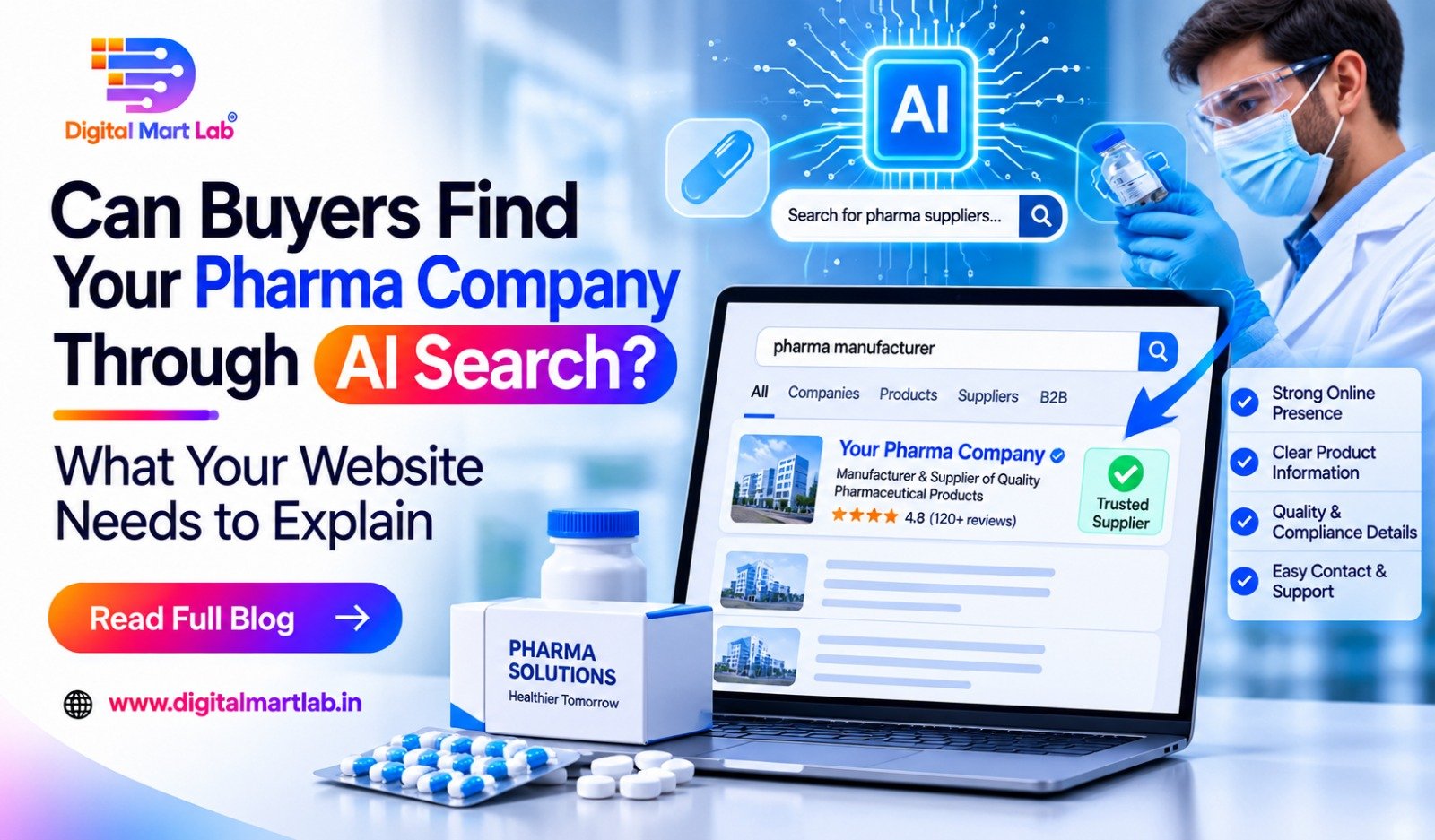
Can Buyers Find Your Pharma Company Through AI Search? What Your Website Needs to Explain
Imagine a potential distributor researching a new pharma partner. Instead of entering only a short keyword, they ask a detailed question:
“Which companies offer a derma franchise, and what should I check before contacting them?”
Another buyer wants to understand the difference between a manufacturer and a pharma marketing company.
If they reach your website during that research, will they find clear answers?
A company name, product catalogue and a few broad promises may not explain enough. Buyers need to understand what your business actually does, which requirements it serves and how to begin a conversation.
AI search for pharma companies starts with a familiar priority: accurate, useful website information. Clear pages give buyers and search systems a better account of your business.
They do not guarantee that an AI tool will recommend your company. But they make your website a more useful place to discover and assess your offering.

What does AI search mean for a pharma business?
AI-assisted search can help a person explore a question through explanations, summaries and links to supporting information.
A pharma buyer might use it to understand partnership options, prepare supplier questions or research a manufacturing requirement.
Your website may become one of the sources they encounter during that process. Whether it is included depends on the particular system and question.
For Google’s AI search features, its official guidance for website owners says established SEO practices remain relevant. There is no additional special optimisation required specifically for those features.
Different services operate differently, so avoid treating one platform’s guidance as a rule for every AI tool.
The practical starting point is to make your company information clear enough to be useful wherever a buyer finds it.
Can someone understand your business from the homepage?
Open your homepage and read the first few paragraphs.
Could a new visitor tell whether you:
- Manufacture products at your own facility.
- Operate a pharma marketing company.
- Offer PCD franchise opportunities.
- Seek distributors or stockists.
- Arrange manufacturing through partner facilities.
If the description says only “a leading pharmaceutical company offering complete solutions,” the answer may remain unclear.
This matters because each business model gives the buyer different questions to ask.
Describe your actual role in simple language
A pharma marketing company can explain how it manages its portfolio, manufacturing arrangements and partner support.
A manufacturer can explain its actual capabilities and how requirements are reviewed.
A PCD business can explain its ranges and the process for discussing a territory.
Use the description that accurately fits your company. Do not make buyers infer the business model from product images or a factory photograph.
Explain your value without implying factory ownership
A marketing company does not need to present itself as a manufacturer to explain why a distributor should consider it.
Its value may include an organised portfolio, clear ordering support, relevant range information and a responsible contact for partner questions.
Describe those strengths directly.
| Broad or unclear statement | More useful information |
| “Complete pharma solutions” | The specific business relationships and services you offer |
| “Our manufacturing excellence” | Whether you operate the facility or work through manufacturing partners |
| “Complete distributor support” | The actual support available and any conditions |
| “A wide range of products” | Organised categories and current range information |
| “Available across India” | Where you currently serve buyers and how new territory requests are reviewed |
Use wording your team can support with facts.
Did You Know? You do not need to imply factory ownership to demonstrate business value. Clear information about your actual manufacturing arrangements, portfolio management and distributor support helps buyers understand what your company provides.
Check images and captions too
A description can be accurate while the surrounding images create a different impression.
Use genuine, authorised visuals. If a photograph shows a partner facility, identify it appropriately rather than allowing visitors to assume it belongs to your company.
The company profile, service pages and downloadable brochure should tell a consistent story.
Give franchise buyers more than a catalogue
A product catalogue helps visitors explore your portfolio. It does not explain the whole partnership.
A potential franchise applicant may also want to know:
- Which ranges are available for discussion.
- How territory requests are assessed.
- What support the company actually provides.
- What responsibilities the partner handles.
- What information is needed before a commercial discussion.
Put these answers on relevant website pages.
A visitor should not have to call simply to discover whether your business offers the type of relationship they are researching.
Example: explaining a derma franchise offering
Illustrative example: A company offers a derma range, but its website shows only product images and a price-list request.
A useful page could explain the range, outline actual support and describe how applicants can discuss their preferred district.
It could then link to the relevant catalogue and enquiry form.
This gives buyers a clearer account of the offering. It also gives your team a page to share when the same opening questions arise.
Did You Know? If your website barely explains your franchise offering, search and AI tools have little useful information to draw from. Clear content about ranges, support and territory assessment strengthens the foundation for online discovery.
Answer the distributor questions your team hears repeatedly
Your sales team already knows many of the questions your website should answer.
Listen for the ones that appear in initial conversations:
“How do I select a range?”
“Who handles order queries?”
“How will I receive product updates?”
“What happens after I submit a distribution enquiry?”
These are useful starting points for content because they reflect actual buyer needs.
Make the answers specific to your business
Avoid a paragraph that says only, “We provide excellent service and complete support.”
If your process includes an assigned contact, explain how that contact helps. If range selection begins with a discussion, explain what information the buyer should share.
State what is available without inventing promises about response times, product availability or commercial terms.
Put answers where buyers need them
An ordering question belongs near the ordering information. A territory question belongs on the franchise page.
A separate FAQ section can help, but it should not be the only place where important service details appear.
Write the answer first, then add useful context. Avoid making every answer a long sales pitch.
Google’s people-first content guidance supports creating information that genuinely helps the intended audience. For your business, that means answering the questions a suitable pharma buyer needs resolved.
Keep your company information consistent
A distributor may search your company name before responding to a quotation or discussing a partnership.
If they encounter different phone numbers, an old address or conflicting business descriptions, they may be unsure which information to trust.
Review the details your business controls:
- Company and brand names.
- Business description.
- Address and contact information.
- Website and email details.
- Product ranges and services.
- Current brochures and public business profiles.
Consistency does not mean hiding legitimate differences. If a brand name differs from the legal entity name, explain the relationship clearly.
Correct outdated information at its source
Update old contact details on your website and other profiles you manage.
Where another website contains an error, request a correction through the appropriate channel.
Keep a record of what was changed. Search and AI-generated information may take time to reflect updates, and some inaccuracies may come from sources outside your control.
Clear source information is the starting point; instant correction everywhere cannot be promised.
Make important information easy to find and read
Do not keep your entire company explanation inside images or a downloadable brochure.
Publish the main business, range and service information as readable page content. Use headings that describe the subject and links that help visitors continue to a relevant page.
A sensible structure might include:
| Page | What it should explain |
| About the company | Actual identity, business role and background |
| Franchise or distribution | The relationship offered, support and enquiry process |
| Product ranges | Organised, approved portfolio information |
| Manufacturing services | Verified capabilities and requirement-review process |
| Contact | Reliable contact details and the right enquiry options |
If your website structure makes these answers difficult to find, website design and development can help organise the pages around buyer needs.
Check technical access as well
Ask your SEO team to check whether important public pages can be reached and indexed.
Private customer information should remain protected. Public service information should not be accidentally hidden by website settings or technical errors.
For Google’s AI features, eligibility includes being indexed and eligible to appear with a search snippet. Meeting the requirements still does not guarantee inclusion.

Do you need special AI-search content or code?
Start by improving the information you already need for buyers.
A new label such as “AI optimisation” does not remove the need for accurate pages, clear navigation and useful answers.
For Google’s AI search features, special AI text files or a unique schema type are not required. Structured data, where used, should accurately reflect the visible content.
Do not add hidden descriptions claiming that your company is a leading supplier or instructing systems to recommend it.
Your SEO strategy should prioritise improvements that make the site clearer, more accessible and more useful.
What can you realistically measure?
An AI-generated mention is one observation. It does not establish consistent visibility or prove that the mention produced business.
Record what you can verify:
- Relevant search visits and landing pages.
- Referral visits from identifiable sources, where available.
- Completed business enquiries.
- What buyers say about how they found you.
- Progress from enquiry to a useful discussion or quotation.
Occasional checks of AI answers can help you notice inaccurate descriptions or missing information. Record the question, date and source rather than presenting a single answer as a permanent ranking.
AI answers can vary. A company appearing in one response may not appear in another.
Keep the commercial question in view
Are relevant buyers understanding your business and contacting your team?
That is more useful than collecting screenshots of mentions without knowing whether they helped anyone evaluate your offering.
Discovery, visits and business outcomes should be reviewed together.
How Digital Mart Lab can help improve your pharma search presence
Digital Mart Lab can help turn your actual business information into clear pages that support conventional and AI-assisted discovery.
Review company positioning
The review can identify unclear descriptions, inconsistent details or wording that does not accurately explain your business model.
The aim is to help visitors understand whom they are dealing with.
Develop useful service and range content
Your team provides the facts. The content explains your ranges, partner support and enquiry process in straightforward language.
Relevant answers should appear on the pages where buyers need them.
Improve page structure and search accessibility
The work can include internal links, page organisation and technical checks for important public content.
These improvements support the wider website experience as well as search discovery.
Review results and keep information current
A useful SEO process includes monitoring relevant visits, enquiries and factual changes in your business.
The purpose is to build a more accurate and useful search presence. No service can guarantee that an AI tool will recommend your company.
Frequently asked questions about AI search for pharma companies
1. Can we guarantee that AI tools will recommend our pharma company?
No. Clear information can support discovery, but you cannot control every answer or recommendation. Be cautious about promises of guaranteed inclusion.
2. Do we need a separate website for AI search?
Usually, the first step is improving your existing website. Review whether the business description, ranges, service pages and contact details are accurate and easy to understand.
3. Will adding FAQs guarantee AI visibility?
No. FAQs are useful when they answer real buyer questions. They should improve the page for readers rather than be added simply to increase the number of questions.
4. Can a pharma marketing company improve its visibility without owning a factory?
Yes. Explain the business accurately, including its portfolio, manufacturing arrangements and actual partner support. Factory ownership should never be implied when it is not true.
5. Is an AI chatbot the same as AI search visibility?
No. A website chatbot helps visitors once they arrive. AI search visibility concerns whether information about your business appears during research through search or AI tools. They serve different purposes.
6. What should we do if an AI answer describes our company incorrectly?
Check the sources shown where available, correct inaccurate information you control and request corrections elsewhere when possible. Clear, consistent source information helps, but changes may not appear immediately.
Give buyers a clear account of your pharma business
Your website should answer a few essential questions: Who are you? What do you offer? Whom do you serve? What can a buyer expect next?
When those answers are accurate and useful, your website becomes a stronger reference for prospects researching your company.
Want your pharma business to be easier to understand through search?
Discuss Your Pharma SEO and AI Search Visibility with Digital Mart Lab
Share your website, company profile and the questions your team hears most often. We can use them to identify the information and website improvements your business needs.
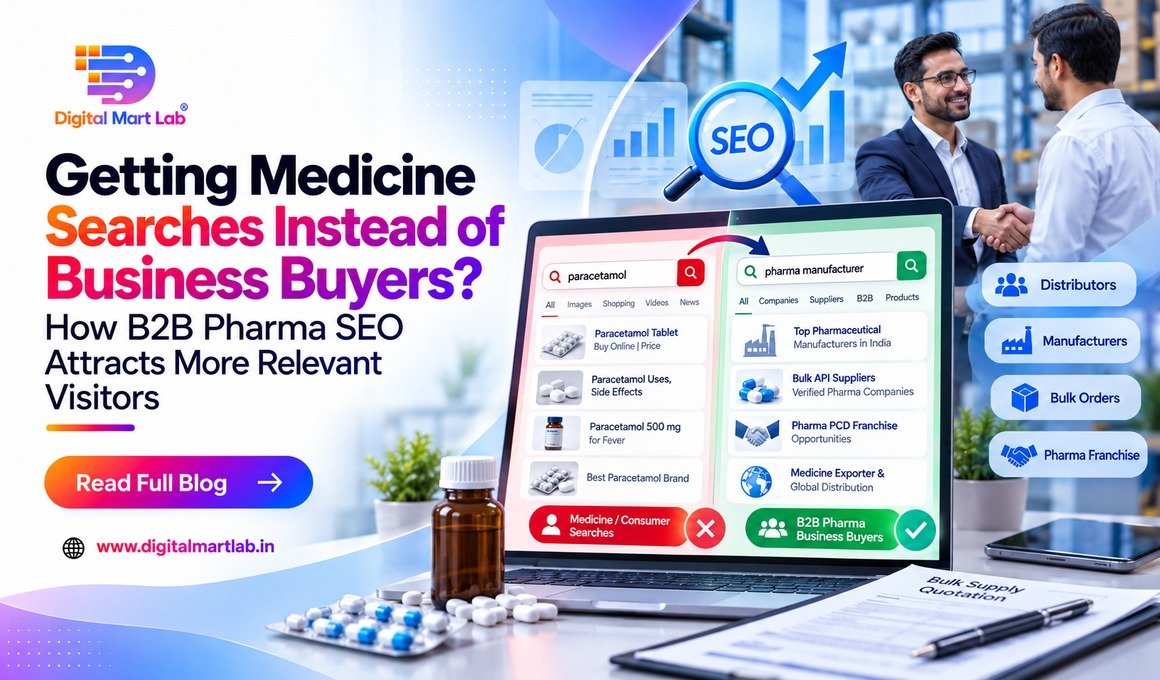
Getting Medicine Searches Instead of Business Buyers? How B2B Pharma SEO Attracts More Relevant Visitors
Your website is receiving visitors, but the questions reaching your team are not the ones you expected.
“Where can I buy one strip?”
“What is this medicine used for?”
“Can you deliver a bottle to my address?”
Meanwhile, your business wants enquiries from franchise applicants, distributors or companies looking for third-party manufacturing.
The traffic report may look encouraging, but your sales team is spending time explaining that you do not handle individual medicine purchases.
B2B pharma SEO helps organise your website around the business relationships and requirements you actually serve. It connects product information with franchise opportunities, distribution discussions and manufacturing capabilities.
The aim is to make your intended audience clear and give relevant buyers useful reasons to contact you.
Why can a pharma website attract the wrong searches?
A product name alone does not explain what your company offers to the person searching for it.
The same name may interest a patient, a retailer, a distributor or a manufacturing buyer. If your page mainly discusses medicine uses and displays a price, visitors may understand it as a consumer product page.
Your company may operate entirely in B2B markets, but that business context needs to appear in the content.
Common gaps include:
- Product pages that do not explain the business enquiry available.
- A homepage that lists products without describing whom the company serves.
- Blog topics focused mainly on general medicine questions.
- One large catalogue with little supporting range information.
- Manufacturing pages that do not explain capabilities or requirements.
- Contact forms that treat every enquiry in the same way.
Adding “B2B” to the footer will not resolve all these issues. The page itself needs to explain its purpose.

Understand the difference between a medicine search and a business search
The wording of a search can provide clues about what someone wants. However, it does not prove who the person is or whether they are suitable for your business.
For example, a broad product search may come from several types of visitor. A search mentioning a franchise range or manufacturing service gives more business context.
| Search theme | Possible requirement | Useful website content |
| Medicine uses or individual purchase | Consumer information or retail purchase | Usually outside the main acquisition focus of a B2B-only business |
| Derma PCD franchise | A range-specific partnership opportunity | Derma range and franchise information |
| Tablet third-party manufacturing | A manufacturing service | Supported capabilities and requirement-review process |
| Pharma distribution opportunity | A business relationship | Portfolio, partnership information and an enquiry route |
| Manufacturing for a stated export market | Market-specific supply or manufacturing discussion | Verified market information and a suitable enquiry process |
Use these differences to plan content. Then compare the resulting enquiries with what your sales team can actually support.
Check which pages are attracting unrelated visitors
Before deleting content or changing the whole website, identify where the mismatch begins.
Review available search-query information, the pages receiving visits and the questions reaching your team.
Ask:
- Which pages appear for medicine-information searches?
- Which pages attract searches about franchises or manufacturing?
- Do product pages explain the intended business offering?
- Are useful business pages difficult to find?
- What do visitors repeatedly misunderstand?
Available search data will not explain every visit. Combine it with sales feedback.
Separate traffic volume from commercial relevance
A page receiving many visits may contribute little to your business goals. A more specific service page may receive fewer visits but produce more suitable discussions.
Do not assume either outcome without checking.
Record whether enquiries concern a supported range, territory or manufacturing requirement. This gives your SEO strategy a more useful direction than traffic growth alone.
Make your business offering clear on important pages
Visitors should quickly understand what kind of conversation your company wants to have.
For a PCD company, that may mean explaining franchise ranges and the territory enquiry process.
For a manufacturer, it means describing actual capabilities and how buyers can submit requirements.
For a pharma marketing company, it may involve explaining the portfolio and distributor relationship.
Use page titles that describe the offer
A heading such as “Our Derma Products” identifies a category but may leave the business purpose unclear.
Where accurate, a more useful heading could be:
“Explore Our Derma Range for PCD Franchise Enquiries”
A manufacturing page might use:
“Tablet Manufacturing: Capabilities and Enquiry Requirements”
These headings tell visitors more about what they can discuss. Use wording that reflects the actual page rather than inserting business keywords into unrelated content.
Keep product information accurate
Business-focused content still needs useful product details.
Retain approved information buyers need to identify the range or product. Add the relevant partnership or manufacturing context around it.
Do not remove necessary information simply to avoid consumer searches, and do not add unsupported commercial or medical claims to make the page sound more persuasive.
Create range pages that answer franchise buyers’ questions
A prospect researching a specific franchise range needs more than a general company introduction.
If your company genuinely offers that range, a dedicated page can explain:
- The relevant portfolio.
- Available catalogue information.
- Actual partner support.
- How territory requests are assessed.
- What details the applicant should share.
- The next step in the discussion.
This helps connect the range with the business opportunity.
Example: a derma franchise search
Illustrative example: A company offers a derma range, but its website lists every product on one general portfolio page.
A relevant derma franchise page could bring together the range information, support details and territory enquiry option.
The buyer can assess the offering without searching through unrelated categories or guessing how to begin.
Did You Know? A distributor seeking a derma franchise may overlook a website that only describes a general pharma portfolio. Useful pages about your actual ranges help buyers find partnership information matching their requirement.
Avoid producing pages without meaningful differences
Do not create a separate page for every possible keyword if the information is effectively the same.
Start with the ranges your business prioritises and explain each properly. Expand when you have useful information to add.
The objective is a clear website, not a large collection of repetitive pages.
Make the catalogue easier for business buyers to explore
If your portfolio sits only inside one long PDF, buyers may struggle to shortlist relevant products.
An organised digital catalogue can help them browse by range, category or other useful characteristics.
The website can show the approved details needed to identify a product, then offer a relevant next step.
For example:
- Enquire about this range.
- Discuss distribution.
- Request relevant catalogue details.
- Add products to a business enquiry.
Make the action match what your team actually provides. A button should not imply immediate retail purchase if that is not your service.
Did You Know? A large product portfolio becomes harder to explore when everything sits inside one long PDF. An organised digital catalogue helps distributors shortlist relevant ranges before asking your team for commercial details.
Keep downloadable files and website information consistent. Buyers should not find different pack details or discontinued items in an older catalogue.
Build manufacturing pages around requirements buyers need reviewed
A manufacturing buyer is assessing whether your business could support a requirement.
Your content should help them understand:
- Supported dosage forms.
- Relevant packaging options.
- Information needed for technical review.
- Quantity details required for a commercial discussion.
- How the quotation process begins.
A product list alone may not explain these points.
Connect the capability with a clear enquiry
For example, a capsule-manufacturing page can describe the actual supported work and ask the buyer to share their product requirement, estimated quantity and packaging preference.
This gives the page a business purpose beyond the medicine or product name.
The form should also allow a buyer to say that a detail is undecided. Your team can clarify it during the discussion.
Be precise about your role
If your company arranges manufacturing through partners, explain that accurately.
Do not imply ownership of a facility or availability of a capability that your team has not confirmed.
Clear positioning helps both search visitors and salespeople understand what can reasonably be discussed.
Give domestic and export buyers relevant enquiry routes
Domestic and export enquiries may need different starting information.
A domestic manufacturing buyer may begin with a product, quantity and packaging requirement. An export enquiry also needs the intended destination market identified so your team can review the appropriate capability and documentation questions.
Do not assume that a product or service suitable for one market can automatically be supplied to another.
| Enquiry type | Useful starting details |
| Domestic manufacturing | Product requirement, dosage form, estimated quantity and packaging |
| Export manufacturing or supply | The same starting details, plus destination market and known documentation or labelling requirements |
Explain what your team will confirm
A useful export enquiry message could say:
“Share your intended market and product requirement so our team can review the relevant manufacturing, packaging and documentation details.”
This starts the appropriate discussion without promising market eligibility before review.
Create separate pages where you have enough verified information to make them useful. Otherwise, a clear choice within the enquiry form can direct the request appropriately.
Do not publish country-specific claims or pages simply to attract searches for markets you have not assessed.
Use educational content that prepares a business enquiry
Blog topics should support the decisions your intended customers need to make.
Useful subjects may include:
- What to prepare before requesting a manufacturing quotation.
- Questions to ask when discussing a franchise range.
- How to share quantity and packaging requirements.
- What a distributor should clarify before selecting a portfolio.
- Which initial details an export enquiry should contain.
These topics give business buyers information they can use.
They also connect naturally to relevant service and range pages.
This does not mean every article must sell a service. It means the educational content should help the audience your business wants to serve.
What should you do with existing consumer-focused articles?
Review them individually.
Some may provide useful information or serve an existing purpose. Others may be outdated, unrelated to your business or attracting visits that your team cannot help.
Assess their accuracy, audience, links and contribution before deciding whether to update, retain, combine or remove them.
Avoid changing or deleting many URLs without a plan. The decision should reflect the value of each page and the structure of the website.
Where a page remains, make its purpose clear and link to relevant business information only when the connection is useful.
You cannot prevent every unrelated visitor from reaching your website. You can make the intended offer easier to understand.
Measure whether your audience is becoming more relevant
Do not judge B2B pharma SEO only by the total number of visits.
Review the enquiries alongside search and page data:
- Are more visitors reaching franchise or capability pages?
- Do enquiries mention relevant ranges?
- Are manufacturing requests aligned with supported work?
- Can domestic and export enquiries be identified clearly?
- Do useful discussions progress to a requirement review or quotation?
Keep a simple record of unrelated enquiries too. They can reveal confusing page wording or a content gap.
Look beyond the first contact
A relevant enquiry is still only the beginning.
Commercial terms, availability, response time and follow-up affect whether it becomes business. Use sales feedback to separate a traffic problem from a later sales-process issue.

How Digital Mart Lab can help attract more relevant pharma visitors
Digital Mart Lab can help organise your SEO and website content around the buyers and requirements your business actually serves.
The proposed work can include:
- Reviewing search intent and existing page content.
- Planning relevant franchise range and manufacturing pages.
- Improving catalogue structure.
- Explaining domestic and export enquiry requirements.
- Connecting useful articles with the appropriate service pages.
- Reviewing enquiry relevance with your sales team.
Through website design and development, the content, navigation and enquiry forms can work together.
Where you also run eligible campaigns, performance marketing planning can use the same clear audience definitions and relevant destination pages.
The aim is to make your business offering easier to discover, understand and discuss.
Frequently asked questions about B2B pharma SEO
1. Can B2B pharma SEO stop all consumer medicine searches?
No. Search intent can overlap, and some unrelated visitors may still arrive. Clear business content helps communicate whom you serve and provides more relevant information for intended buyers.
2. Should we remove product names from our website?
No. Business buyers need accurate product information too. Explain the range or service context around the product instead of relying on the name alone.
3. Do we need separate pages for each franchise range?
Where you offer distinct ranges and can provide useful information, separate pages may help. Avoid repetitive pages that add little beyond a different heading.
4. Is a searchable catalogue enough for SEO?
It can improve product discovery, but buyers also need useful range, company and service information. The catalogue should be part of a clear website structure with appropriate enquiry options.
5. Should domestic and export enquiries use separate forms?
They can use separate forms or one form that asks the intended market and then shows relevant questions. Choose the arrangement that makes the requirement clear without unnecessary steps.
6. How do we know whether our SEO is attracting better buyers?
Compare page visits and available search information with actual enquiries. Look for supported requirements, useful business conversations and progress towards quotations or orders.
Make your website clear about the business you want
A visitor should not have to guess whether your company sells individual medicines, appoints franchise partners or handles manufacturing enquiries.
Explain your actual offering through organised ranges, useful capability pages and relevant enquiry options.
That gives business buyers a clearer route from discovering your company to discussing their requirement.
Want your pharma website to attract more relevant business enquiries?
Discuss Your B2B Pharma SEO Strategy with Digital Mart Lab
Share your website, priority services and the kinds of enquiries your team currently receives. We can use that information to identify where the content and search strategy need better alignment.
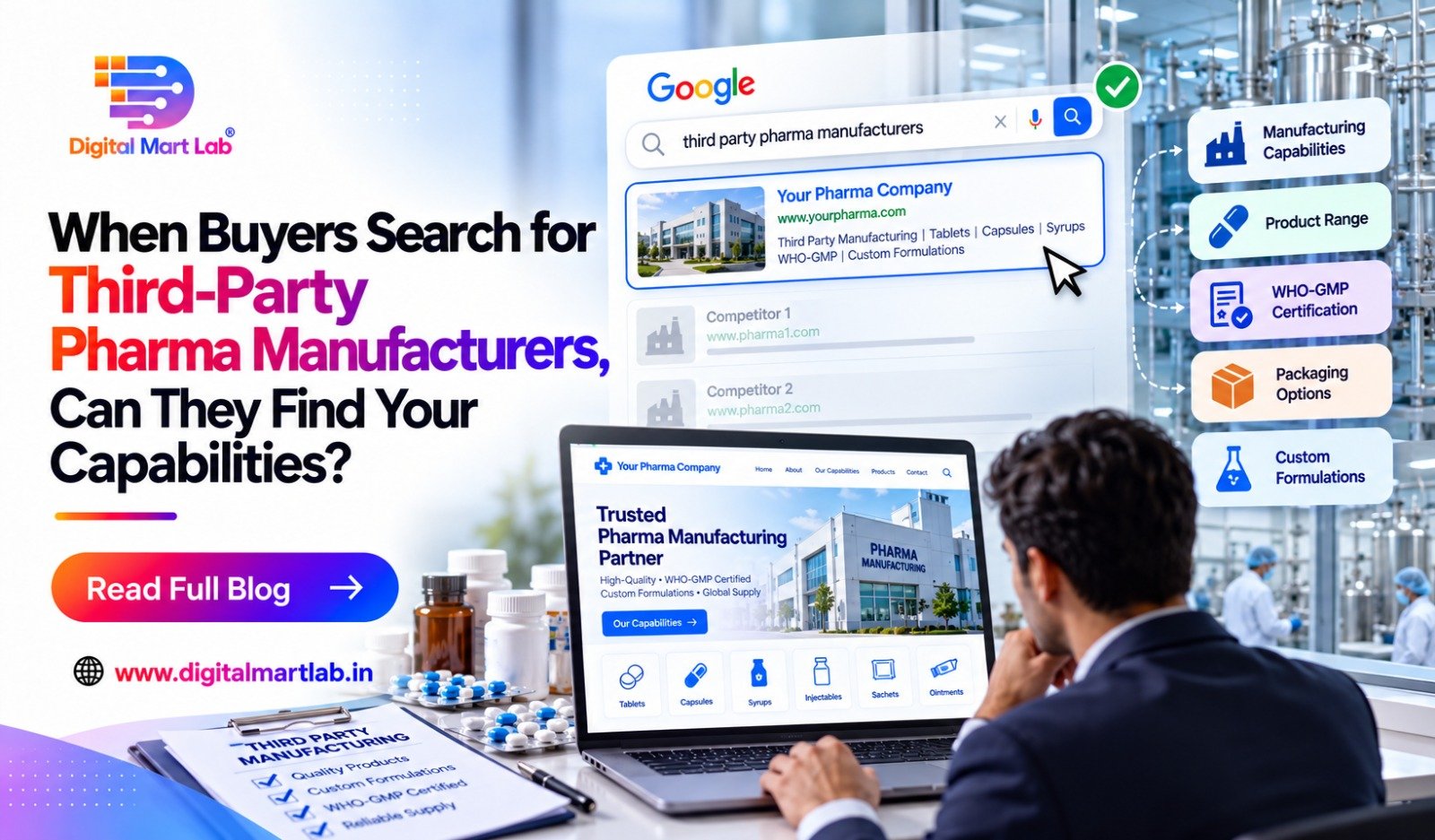
When Buyers Search for Third-Party Pharma Manufacturers, Can They Find Your Capabilities?
Your facility may support the dosage form a buyer needs. Your team may also offer a suitable packaging option.
But can the buyer discover that information on your website?
If the homepage says only “complete pharmaceutical manufacturing solutions,” they still have to contact you to understand the basics. Some will call. Others may continue searching for a company that explains its capabilities more clearly.
SEO for pharma manufacturers starts with making actual capabilities easy to find and understand. Useful pages explain the dosage forms you support, relevant packaging options and the information your team needs to review a requirement.
This gives buyers a clearer basis for deciding whether to begin a manufacturing discussion.
Buyers search for a requirement, not always a company name
A buyer who already knows your company may search for your brand.
Someone looking for a new manufacturing partner may begin with a specific need. Their search might concern tablet manufacturing, capsule manufacturing or a particular packaging format.
These searches can reflect different stages of a decision. One buyer may be preparing a quotation request. Another may still be learning what information they need.
Your website should help both understand the relevant offering.
A general manufacturing page provides an introduction. More specific pages give buyers the detail needed to assess whether your business could be suitable.
Did You Know? A manufacturing buyer cannot assess your facility from a homepage saying “complete pharma solutions.” Clear capability pages explain supported dosage forms and order requirements, helping buyers reach your team with more relevant requests.
Start with the capabilities your business actually provides
Before choosing keywords or writing pages, prepare an accurate capability list with your technical and commercial teams.
Identify:
- The dosage forms you currently support.
- Relevant packaging formats.
- Important conditions affecting suitability.
- Order requirements that can be explained publicly.
- The information needed before reviewing a quotation request.
- The correct team for technical and commercial questions.
This becomes the foundation for your website content.
Do not add a capability simply because competitors mention it or because a keyword looks attractive. It may bring enquiries, but those enquiries will waste time if your business cannot serve them.
Make your business role clear
Explain whether visitors are dealing with the manufacturer operating the facility or a company arranging manufacturing through partners.
If your business uses more than one facility, avoid implying that every capability is available at every location.
Buyers should understand who provides the service and which details need confirmation.

Create useful pages for your main dosage forms
A visitor searching for tablet manufacturing should be able to reach information about that capability without searching through unrelated franchise or distribution content.
Depending on your actual offering, separate pages may be useful for tablets, capsules, oral liquids or other supported dosage forms.
Each page needs enough specific information to justify its existence.
What should a dosage-form page explain?
Start with a plain-language description of the supported work. Then explain:
- What the buyer can discuss with your team.
- Which relevant packaging options are available.
- What details affect the requirement review.
- Whether order requirements vary.
- How to submit an enquiry.
Include genuine photographs where they help explain the facility or process. A photograph should support the information rather than carry the entire explanation.
Avoid repeating the same page with a different heading
Changing “tablet manufacturing” to “capsule manufacturing” throughout otherwise identical text adds little value.
Ask your team what buyers need to understand about each service. Differences in the requirement-review process, packaging options or information needed for a quotation can help make the pages useful.
If you do not have enough distinct information for a separate page, a clear section within a broader capability page may be more appropriate.
Explain packaging options in the buyer’s language
Packaging can be part of the requirement from the beginning.
A buyer may want to know whether you support a particular blister format, bottle size or other presentation before discussing the project further.
List only the formats you actually support, and connect them to the relevant dosage forms or services.
Avoid presenting packaging as a broad promise such as “all types available.”
Explain what needs confirmation
A supported format does not automatically mean every product and pack combination is suitable.
Use straightforward wording, such as:
“Share the required packaging format and pack size so our team can review compatibility and the applicable commercial requirements.”
This gives the buyer a useful next step without promising approval before review.
Decide whether packaging needs its own page
A separate packaging page can be useful when there is enough relevant information and buyer demand to support it.
Otherwise, explain packaging within the appropriate manufacturing page.
In either case, visitors should be able to move easily between the dosage-form information, packaging details and enquiry option.
Did You Know? Buyers may search for specific packaging options when choosing a manufacturer. Clear content about the formats you genuinely support helps them assess your facility against a more precise requirement.
Make order requirements clear before the quotation discussion
Some enquiries become unsuitable because the quantity does not fit the manufacturing arrangement.
Your website can help buyers understand this earlier.
Where a minimum order quantity is confirmed and appropriate to publish, state it accurately with the unit and any relevant conditions.
If requirements vary by product or packaging, explain that variation.
For example:
“Minimum order requirements depend on the product and packaging. Share your estimated quantity and pack details so our team can confirm what applies.”
Avoid publishing one general figure that could mislead buyers about several different services.
Ask for a quantity and its unit
“Quantity: 5,000” is incomplete if the team does not know whether the buyer means tablets, strips, bottles or boxes.
Your website form should ask for the unit and, where relevant, the pack size.
Let buyers indicate that the quantity is still being decided. An uncertain requirement may need guidance rather than immediate rejection.
Answer the questions buyers ask before requesting a quotation
Some prospective customers are not ready to submit a complete specification. They first want to understand how the process works.
A practical quotation guide can help them prepare.
Useful questions include:
- What information should I send with a manufacturing enquiry?
- Do you need an estimated quantity before reviewing the request?
- What packaging details should I provide?
- Can I enquire if part of the specification is undecided?
- What happens after the requirement is submitted?
- Which details need technical or commercial confirmation?
Answer these questions using your actual process.
This content should help buyers prepare a better enquiry. It should not imply that every request can receive an immediate fixed quotation.
A simple manufacturing enquiry checklist
| Information | Why your team needs it |
| Product requirement | Understand what the buyer wants reviewed |
| Dosage form | Identify the relevant capability |
| Estimated quantity and unit | Assess the scale of the requirement |
| Packaging preference and pack size | Understand the requested presentation |
| Intended market, where relevant | Direct the appropriate documentation and capability discussion |
| Expected timeline | Understand the buyer’s plan without confirming a delivery commitment |
| Business and contact details | Arrange clarification and further discussion |
Request detailed specifications or documents at the stage when your team needs them. Do not force a first-time visitor to upload sensitive information just to ask an initial question.
Connect your pages so buyers can continue their research
A useful manufacturing website should let visitors move naturally from a general introduction to more specific information.
For example:
- A manufacturing overview introduces the available services.
- A dosage-form page explains the relevant capability.
- A packaging section answers presentation questions.
- A quotation guide explains what to prepare.
- An enquiry form collects the starting requirement.
Use descriptive links such as “Packaging options for this service” or “Details needed for a manufacturing quotation.”
The visitor should understand where each link will take them.
A review of your website design and page structure can help organise this journey without making the website unnecessarily complicated.
Show evidence that supports the capability description
Buyers may use the website to decide whether to start a conversation or share the company with a colleague.
Give them accurate information they can assess.
This may include:
- Genuine facility photographs with clear descriptions.
- Relevant credentials and their scope.
- A factual explanation of the requirement-review process.
- Current company and contact information.
- A capability profile that matches the website.
Avoid using an unexplained collection of logos as the main proof of suitability.
Where a credential applies to a particular entity, facility or activity, make that relationship clear. Your team should review the wording before publication.
Illustrative example: A buyer is exploring capsule manufacturing with a particular packaging preference. A relevant website page explains the supported capability, identifies the packaging details needed for review and links to a quotation checklist.
The buyer can now send a more useful initial requirement. The technical and commercial teams still need to confirm whether it can be accepted.
Make the information available on the website, not only in a PDF
A downloadable capability profile can be helpful for internal buyer discussions.
However, the main service explanation should also appear as readable website content.
This lets visitors quickly find the information they need without downloading a long document first. It also provides a clear page to share, link to and update.
Keep both versions consistent. If a capability changes, update the website and the downloadable profile.
Your SEO work should also include checking whether important public pages are accessible, correctly organised and connected through internal links. Publishing a page does not guarantee that it will appear prominently in search.
How should you judge whether these pages are helping?
More visitors are useful only when you understand what they are looking for and what happens next.
Review:
- Whether relevant capability pages receive search visits.
- Which available search terms lead to those pages.
- Whether enquiries mention supported dosage forms.
- Whether buyers provide clearer quantities and packaging details.
- Whether discussions progress to a requirement review or quotation.
Ask your sales team which mismatches keep appearing.
If buyers repeatedly enquire about a service you do not provide, check whether the content creates the wrong impression. If suitable buyers ask the same basic question, the page may need a clearer explanation.
Avoid judging the entire project by one keyword position or the number of published pages.

How Digital Mart Lab can help manufacturers explain their capabilities online
Digital Mart Lab can help turn approved business information into useful website pages that support discovery and enquiry.
Plan pages around actual services
The work starts with the dosage forms, packaging options and commercial priorities your company confirms.
This helps identify which subjects need separate pages and which can be explained within an existing page.
Write clear manufacturing content
Content can explain the capability, answer common buyer questions and show what information is needed for a review.
Your team provides and approves the technical facts. The website presents them in language business buyers can understand.
Improve the website and enquiry process
Through website design and development services, the pages and forms can be organised around how buyers explore a requirement.
Relevant forms can collect the starting details and direct the enquiry to the responsible person.
Review search performance and sales feedback
The SEO process should connect page improvements with relevant searches, visits and business enquiries.
Where you also run eligible campaigns, these capability pages may support performance marketing by giving the advertisement a relevant destination. Campaign eligibility and landing-page requirements still need separate assessment.
The aim is to make your actual offering easier to discover and evaluate.
Frequently asked questions about SEO for pharma manufacturers
1. Do we need a separate page for every dosage form?
Create separate pages where you have distinct, useful information about a supported service. Avoid producing near-identical pages simply to target more keywords.
2. Should packaging information be on the same page?
Often, relevant packaging details belong on the dosage-form page. A separate page may help when there is enough information to answer additional buyer questions. Link the pages clearly.
3. Should we publish our manufacturing rates?
That depends on your commercial process. Where pricing requires a specification review, explain what details buyers should provide and how the quotation discussion works.
4. Can we publish capabilities offered through manufacturing partners?
Yes, provided you describe your role and arrangements accurately. Do not present a partner’s facility as your own or imply that every requirement is already approved.
5. Is a downloadable company profile enough?
It can support the discussion, but useful website pages make the main information easier to find and review. Keep the profile and website consistent.
6. Will capability pages guarantee enquiries?
No. Results also depend on search demand, competition, website performance and the suitability of your offering. Clear pages improve the information available to buyers and provide a better starting point for enquiries.
Help buyers discover what your facility can actually do
Your website should make it easier for a buyer to answer a practical question: “Could this company support my requirement?”
Clear dosage-form pages, accurate packaging information and useful quotation guidance help them make that initial assessment.
They also give your team a stronger starting point when the enquiry arrives.
Want buyers to find and understand your pharma manufacturing capabilities?
Discuss SEO for Your Pharma Manufacturing Business with Digital Mart Lab
Share your website, supported capabilities and the questions your quotation team receives most often. We can use that information to plan the pages and improvements your business needs.
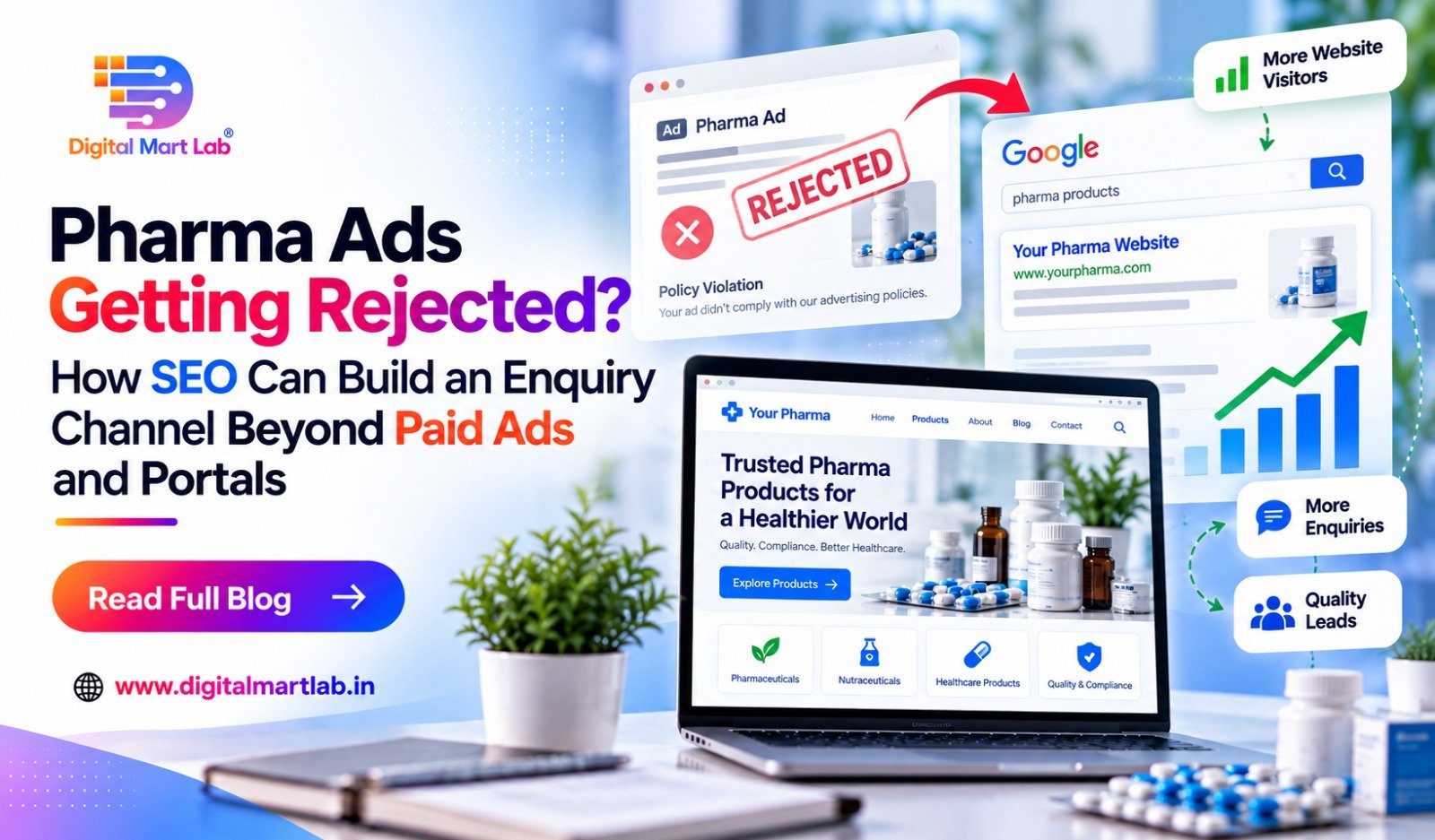
Pharma Ads Getting Rejected? How SEO Can Build an Enquiry Channel Beyond Paid Ads and Portals
Your campaign is ready. The advertisement has been prepared, the budget is allocated and your sales team is waiting for enquiries.
Then the ad is rejected.
While your team investigates the issue, you continue depending on portal enquiries, referrals and existing contacts. It raises an important question: how else can a new buyer find your company?
Pharma SEO can help your business build another discovery route through organic search. When your website clearly explains your ranges, manufacturing capabilities and partnership process, relevant buyers have more information to find and assess.
This takes sustained work. It will not immediately replace enquiries from an interrupted campaign. But it can reduce your dependence on a single source over time.
Start by understanding why the advertisement was rejected
A rejected pharma advertisement does not automatically mean that every campaign for your business is prohibited.
Equally, describing an offer as “B2B” does not automatically make it eligible.
The reason depends on the platform, the specific offer, the destination page and the applicable requirements.
For example, Google’s healthcare and medicines advertising policy places restrictions on certain healthcare content, with conditions that vary by category and location. The destination website can matter as well as the advertisement.
Ask your campaign manager to identify the exact policy cited and review the relevant page before making changes.
SEO is a separate discovery channel. It does not resolve an advertising rejection or make inaccurate claims acceptable. Your website information still needs to be truthful and appropriate for the business you conduct.

How does pharma SEO create another route for enquiries?
SEO helps search engines discover and understand useful website pages so they can be considered for relevant searches.
For a pharma business, those pages should explain what you actually offer and whom you serve.
A prospective buyer might research:
- A particular PCD franchise range.
- A manufacturer supporting a specific dosage form.
- Packaging options for a manufacturing requirement.
- Information needed to request a quotation.
- Partner support before discussing a franchise.
If your website answers those questions clearly, it gives the buyer a reason to explore your company.
The journey may be:
A relevant search → a useful website page → a business enquiry → a sales discussion.
Being found is the beginning. Your offer, website experience and follow-up determine whether the conversation progresses.
Did You Know? Rejected ads do not have to leave your franchise business dependent on referrals alone. SEO can build a separate discovery route while your advertising issue is assessed and addressed where possible.
Why relying on one portal can leave a gap
A pharma portal may remain a useful source of business enquiries. Review its contribution based on the relationships and orders it helps create.
However, a portal listing gives you only part of the buyer’s discovery journey.
Your own website provides room to explain your company, relevant ranges, actual support and manufacturing capabilities in more detail. Buyers can return to those pages while comparing options or preparing questions.
It can also help someone who first sees your company on a portal and then searches your name before contacting you.
The aim is to give buyers several relevant ways to discover and evaluate the business. Decisions about portal spending should follow evidence, rather than the assumption that SEO will replace it immediately.
Give each channel a clear role
| Channel | What it can contribute |
| Paid advertising | Visibility for eligible campaigns and offers |
| Pharma portals | Discovery through the platform’s listings and enquiry process |
| Organic search | Discovery of relevant pages on your website |
| Referrals | Introductions based on existing relationships |
| Your website | A consistent place to understand the business and make contact |
These sources can support one another. A buyer may encounter your company through more than one before making an enquiry.
What does your website need before SEO can support enquiries?
Publishing more blogs is not always the right first step.
If your main pages are unclear, difficult to access or unable to receive enquiries, additional content may leave the underlying problem unresolved.
1. Pages that search engines can access
Your SEO team should check whether important public pages can be crawled and indexed.
In simple terms, search engines need to reach the pages and consider including them in search results.
Accidental blocking, incorrect indexing settings, broken pages or conflicting page versions may need attention. A sitemap and internal links can help discovery, but they do not guarantee indexing.
Private customer accounts and restricted commercial information should remain protected.
2. A clear explanation of your business
State whether you are a manufacturer, a pharma marketing company, a franchise business or a business providing several services.
Do not imply factory ownership when you work through manufacturing partners.
Accurate positioning helps visitors understand what they can request and who will handle it.
3. Useful range and capability pages
A homepage saying “complete pharma solutions” leaves too much unexplained.
Create relevant pages for the ranges or capabilities you genuinely offer. Explain the details a business buyer needs before contacting your team.
These pages form the foundation for focused SEO services for your pharma business.
4. A working enquiry process
Test your forms, phone links and contact options on a mobile device.
Confirm that submitted details reach the responsible person and that your team records the next action.
Search visibility creates an opportunity. A broken form can prevent that opportunity from becoming a conversation.
Build content around the questions business buyers ask
The purpose of pharma SEO is not simply to attract anyone searching for a medicine-related word.
A manufacturer seeking business buyers needs different content from a website answering consumer medicine questions.
Start with your actual customers and the requirements your company serves.
| Buyer question | Useful website content |
| “Do you support this dosage form?” | A factual capability page explaining the supported work |
| “Which franchise ranges do you offer?” | Organised range pages with partnership information |
| “Can you discuss this packaging requirement?” | Accurate packaging information and an enquiry route |
| “What details do you need for a quotation?” | A practical guide to preparing a manufacturing enquiry |
| “What support would I receive?” | A clear explanation of actual partner support and conditions |
Search research should help refine these subjects. Your sales team should check whether the content reflects questions buyers actually ask.
Example: a manufacturing capability page
Illustrative example: A business supports capsule manufacturing, but its website only has a general services page.
A dedicated capability page could explain the supported work, information needed for review and how to submit a requirement. It could also direct buyers to relevant packaging information.
This gives a visitor more substance to assess. It does not guarantee a ranking or establish that every submitted request is suitable.
Example: a franchise range page
A prospect researching a derma franchise may need range information, support details and an explanation of territory assessment.
A relevant page can answer those questions together and invite the visitor to discuss their preferred district.
Avoid creating numerous near-identical city pages that do not add useful information. Each page should have a clear purpose for the reader.
Can this also help buyers using AI search?
Buyers may use search engines and AI tools to research suppliers and compare business options.
Clear company information and useful service pages give these systems better material to understand. Technical accessibility also remains important.
For Google’s AI search features, its official website guidance explains that established SEO practices remain relevant. Pages must meet the applicable search requirements, and there is no special markup that guarantees inclusion.
No agency can reliably promise that an AI tool will recommend your company.
Focus on accurate company details, useful explanations and accessible pages. These are worthwhile improvements regardless of which discovery tool a buyer uses.
Did You Know? Buyers researching manufacturers through search and AI tools need clear information about your capabilities. Well-written pages can make your actual dosage forms, packaging options and credentials easier to discover and assess.
Why pharma SEO needs sustained work
SEO involves more than adding keywords to a page.
Your team may need to repair technical issues, improve existing content, publish missing information and review which searches lead to useful visits.
Search engines also need time to discover and reassess changes. Competitors continue improving their websites, and your own portfolio may change.
This is why “guaranteed enquiries next week” is not a sensible promise for an SEO project.
Google’s guidance on hiring an SEO advises that benefits typically take time to appear. The pace varies with the website and the work involved.
Expect progress in stages
| Stage | What the work should establish |
| Baseline review | Current visibility, website issues and enquiry sources |
| Foundation improvements | Accessible pages, clear content and working enquiry routes |
| Content development | Useful coverage of relevant buyer requirements |
| Performance review | Evidence about searches, visits and business conversations |
| Continued improvement | Updates based on results and changes in the business |
Discuss specific deliverables and review points with your agency. Avoid judging the entire project by one keyword position.

Measure organic enquiries as well as search visibility
A report showing more impressions or visitors can be encouraging. It still needs a connection to your business goals.
Review:
- Whether relevant pages are being discovered.
- Which searches and pages bring visitors.
- Whether visits produce completed enquiries.
- Whether those enquiries match your ranges or capabilities.
- Whether suitable discussions progress to quotations or orders.
Separate people searching your company name from those discovering you through broader business searches where the available data allows.
Both can be valuable, but they tell you different things about the website’s contribution.
Keep sales feedback in the report
If organic enquiries repeatedly ask for unsupported work, the content may need clearer positioning.
If relevant visitors enquire but conversations stall, review response time, commercial fit and follow-up as well.
Record available source information when buyers contact you by phone. Some will research online and call later, so website forms will not capture the full picture.
What should your business prepare for an SEO project?
Your marketing team needs accurate information from the business.
Prepare:
- Your actual service and product-range priorities.
- Documented capabilities and relevant credentials.
- Common buyer questions.
- Clear descriptions of partner support.
- The details needed to assess an enquiry.
- Someone who can review technical and commercial wording.
- Access to existing website and measurement systems where authorised.
This avoids publishing pages that sound persuasive but do not reflect what your company can deliver.
It also helps the agency prioritise commercially relevant subjects instead of producing general pharma articles simply to meet a content count.
How Digital Mart Lab can help build your organic enquiry channel
Digital Mart Lab can help organise SEO work around your business offering and the buyers you want to reach.
Review the website and its search foundation
The starting review can identify accessibility issues, unclear pages and gaps in the enquiry journey.
Where the site needs improvements, website design and development services can support clearer navigation, relevant pages and working forms.
Plan useful business-focused content
The proposed content can explain your ranges, capabilities and enquiry process in language buyers understand.
The work should include factual input from your team and clear priorities based on your actual offering.
Track relevant progress
Reporting should connect website work with visibility, enquiries and sales feedback where the information is available.
This helps identify what to improve next instead of treating a traffic increase as the final result.
Keep advertising decisions separate and informed
If ads have been rejected, a performance marketing review can examine the stated issue and relevant destination alongside the SEO work.
Neither service should promise approval or guaranteed enquiries. Each should have a clear scope and a practical role in your marketing plan.
Frequently asked questions about pharma SEO
1. Can SEO help if our pharma advertisements are rejected?
It can help build a separate route for buyers to discover your website. The rejection still needs its own assessment, and organic search requires sustained work rather than an immediate replacement promise.
2. Does an ad rejection stop the website from appearing in organic search?
An advertising rejection and organic search visibility involve different systems. The rejection alone does not establish whether a page will be indexed or ranked. The website must meet the relevant search requirements.
3. Should we stop using pharma portals once SEO begins?
Not automatically. Compare the relevant enquiries and business outcomes from each source. SEO can expand your options while useful portal activity continues.
4. Is a company homepage enough for pharma SEO?
Usually, a homepage cannot explain every range and capability in enough detail. Relevant supporting pages help buyers understand specific offerings, provided each page contains useful and accurate information.
5. Will SEO guarantee that AI tools recommend our company?
No. Clear, accessible content can support discovery, but inclusion or recommendation by an AI tool cannot be guaranteed.
6. How soon should we expect enquiries?
That depends on the starting website, demand, competition and implementation. Agree on progress reviews and measurable work, but avoid treating a fixed lead deadline as a reliable SEO promise.
Give buyers another way to find your pharma business
When one campaign stops or one enquiry source slows down, having another discovery route becomes valuable.
A useful website supported by sustained SEO work can help buyers find your actual offering, understand it and contact your team.
Start with clear pages, accurate business information and a working enquiry process. Build from there using evidence about the searches and conversations that matter.
Want to build a search presence that supports relevant pharma enquiries?
Discuss Your Pharma SEO Requirements with Digital Mart Lab
Share your website, priority ranges or capabilities and current enquiry sources. We can use that information to identify the website improvements and content your business needs first.
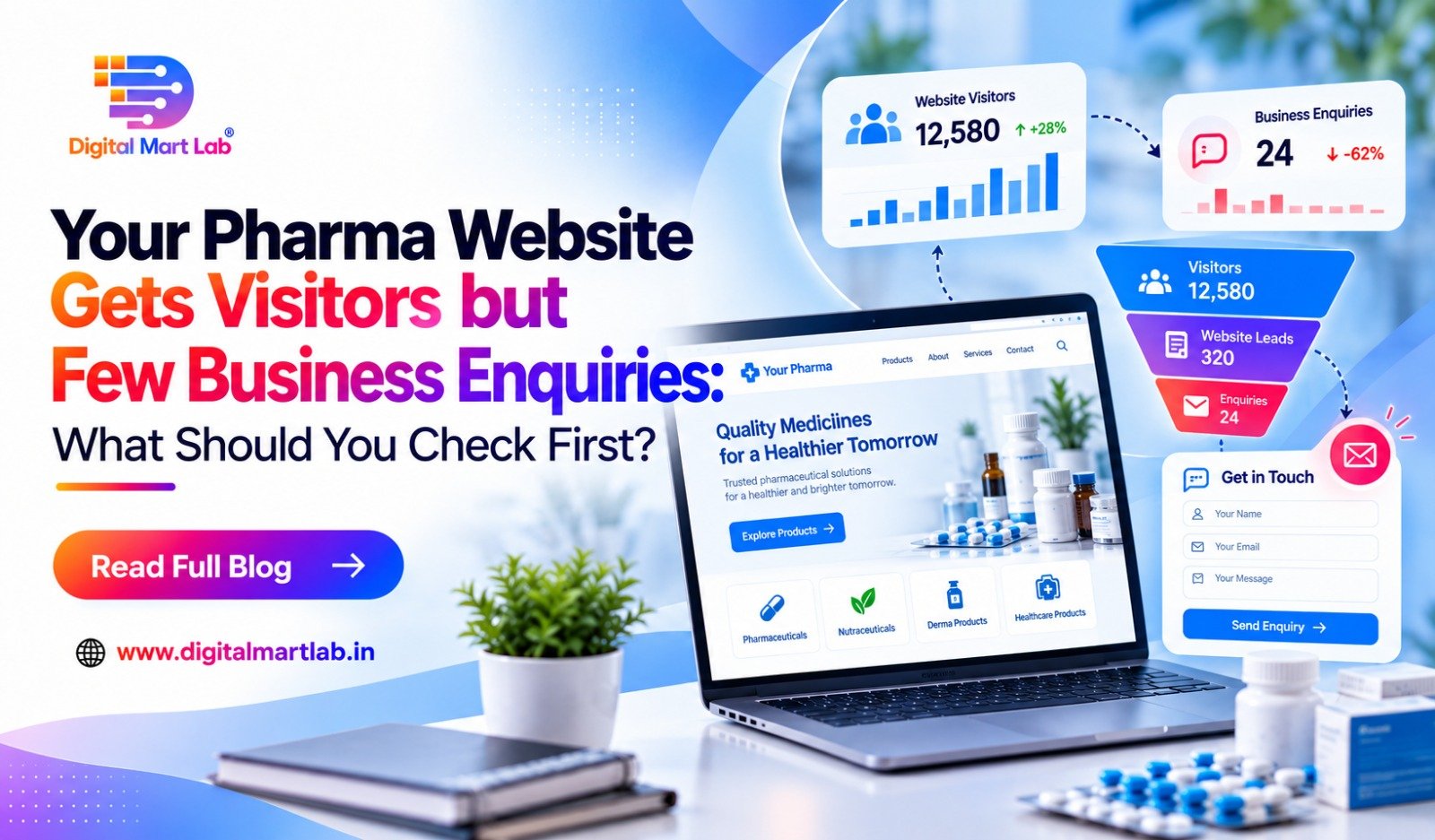
Your Pharma Website Gets Visitors but Few Business Enquiries: What Should You Check First?
Your website report shows visitors. Some people open product pages. Others download the catalogue.
But your sales team says, “We are not getting enough useful enquiries.”
Before increasing your advertising budget or deciding that the website needs a complete redesign, follow the same steps a potential buyer would take.
Open the website on your phone. Find a relevant range. Try to ask about a franchise or submit a manufacturing requirement.
Is the process clear? Does the form work? Does the enquiry reach the right person?
Improving pharma website conversion starts with checking whether suitable visitors can understand your offer, contact your team and receive a response. Traffic figures alone cannot show where that process is breaking down.
A practical review can help you identify what needs attention first.
First, separate website activity from business enquiries
A visit tells you that someone reached your website. A catalogue download tells you they requested a file.
Neither automatically means you have gained a suitable franchise applicant, distributor or manufacturing buyer.
It helps to separate the stages:
| Stage | What it tells you |
| Website visit | Someone reached a page |
| Product-page view or catalogue download | Someone explored information |
| Completed enquiry | Someone submitted details or contacted the business |
| Relevant business conversation | Your team established a requirement your company may be able to serve |
| First paid order | The discussion progressed into a commercial transaction |
These stages are connected, but they should not be reported as the same result.
A buyer may also return several times before making contact. Another may download a catalogue without ever becoming a customer.
Did You Know? A catalogue download is not a distributor appointment. Tracking enquiries, relevant conversations and first paid orders separately helps you understand what your website is contributing to the business.

Check 1: Are the right people visiting your website?
Before changing buttons and forms, review why people are arriving.
A manufacturing company may receive visits from people looking to buy individual medicines. A franchise page may attract job seekers if the message is unclear. An article may answer a general question without attracting someone ready for a business discussion.
Ask your marketing team to review:
- Which pages receive visitors.
- Where those visitors come from.
- Available search-query or campaign information.
- Whether the advertisements explain the intended business offer.
- What your sales team hears from the people who enquire.
Some traffic is useful for awareness even if it does not produce an immediate enquiry. The problem is expecting every type of visit to behave like a buyer actively seeking a supplier or partnership.
Make the intended audience clear
A visitor should be able to recognise whether the page is for franchise applicants, distributors or manufacturing buyers.
For example, “Discuss a PCD franchise opportunity” gives clearer direction than a general “Explore exciting opportunities.”
Relevant wording helps visitors understand what the business is offering before they share their details.
Where search traffic is regularly unrelated to your services, a review of your SEO strategy and website content can help identify the mismatch.
Check 2: Can a buyer use the website comfortably on a phone?
Do not judge the website only from your office computer.
Open it on a phone using an ordinary mobile connection. Start from the page a buyer would actually visit, rather than always starting from the homepage.
Check whether you can:
- Read the main explanation without zooming.
- Find the relevant range or capability.
- Use the menu easily.
- Open a catalogue without losing your place.
- Tap the enquiry button comfortably.
- Complete the form without an overlapping popup.
Large images, crowded layouts and awkward forms can make a simple enquiry feel like work.
Do buyers have to download a large file to understand the offer?
A catalogue can provide useful detail, but basic business information should also be available on the page.
Explain the range, service and next step before asking visitors to open a file.
For example, a franchise prospect should be able to understand which range is being discussed and how to enquire about a territory without first searching through a lengthy PDF.
Check the whole form, including errors
Try submitting the form with a missing required field.
Does it clearly explain what needs correcting? Does it preserve the information already entered? Can the visitor reach the submit button when the phone keyboard is open?
Small usability problems can interrupt an otherwise useful page.
Did You Know? A franchise prospect opening your website on a phone may struggle with crowded pages and heavy downloads. Clear mobile layouts make partnership information and enquiry options easier to access.
Check 3: Does the visitor know what will happen after enquiring?
Someone may be interested in your range without being ready for a sales call.
Make the next step clear so visitors understand what they are requesting.
Compare these options:
| Unclear button | Clearer option, where accurate |
| Submit | Request a Callback |
| Get Started | Discuss Your Preferred Territory |
| Know More | Ask About This Product Range |
| Send | Submit Your Manufacturing Requirement |
The wording should match what happens next.
If the form requests a callback, explain that your team will contact the person. If it requests a quotation review, explain that more details may be needed before a quotation is prepared.
Check what the advertisement promised
If an advertisement invites people to download a catalogue but the form appears to request a business call, expectations may become confused.
The advertisement, form and confirmation message should describe the same action.
If people repeatedly tell your sales team, “I did not ask for a call,” review how the offer and contact request are explained. More follow-up calls will not resolve unclear expectations.
A review of performance marketing campaigns should therefore include the form and destination page, alongside the advertisement itself.
Check 4: Do your forms and contact buttons actually work?
A working-looking form can still fail to deliver an enquiry.
Test every important contact route instead of assuming that a successful website launch means everything continues working.
Test the enquiry form from submission to receipt
Send a clearly labelled test enquiry and check the complete process:
- The form accepts valid details.
- A confirmation message appears.
- The enquiry is recorded in the intended location.
- The notification reaches the responsible person.
- The submitted details are readable and complete.
If your business uses a shared lead system, check that the record reaches it as expected.
Seeing “Thank you” on the website does not prove that your sales team received the enquiry.
Test phone and WhatsApp links
Confirm that the call button opens the correct number and that the WhatsApp link opens the intended business account.
If the WhatsApp message is prefilled, check that it relates to the page and is easy to understand.
Test links from more than one relevant device where possible. Do not count a button tap as proof that a call connected or a WhatsApp conversation started.
Repeat checks after website changes
Updates to forms, plugins, email settings or page layouts can affect enquiry delivery.
Include submission tests in your website maintenance process, especially after changes to the contact journey.
A broken manufacturing enquiry form can waste interest generated by both advertising and search.
Check 5: Is the form asking for the right amount of information?
Your team needs context, but the first enquiry should be manageable.
A franchise applicant might reasonably share a preferred district and range. A manufacturing buyer might share a dosage form and estimated quantity.
However, someone at an early stage may not have every detail decided.
Use clear labels and allow “Need guidance” where appropriate. Review whether a field genuinely helps prepare the first conversation.
Illustrative example: A manufacturing form requires a detailed packaging specification before submission. A buyer with a relevant requirement has not selected the packaging yet.
Allowing them to state “Packaging to be discussed” lets your team continue the conversation with accurate context.
The purpose is to collect useful information without forcing buyers to guess.
Check 6: Are enquiries reaching someone who will act on them?
A website can collect a suitable enquiry and still fail to produce a conversation.
The notification may reach an unattended inbox. Two employees may assume the other person will call. The request may be copied into a sheet without an assigned next step.
Check:
- Who owns each new enquiry.
- Where the details are stored.
- How the team sees requests awaiting a response.
- What happens when the assigned person is unavailable.
- Whether the outcome of the first contact is recorded.
A clear handover can matter as much as the page design.
If your team receives the details reliably but responses are delayed, fix that process before assuming the website needs more traffic.
Check 7: Does your tracking reflect real business activity?
Your report should distinguish between actions that show interest and actions that create contact.
A useful setup may record catalogue downloads, contact-button clicks and completed form submissions separately.
Then compare those records with actual enquiries received by the team.
Do not count every click as a lead
A visitor may click WhatsApp but not send a message. They may tap a phone number and cancel. They may submit the same form twice.
Reporting these actions separately gives you a clearer picture.
Where possible, remove duplicate enquiry records before assessing business outcomes. Keep the original details needed to understand how the buyer contacted you.
Remember that some buyers enquire later by phone
A buyer may discover your company online, save the number and call later. That conversation may not appear as a website form submission.
Ask a simple question during the conversation:
“How did you first hear about us?”
Record the answer alongside available source information. Buyers may not remember every step, so treat this as helpful context rather than perfect attribution.
For businesses with an appropriate setup, call-tracking arrangements may provide additional information.
Use a consistent enquiry-rate calculation
For example, calculate the completed-form rate by dividing completed form submissions by visits to the relevant page during the same period.
Do not mix catalogue downloads, button clicks and confirmed enquiries into one total without explaining what it contains.
There is no single conversion target that suits every pharma website. Buyer type, traffic source, offer and the requested action all affect what a useful result looks like.
What should you fix first?
Use the evidence from your review to set priorities.
| Finding | First action |
| Form submissions are not reaching the team | Repair delivery and retest |
| Mobile visitors cannot complete the form | Fix the mobile interaction |
| People misunderstand why they will be contacted | Clarify the advertisement, form and confirmation |
| Enquiries are mostly unrelated to your business | Review traffic sources and offer wording |
| Suitable enquiries remain unanswered | Assign ownership and a response process |
| Reports show leads the team cannot find | Check event definitions, delivery and duplicate counting |
| Buyers cannot find relevant range information | Improve page content and navigation |
Do not change everything at once unless a wider repair is clearly necessary.
Fix the most direct problems first, then review whether buyer conversations improve. This makes it easier to understand which changes are helping.
How Digital Mart Lab can help review your pharma website
Digital Mart Lab can review the journey from the first visit to the enquiry reaching your team.
The work can include:
- Checking mobile layouts and navigation.
- Reviewing range and service explanations.
- Improving enquiry buttons and form wording.
- Testing submissions and notification delivery.
- Reviewing agreed tracking and enquiry records.
- Identifying gaps between website activity and sales follow-up.
Through website design and development services, the findings can guide focused improvements or a wider rebuild where justified.
The review should help you understand what needs fixing and why. A complete redesign is not automatically the first answer.
Frequently asked questions about pharma website enquiries
1. Why does our pharma website get traffic but few enquiries?
Possible causes include unrelated visitors, unclear information, difficult mobile pages, broken forms or contact options that do not explain the next step. Follow the full buyer journey before deciding which issue applies.
2. Does a catalogue download count as a lead?
It is an interest signal. Whether it creates a contact record depends on the process, but it does not establish that the person is a suitable buyer or ready for a business discussion.
3. Should we redesign the website immediately?
First check whether forms work, enquiries reach the team and important pages are usable on a phone. Targeted improvements may resolve the main problem without a complete redesign.
4. Why do some people say they did not request a sales call?
They may have understood the advertisement or form differently. Review the promised action and make it clear when submitting details means requesting contact from your team.
5. How can we track people who visit the website and call later?
Record available source information and ask how they first heard about your company. Suitable call-tracking arrangements may help, but some journeys will remain only partly visible.
6. Should we increase advertising spending to get more enquiries?
Review the current traffic and enquiry process first. More spending may increase visits, but it will not repair a broken form, clarify an unclear offer or ensure that enquiries receive a response.
Make the enquiry journey work before asking for more visitors
Your website report is a starting point. The real question is whether a suitable pharma buyer can find the right information, make contact and continue a useful conversation.
Check the mobile experience, set clear expectations, test every enquiry route and compare reporting with what your sales team actually receives.
Getting website visitors but too few useful pharma enquiries?
Discuss Your Pharma Website with Digital Mart Lab
Share your website and explain where the results feel disconnected from the reports. We can use that information to identify the pages, forms and follow-up steps that need attention.
Can Your Pharma Website Answer Buyer Questions When Your Sales Team Is Busy? How an AI Assistant Helps
A potential franchise partner opens your website and likes the product range. Before sharing their number, they want to ask a few questions.
“Do you offer this range?”
“How do I discuss a franchise for my district?”
“Can someone explain the process in Hindi?”
Meanwhile, your sales team is speaking with existing customers, preparing quotations or handling other enquiries.
The visitor may fill in a form. They may call later. Or they may leave with their questions unanswered.
A pharma website AI assistant can give visitors an immediate starting point. It can explain approved company information, collect their requirements and help them reach the right person.
The value comes from making that first conversation useful and giving your team enough context to continue it.

What is a pharma website AI assistant?
A website AI assistant is a chat feature that helps visitors ask questions and explore your business offering.
For a pharma company, it can be set up to use approved information about:
- Product ranges.
- Franchise and distributor enquiry processes.
- Actual partner support.
- Manufacturing capabilities.
- Details needed for a requirement review.
- Business hours and callback arrangements.
Its role depends on what your company provides and what information you make available.
A useful assistant should also recognise when a question needs a person. Commercial terms, territory decisions and technical commitments often need review before anyone can give a reliable answer.
How is it different from a contact form?
A form collects answers to questions you have already chosen.
An assistant lets the visitor begin with their own question. It can explain something, ask a relevant follow-up and guide them towards a form, page or callback.
Both can work together. Keep the normal enquiry options available so visitors can choose the route they prefer.
Which buyer questions can it help answer?
Start with the questions your sales team answers repeatedly.
These provide a better foundation than trying to make the assistant respond to everything.
Questions from franchise applicants
A visitor may want to understand which ranges you offer, how territory enquiries work or what support is available.
The assistant can explain these points using your approved information. It can then ask for the preferred district and range before passing the enquiry to your team.
It should distinguish between explaining the territory review process and confirming that a territory is available.
Questions from distributors
An established distributor may want the relevant catalogue, information about a particular range or the correct contact for a business discussion.
The assistant can direct them to the appropriate page and collect enough information to identify the enquiry.
Existing order questions should go to the responsible support contact unless the assistant has authorised access to reliable order information.
Questions from manufacturing buyers
A manufacturing buyer may ask whether your business handles a particular dosage form or packaging format.
The assistant can explain documented capabilities and ask for the product requirement, estimated quantity and packaging preference.
If the requirement needs technical assessment, it should say so and pass the details to your team.
Did You Know? Basic capability questions can delay a manufacturing discussion when your team is busy. An AI assistant can explain approved information and refer unconfirmed pricing, capacity and technical requirements to a person.
Help visitors who do not know what to ask
A visitor may be interested in your business without knowing how to start.
A general “How can I help?” message may leave them with the same uncertainty. Simple opening choices can provide direction:
- Explore franchise opportunities.
- Find a product range.
- Discuss manufacturing.
- Request a callback.
After the visitor selects an option, the assistant can ask a relevant question.
For example:
“Which district and state would you like to discuss for the franchise opportunity?”
Or:
“What dosage form and approximate quantity are you considering?”
This gives the conversation a starting point without expecting the visitor to understand your full business process.
The same choices should be easy to find on the website itself. A chat feature is most helpful when it supports clear pages and enquiry options.
Let buyers use the language they are comfortable with
Some prospects are comfortable reading English but prefer discussing business in Hindi. Others may use a mixture of both.
A suitable assistant can offer supported language options and respond in the visitor’s preferred language.
The language should remain simple. Replacing a complicated English explanation with complicated Hindi does not make the conversation easier.
Keep product details and commercial meaning accurate
Product names, strengths, pack sizes and quantities should remain accurate when the language changes.
Test the assistant with the words and mixed-language questions your buyers actually use. Check whether the response preserves the meaning of your approved information.
For sensitive commercial details or unclear questions, provide a route to a person rather than allowing the assistant to interpret uncertain terms.
Did You Know? Complicated English can make franchise discussions harder for prospects who prefer Hindi. An AI-assisted conversation can explain approved information in a supported language and pass sensitive details to your team.
Collect useful requirements without making the chat feel like a form
The assistant should answer the visitor’s question before asking for a long list of details.
If someone asks about a range, explain the available information and offer the relevant page. Then ask whether they want to discuss a partnership.
As the conversation develops, collect only what helps the next step.
| Buyer type | Useful starting information |
| PCD franchise applicant | Preferred district, range of interest and expected starting timeline |
| Distributor or stockist | Range interest, business coverage and the opportunity they want to discuss |
| Manufacturing buyer | Product requirement, dosage form, approximate quantity and packaging preference |
| Visitor requesting a call | Name, contact details, subject and preferred callback time |
Do not ask a visitor to repeat information they have already shared.
If something is undecided, record it that way. “Needs help selecting a range” is useful context for a salesperson; a guessed range is not.
Explain why contact details are needed
Before collecting a phone number or email address, explain the purpose.
For example:
“Would you like our team to discuss this with you? You can share your contact number and preferred callback time.”
A request for a callback should not be treated as blanket permission for unrelated promotional messages.
Give your sales team the conversation, not just the phone number
The handover is where the assistant’s work becomes useful to your team.
If the salesperson receives only a phone number, the buyer may have to repeat the whole conversation.
A short summary should include:
- What the buyer wants.
- Requirements already shared.
- Questions answered.
- Information still missing.
- Any preferred callback time.
- Anything requiring human confirmation.
Illustrative example: A prospect asks about a derma franchise in Hindi. They share their preferred district, say they are starting a new business and request an afternoon callback.
The salesperson should receive those details together. They can then begin by discussing the range and territory review instead of repeating every opening question.
The summary should reflect what the buyer actually said. Uncertain information should remain marked as uncertain.
What should happen when the sales team is unavailable?
An assistant can continue the initial conversation outside working hours while the website and connected service are operating.
However, it should make the next step clear.
A useful message could be:
“Our sales team is currently unavailable. I can help with general company information and collect your requirement for a callback during business hours.”
Do not promise an immediate call if nobody is available to make it.
Collect the enquiry, notify the assigned person and make sure someone reviews pending requests when the team returns.
Accepting enquiries at more times is useful only when the business follows through.
Which questions should go directly to a person?
Define these boundaries before launch.
| Question | Appropriate response |
| “Is this district definitely available?” | Record the district and request confirmation from the responsible person. |
| “What is your final price?” | Refer to approved information where applicable and arrange a commercial discussion. |
| “Can you manufacture this exact formulation?” | Collect the requirement for technical review. |
| “Can you guarantee dispatch by this date?” | Seek confirmation from the authorised team. |
| “What is happening with my order?” | Use authorised, verified order information or refer the question to support. |
| “Which medicine should I take?” | Explain that the assistant handles business enquiries and cannot provide personal treatment advice. |
The assistant should also offer human contact when a visitor asks for it.
A confident answer is not useful if the information has not been confirmed.
What information does your company need to provide?
An assistant needs a maintained set of answers and instructions.
Prepare the information your team would give a new employee handling initial enquiries:
- A clear company description.
- Current ranges and relevant page links.
- Actual partner support.
- Franchise and distributor enquiry steps.
- Documented manufacturing capabilities.
- Information needed for a requirement review.
- Business hours and contact routes.
- Questions that require human confirmation.
Assign someone to approve changes.
If a range changes or a capability is no longer offered, the assistant’s information needs to change too. Updating a brochure elsewhere does not necessarily update the assistant automatically.
Test real questions before launch
Use examples from genuine business conversations, including incomplete questions and mixed Hindi-English messages.
Check whether the assistant:
- Gives accurate answers.
- Admits when information is unavailable.
- Preserves product and quantity details.
- Collects relevant requirements.
- Produces a useful summary.
- Sends the enquiry to the right person.
Also test how visitors can close the chat and use the normal form or contact button.

How Digital Mart Lab can help
Digital Mart Lab can help plan an assistant around your website, buyer questions and sales process.
The work can include:
- Reviewing repeated questions from prospects.
- Preparing approved answer content.
- Designing franchise and manufacturing conversation paths.
- Setting up supported language options.
- Collecting agreed enquiry details.
- Preparing summaries and team notifications.
- Testing responses and human handovers.
A clear website remains important. Through website design and development services, your range pages, enquiry options and assistant can be planned together.
For the assistant itself, AI-enabled marketing and automation can support the agreed conversation and follow-up process. Connections to shared lead records, email or other business systems depend on the project requirements.
Useful public information can also support your wider SEO strategy. Keep important range and service information on readable website pages rather than making visitors use the chat to access every answer.
How to tell whether the assistant is helping
Do not measure success only by the number of chat messages.
Review whether it makes the first conversation easier for buyers and more useful for your sales team.
Useful checks include:
- Whether answers match approved company information.
- Whether visitors find the range or process they asked about.
- Whether enquiries include relevant requirements.
- Whether the salesperson receives a clear summary.
- Whether requested callbacks are completed.
- Whether the team needs to correct answers or repeat questions.
Review unresolved conversations regularly. They can reveal missing website information, unclear wording or a question that should go to a person sooner.
Begin with a focused set of tasks. Add more only when the existing conversations are working reliably.
Frequently asked questions about pharma website AI assistants
1. Can an AI assistant answer visitors when our team is busy?
Yes, when the service is available, it can handle the initial conversation using approved information. It should explain when a person will need to review the enquiry or respond.
2. Can it communicate in Hindi and English?
It can be configured to support suitable languages, depending on the chosen system. Test both languages and mixed-language questions before launch, especially where product details and commercial meaning must remain accurate.
3. Will it replace our salespeople?
Its purpose is to support them by explaining initial information and collecting requirements. Salespeople remain important for assessing suitability, discussing terms and building the relationship.
4. Can it confirm franchise territory availability?
Only where there is an authorised, reliable process for doing so. Otherwise, it should collect the preferred territory and explain that the team must confirm availability.
5. Can it share catalogues and relevant website pages?
Yes, if the approved links and files are configured and maintained. It should share the information relevant to the buyer’s question rather than sending every document automatically.
6. Do we need to redesign the whole website first?
Not necessarily. Review the existing pages and enquiry process. The assistant may be added to a suitable website, while unclear content or difficult navigation may need improvement alongside it.
Give interested buyers a helpful first response
A visitor should not have to wait for a salesperson to understand your basic offering or find the right enquiry route.
A well-planned assistant can explain approved information, support language preferences and collect useful details. Your team can then continue with the questions and decisions that need a person.
Want your pharma website to help buyers even when your sales team is busy?
Discuss Your Pharma Website AI Assistant with Digital Mart Lab
Share your website, the questions buyers ask most often and how your team currently handles enquiries. We can use that information to plan an assistant that fits your business process.