
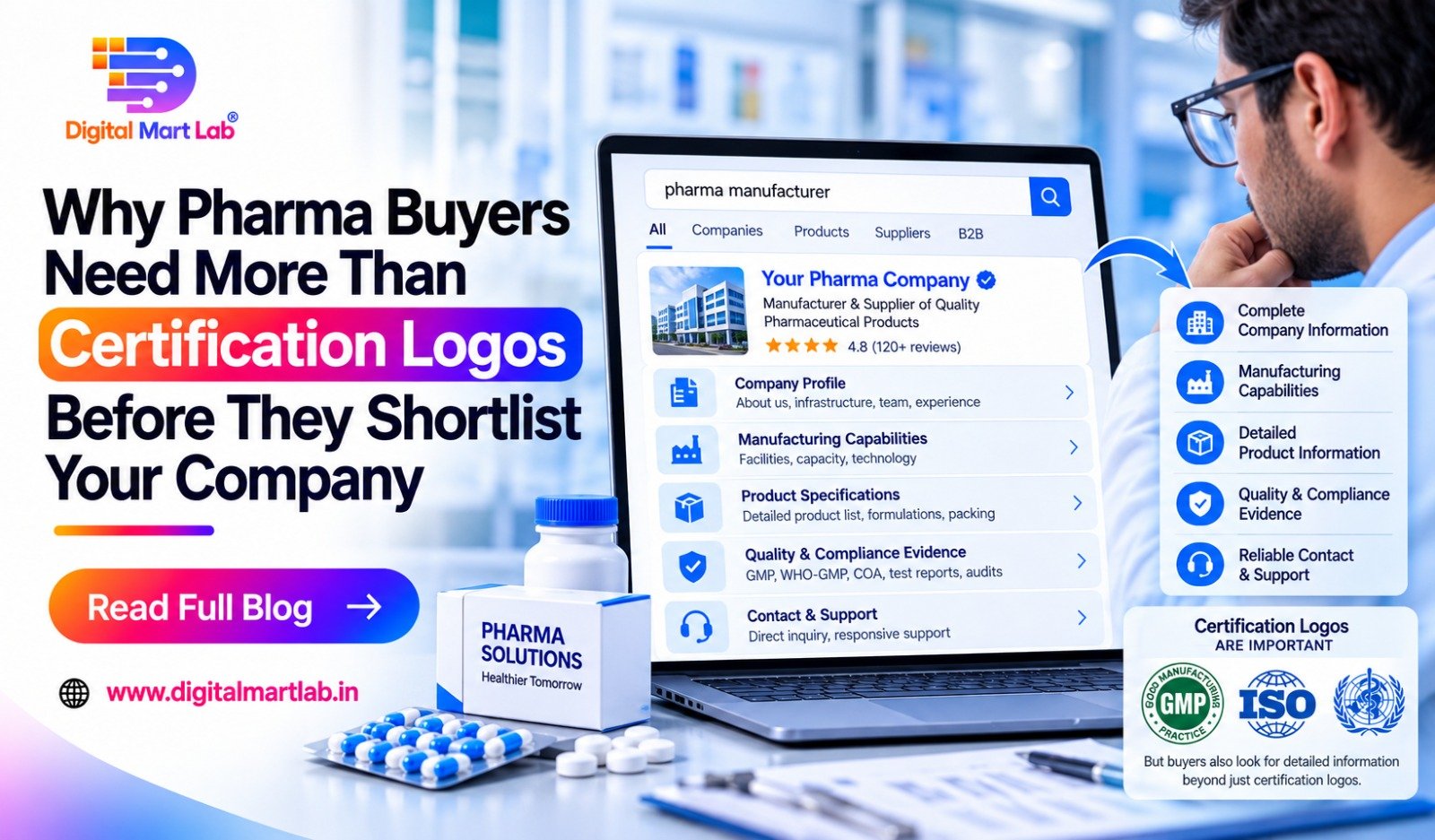
Your pharma website displays certification logos. It has a factory photograph, product images and a statement about quality.
But a potential buyer still asks:
“Which facility does this certificate cover?”
“Can you handle our dosage form and packaging requirement?”
“What happens before you confirm a manufacturing order?”
These are reasonable questions. A logo may draw attention to a credential, but it does not explain the full business behind it.
Pharma website credibility comes from giving buyers clear, accurate information they can assess. That includes the scope of documented credentials, genuine facility details, actual capabilities and an understandable explanation of your process.
This information can help buyers decide whether to begin a supplier discussion. It also gives them something useful to share with colleagues before moving forward.

What does a certification logo leave unexplained?
A badge usually communicates very little on its own.
It may not tell the visitor which legal entity holds the credential, which site it relates to or what activities it covers.
The buyer may also need to understand whether the information is current and how it relates to the service they are considering.
A website should help them make those connections.
| What the buyer sees | What they may still need to know |
| A certification logo | Which credential is being referenced? |
| A certificate image | Which entity, site and activities does it cover? |
| A factory photograph | Whose facility is shown, and what happens there? |
| “Advanced manufacturing” | Which capabilities are actually available? |
| “Strict quality process” | What checks and approvals are relevant to the buyer’s requirement? |
The solution is to add accurate context rather than expect visitors to interpret the image themselves.
Did You Know? A certification logo alone does not explain which facility or activities it covers. Clear, documented credential information helps manufacturing buyers assess your business more meaningfully than broad claims about quality.
Explain each credential in plain language
Start with the documents your company is authorised to reference.
Have the responsible person confirm the details before the website team publishes them.
Identify the relevant company and facility
State the entity and site to which the credential applies.
If your business operates across several locations, do not let visitors assume that a document relating to one site covers all of them.
If a credential belongs to a manufacturing partner, explain that relationship accurately.
A pharma marketing company should not present a partner’s certificate as though it were issued to its own business.
Describe the documented scope
Use the wording supported by the document and explain it clearly where necessary.
Avoid turning a credential into a broader claim about every product, service or market your company works with.
Different documents serve different purposes. A certificate, licence and product approval should not be treated as interchangeable badges.
Keep the information current
Record who is responsible for checking the website when documents are renewed, changed or replaced.
Where relevant, display accurate dates and explain how a buyer can request further verification.
You do not need to publish confidential records openly. A clear summary and an appropriate document-request process can provide a useful starting point.
Show genuine facilities with an explanation of what buyers are seeing
A photograph can help a visitor understand your business, but it needs context.
A room full of equipment does not explain which operation it supports. A stock image of a laboratory does not show your actual facility.
Use genuine, authorised images and captions that describe the relevant area or activity.
Make facility videos informative
A short facility video can introduce the setting and explain supported operations.
For example, it could show selected areas, identify their purpose and introduce the relevant team or process where appropriate.
Keep the narration factual. Avoid presenting visual scale or appearance as proof that every requirement can be handled.
A video can support an initial assessment. It does not replace technical discussions, document checks or a facility visit where those are needed.
Explain ownership and business relationships
If the facility belongs to a partner, say so.
Your business can still explain the role it plays in coordinating requirements, managing the portfolio or supporting the customer.
Illustrative example: A pharma marketing company arranges manufacturing through a partner facility. Its website can explain that arrangement and describe how it coordinates the buyer’s requirement.
It should not label the partner’s building “Our Factory” if that is inaccurate.
Clear positioning prevents confusion later in the discussion.
Connect credibility with the capability the buyer needs
A buyer may respect your credentials and still need to know whether your business fits the project.
Your website should connect the company information with actual services.
For manufacturing buyers, useful details may include:
- Supported dosage forms.
- Relevant packaging options.
- Information needed to review a requirement.
- Order conditions that can be explained publicly.
- The process for discussing technical questions.
- How the quotation conversation begins.
Do not list every possible service to make the company appear larger. Unsupported capabilities can attract enquiries your team cannot fulfil.
Give each major service enough explanation
A page about capsule manufacturing should explain the relevant capability and enquiry requirements.
A general list saying “tablets, capsules, liquids and more” gives the buyer less information to assess.
Clear service pages also create useful places for visitors to arrive through search. Your SEO strategy should reflect the services you genuinely provide and the questions buyers ask about them.
Explain what happens between an enquiry and a confirmed requirement
A buyer comparing quotations may struggle to understand the work behind the price.
Your website can explain the main stages without publishing confidential procedures.
Describe your actual process, using a sequence your team can confirm.
| Stage | What the website can explain |
| Initial enquiry | The product, quantity and packaging details needed to begin |
| Requirement review | Which details need technical or commercial assessment |
| Clarification | How missing information is discussed |
| Quotation | What must be confirmed before commercial terms are prepared |
| Approvals | Which agreed checks or customer approvals apply before work proceeds |
| Further coordination | Who handles questions and subsequent updates |
This is an example structure, not a universal manufacturing procedure. Your published version should follow your own operation.
Give buyers enough detail to ask better questions
Instead of “We follow a strict quality process,” explain an appropriate, documented part of the process.
For example, you may describe how specifications are reviewed or how an artwork approval step works, where that is part of your actual service.
This helps a buyer ask informed questions during the next conversation.
It also gives them more to evaluate than a general statement about quality or a quoted rate.
Separate an overview from a commitment
A process page should explain how the discussion works. It should not automatically promise feasibility, capacity or a delivery date for every enquiry.
Project-specific decisions still need confirmation from the responsible team.
Keep that distinction clear without filling the page with lengthy qualifications.

Make the information easy to find through search
If your useful information exists only inside a scanned brochure, visitors may have difficulty finding and reviewing it.
Publish the main explanations as readable website content.
Suitable pages might include:
- Company information.
- Facilities and capabilities.
- Credentials and supporting details.
- Manufacturing services.
- The enquiry and quotation process.
- Frequently asked buyer questions.
Connect these pages with descriptive links.
For example, a manufacturing page can link to the relevant facility information and explain where to find the quotation requirements.
Use headings that describe the information
Headings such as “Manufacturing Capabilities” or “Information Needed for a Quotation” help visitors understand what a section contains.
Avoid repeating “best pharma company” across headings when it does not explain the content.
Good website design and page structure should help the visitor move from the service they need to the evidence and next step.
Keep downloadable profiles consistent
A company profile remains useful for sharing.
Make sure its business description, contact details, capabilities and credential information match the website. Include an update date or version reference so your team can distinguish it from older copies.
When a material fact changes, review both versions.
Help your contact explain your company internally
The person making the first enquiry may not make the final decision alone.
They may need to discuss the supplier with purchasing, technical or management colleagues. Each person may have a different question.
A clear website lets them share the relevant page instead of forwarding a long conversation and trying to explain everything themselves.
A concise capability profile can also help them prepare an internal discussion.
Did You Know? Your manufacturing contact may need approval from technical and purchasing colleagues. A clear website and downloadable capability profile help them share relevant information beyond the first sales call.
Make useful information easy to share
Use stable page links, readable layouts and clear document names.
Do not require a new enquiry form every time an existing prospect wants to reread basic company information.
Sensitive records can follow a controlled sharing process. Public service explanations should be easy for the intended reader to access.
What should a buyer be able to verify before contacting you?
Review your website from the perspective of someone who has never spoken with your team.
Can they find:
- Your actual business identity and role?
- Reliable contact information?
- The service relevant to their requirement?
- Accurate facility information?
- The context behind published credentials?
- A clear explanation of the next step?
If these answers are missing, adding more badges is unlikely to solve the problem.
Illustrative example: A buyer reaches a manufacturing page and sees a certificate image. Beside it, the website identifies the relevant facility and explains how to request further details. The page also links to supported capabilities and quotation requirements.
The buyer now has a clearer starting point for supplier research. They still need to complete their own assessment, but the website has made that work easier.
How Digital Mart Lab can improve your pharma website credibility
Digital Mart Lab can help organise your approved company information into content buyers can understand and use.
Review existing claims and content gaps
The review can identify broad statements, unclear facility descriptions and missing context around credentials.
Your authorised team confirms the facts. The content work makes those facts easier to follow.
Build useful company and capability pages
Through website design and development services, the information can be presented through clear service pages, facility sections and enquiry options.
Genuine images and accurate captions can support the explanation.
Support relevant search discovery
SEO work can connect page topics with the questions business buyers ask while improving the organisation of public content.
The aim is to help suitable visitors discover and assess your actual offering.
Create a consistent reference for the sales team
The website and company profile can give your team approved material to share before and after a call.
This does not replace verification or buyer assessment. It makes the initial information more complete and consistent.
How can you tell whether the content is helping?
Ask your sales team what changes in the conversations.
Are buyers reaching the correct service page? Do they understand your business role? Are they asking more specific questions about a supported requirement?
Useful indicators include:
- Fewer repeated questions caused by unclear company information.
- Enquiries referring to relevant capabilities.
- Prospects sharing the correct pages with colleagues.
- Progress towards technical review, document exchange or quotation discussions.
Downloads and page views can show activity, but they do not prove that a company has been shortlisted.
Record the business stage separately and use buyer feedback to improve the content.
Frequently asked questions about pharma website credibility
1. Are certification logos enough to build buyer confidence?
They can draw attention to a credential, but buyers also need to understand the entity, facility and scope involved. Provide accurate context and a suitable route for further verification.
2. Should we publish complete certificates on the website?
That depends on your document-sharing policy and the information involved. Publish only what you are authorised to share. A clear summary and a controlled request process may be appropriate for further details.
3. Can we show a manufacturing partner’s facility?
Use authorised material and describe the relationship accurately. Do not imply that the facility belongs to your company if it does not.
4. Does a facility video replace a buyer visit?
No. A video can introduce relevant areas and capabilities. Buyers may still need technical discussions, documentation checks or a visit as part of their assessment.
5. How much of our manufacturing process should the website explain?
Explain the steps that help a buyer understand how a requirement is reviewed and progressed. Keep confidential procedures and sensitive records within your approved sharing process.
6. Can better website content help buyers compare more than price?
It can give them more information about your actual capabilities and process. Pricing remains important, but useful explanations create a better basis for a detailed supplier discussion.
Give buyers information they can assess and share
A certification logo can begin a question. Your website should help answer it.
Explain the documented credential, the relevant facility, the capability and the process behind the offer. Keep the information accurate, readable and consistent.
That gives prospective buyers a more useful starting point for deciding whether your company belongs on their shortlist.
Want your pharma website to explain your credentials and capabilities more clearly?
Discuss Your Pharma Website and SEO Requirements with Digital Mart Lab
Share your current website, company profile and approved business information. We can use them to identify the content and page structure your buyers need.