
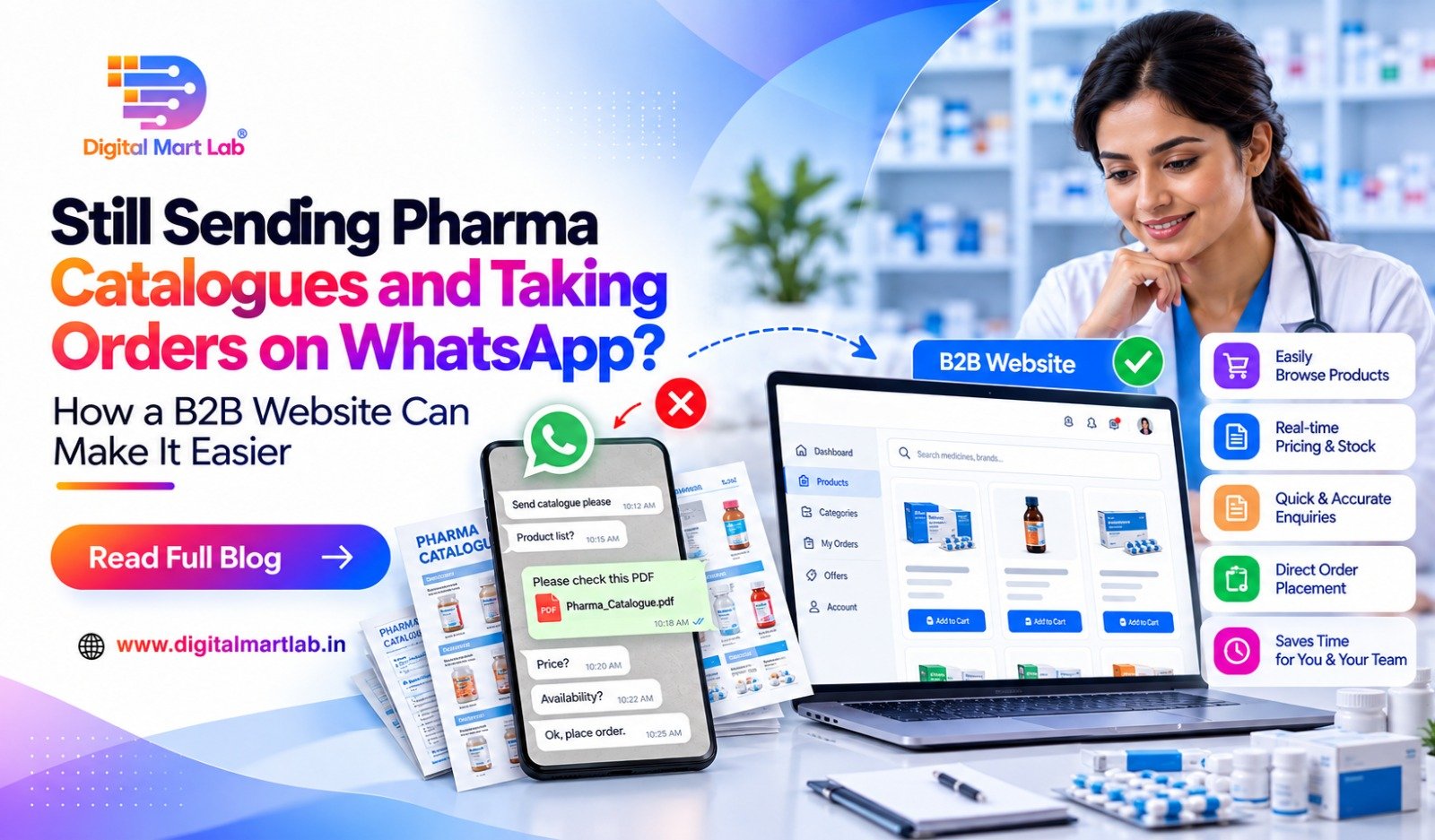
Still Sending Pharma Catalogues and Taking Orders on WhatsApp? How a B2B Website Can Make It Easier
“Please send the latest catalogue.”
“Is this product available?”
“Add ten more boxes to yesterday’s order.”
If your pharma business works with distributors or franchise partners, these messages may be part of your daily routine.
WhatsApp makes communication convenient. But when catalogues, product selections, quantities and changes sit across different chats, your team has more information to check before processing an order.
A distributor may refer to an old PDF. A salesperson may need to clarify a pack size. An extra quantity may arrive after the original request has already been forwarded.
A pharma B2B website can give your business customers one organised place to find current product information and submit clear order requests. Your team can then review availability, pricing and terms before confirming the order.
WhatsApp can remain part of the relationship. The website gives the product and ordering information a more consistent place to live.
When does taking orders on WhatsApp become difficult?
For a small number of customers and products, a simple catalogue and chat may be manageable.
As the portfolio and repeat business grow, familiar problems can appear:
- Different customers use different catalogue versions.
- Product names are typed in different ways.
- Quantities arrive without clear units or pack sizes.
- Changes are spread across several messages.
- Salespeople repeatedly answer the same product questions.
- Someone has to copy the final request into another record.
The difficulty is often the amount of checking needed to turn a conversation into an accurate order request.
Before changing your system, ask your team where that work occurs. Do they spend more time finding products, clarifying quantities, checking old prices or collecting changes?
Those answers should guide what you build.

What is a pharma B2B website?
A pharma B2B website serves business customers such as distributors, stockists, franchise partners or manufacturing buyers.
Depending on your requirements, it may include:
- An organised product catalogue.
- Search and category filters.
- Product and pack information.
- Access for approved business customers.
- Product selection and quantity fields.
- A structured order-request form.
It does not have to begin as a complete online store with immediate payment.
For many businesses, a useful first step is letting approved customers select products and send a request that the team checks before acceptance.
That distinction matters: an order request records what the buyer wants; an order confirmation records what your business has agreed to supply.
Start with a digital catalogue your team can keep current
Moving the same PDF onto a website may make it easier to download, but buyers still have to search through the document.
An organised digital catalogue lets them browse relevant categories and open individual product details.
Use a consistent product reference
Each catalogue item should have a clear identity. Depending on the product, useful information may include:
- Product name and internal code.
- Category or range.
- Approved product details.
- Dosage form, strength and pack size where applicable.
- A current product image.
- The unit used when requesting a quantity.
Your team should approve the information before it goes live.
A product code can be particularly useful when names or packaging look similar. It gives the customer, salesperson and order-processing team a common reference.
Make relevant ranges easy to find
A distributor interested in one range should not need to scroll through the entire portfolio.
Let customers browse the categories you actually offer and use straightforward search options.
For example, a buyer could open the relevant range, review a product and add it to a request from the same page.
The purpose is to make selection easier, especially for repeat customers who already know what they need.
Assign responsibility for updates
A digital catalogue still needs someone to maintain it.
Decide who approves new products, changes pack details and removes discontinued items. Update downloadable catalogues alongside website information if you continue offering both.
If stock information is not connected to a reliable source, do not display it as live availability. Explain that availability will be checked when the request is reviewed.
Did You Know? Orders based on outdated product files can create unnecessary confusion. A maintained B2B catalogue gives approved buyers one current reference and lets them submit selected products for your team’s confirmation.
Let distributors select products instead of typing every item
A structured request can collect the product reference, pack and quantity together.
This reduces the need to interpret a message such as “Send the same tablets, twenty boxes, and add the other syrup.”
The buyer still needs to check their selection, but the information reaches your team in a consistent format.
| Information | How the request should capture it |
| Product | Selected from the current catalogue |
| Product code | Carried into the request automatically |
| Pack size | Shown clearly beside the selected item |
| Quantity | Entered against that specific product |
| Ordering unit | Clearly labelled, such as boxes or bottles |
| Special request | Added in a separate notes field |
Show the unit wherever the customer enters a quantity. “20” alone is not enough if the buyer means boxes and the team reads it as individual packs.
Give buyers a review screen
Before submission, show the complete selection so the buyer can check products and quantities.
For approved repeat customers, a saved list or previous-request feature may be useful. Any reused selection should still be checked against the current catalogue and applicable terms.
Keep changes attached to the original request
Once submitted, give the request a reference number.
If the buyer needs to make a change, direct them to quote that reference or use an agreed amendment process.
This helps your team distinguish the original selection from the latest instruction.
Did You Know? Repeat distributor orders can become time-consuming when every item is typed into WhatsApp. A B2B portal can collect product selections and quantities, leaving your team to verify availability and approve commercial terms.
Keep pricing and order confirmation under your team’s control
You do not have to publish every commercial detail openly to make the website useful.
Some businesses may show product information publicly and reserve ordering features for approved customers. Others may offer customer-specific access where the project supports it.
Choose the approach that matches how your business actually works.
Decide what the customer can see
Before development, agree whether customers should see:
- Product information only.
- Indicative information requiring confirmation.
- Approved customer-specific prices.
- Availability information from a maintained source.
If different customers have different terms, the website must handle those differences correctly. A general price should not accidentally appear to be an agreed customer rate.
Explain what happens after submission
Use clear wording such as:
“Your order request has been received. Our team will check availability and applicable commercial details before confirming acceptance.”
The team may need to check quantities, pricing, payment terms, delivery details and any relevant account requirements.
Avoid using “Order confirmed” as an automatic message if those checks have not happened.
Keep WhatsApp useful with more relevant messages
A B2B website does not remove the need for conversation. Distributors may still want to ask a question, discuss a change or speak with their contact person.
WhatsApp can direct them to the relevant information instead of carrying every part of the process.
For example, a message can link to:
- The product range the customer is interested in.
- An updated catalogue section.
- The approved customer login.
- A specific product page.
Illustrative example: A distributor has asked for updates about a particular range. With their permission, your team sends a short message linking to that range’s updated page.
The buyer can review the information and select products without receiving another unrelated full catalogue.
Relevant updates should reflect the customer’s stated interests and contact preferences. Provide a way to stop promotional messages.
This is one practical use of AI-enabled marketing and automation: helping organise approved information and appropriate follow-ups around the customer’s requirements.
Give manufacturing buyers a separate enquiry process
A manufacturing enquiry is different from a distributor selecting products for repeat supply.
The buyer may need to discuss a formulation, dosage form, quantity and packaging before a quotation can be prepared.
Use a separate form or conversation flow to collect:
- The product requirement.
- Dosage form.
- Estimated quantity and unit.
- Packaging preference, if known.
- Contact and company details.
A simple WhatsApp flow can also collect these opening details before passing the conversation to a person.
Allow buyers to say that a detail is undecided. The purpose is to prepare the discussion, not to assume that every submitted requirement is technically or commercially suitable.
Your team should review feasibility and confirm terms separately.
What should happen after an order request arrives?
The website is only useful if someone receives and handles the request.
A practical process is:
- The customer submits the selected products and quantities.
- The system records the request and sends an acknowledgement.
- The assigned employee reviews the details.
- The team clarifies anything missing and confirms the applicable offer.
- The accepted order moves into the agreed processing system.
Decide where the record will be maintained. It may begin in a shared system your team already uses, with further integration added where worthwhile.
Do not assume the website automatically updates accounting software, stock records or invoices. Those connections need to be planned and tested as part of the project.
Start with the features your business needs now
You may not need a large portal immediately.
| Current problem | Useful starting feature |
| Customers cannot find relevant products | Organised catalogue with search and categories |
| Buyers refer to outdated files | Maintained product pages and consistent downloads |
| Requests arrive without clear quantities | Product selection with labelled units |
| Commercial information needs restricted access | Approved customer accounts |
| Changes are scattered across chats | Request references and an amendment process |
| The team answers the same opening questions | Clear page content and a guided enquiry form |
Start with the problems causing the most repeated work.
A larger system may become useful later, but the first version should be manageable for your customers and staff.
If you are unsure where to begin, discuss your catalogue and website requirements with Digital Mart Lab. Bring your current catalogue and explain how your team receives and confirms requests today.

How Digital Mart Lab can help build your pharma B2B website
Digital Mart Lab can help translate your current process into a website that makes product selection and business enquiries easier.
The proposed work can include:
- Planning product categories and catalogue pages.
- Organising approved product information.
- Building mobile-friendly product selection and request forms.
- Setting up approved-customer access where required.
- Providing clear acknowledgements and team notifications.
- Connecting agreed systems where the project requires it.
- Explaining how your team will maintain the information.
Through website design and development services, the catalogue, customer experience and request process can be planned together.
For public pages intended to help new business buyers discover your offering, SEO services can support useful page content and search accessibility. Private customer details and restricted commercial pages should remain protected.
The project should define what the website does, what your team confirms and who maintains each part.
How to check whether the new process is helping
Compare the work involved before and after customers start using the website.
Look at:
- How often staff need to resend catalogues.
- How many requests arrive with missing product or quantity details.
- How much clarification is needed before confirmation.
- Whether customers can find and select products successfully.
- Whether staff and customers continue using the process.
Do not judge success only by account registrations.
A portal that customers rarely use may need clearer instructions, fewer steps or better product information.
Ask a small group of regular customers to try the process and explain where they get stuck. Their feedback can reveal practical problems before a wider rollout.
Frequently asked questions about pharma B2B websites
1. Do we have to stop taking requests on WhatsApp?
No. WhatsApp can remain a contact option. The website gives customers a more organised way to find products and submit details, while your team can still assist those who need help.
2. Can we start with a digital catalogue without online payment?
Yes. Customers can browse products and submit a request for your team to review. Payment features can be considered separately if they fit your process.
3. Can different distributors see different prices?
That can be built where required. It needs approved customer accounts, accurate pricing rules and maintenance. Define the requirement before development rather than assuming it is included.
4. Will the website show live stock automatically?
Only if it is connected to a reliable, maintained source. Otherwise, use wording that makes availability subject to confirmation.
5. Can manufacturing enquiries use the same ordering process?
They usually need a separate enquiry route because specifications, quantities and packaging require review. A structured form can collect the starting details without treating the submission as an accepted order.
6. Who will update the catalogue after launch?
Assign an authorised person or team to maintain it. Agree on training, access and any ongoing support when planning the website. An organised catalogue depends on accurate updates.
Give your distributors one clear place to find products and send requests
Your team should be able to spend more time helping customers and less time piecing together product lists from separate messages.
A pharma B2B website can provide a current catalogue, clear product selections and structured requests. Your team keeps responsibility for checking the details and confirming the order.
Want to make catalogue sharing and distributor order requests easier?
Discuss Your Pharma B2B Website with Digital Mart Lab
Share your current catalogue and explain how your team handles requests today. We can use that process to identify the website features your business actually needs.
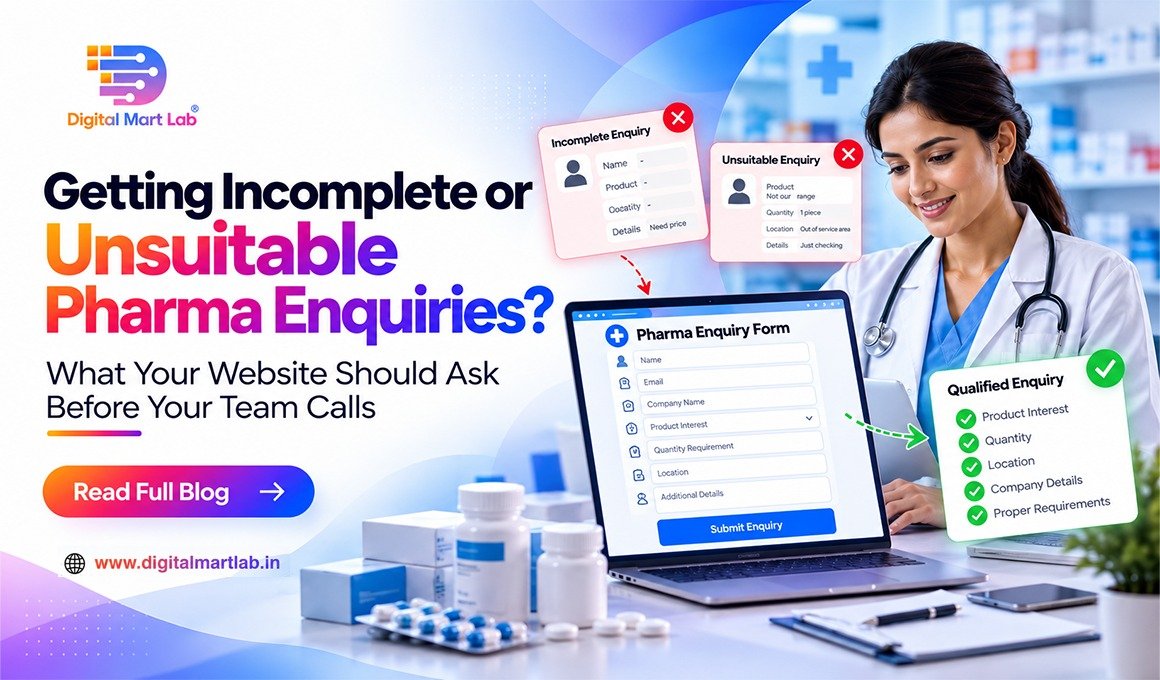
Getting Incomplete or Unsuitable Pharma Enquiries? What Your Website Should Ask Before Your Team Calls
Your salesperson opens a new enquiry. There is a name, a phone number and one message: “Send details.”
But details about what?
A PCD franchise? A distribution opportunity? Third-party manufacturing?
Your team calls to find out. The first few minutes go into basic questions. Sometimes the buyer wants a district you cannot offer. Sometimes the manufacturing quantity does not fit your order requirements. Other times, the buyer is interested but has not yet decided what they need.
These situations require different responses.
Well-planned pharma enquiry forms help your team understand the buyer’s requirement before calling. They collect enough information to prepare for a useful conversation while giving uncertain buyers a way to ask for guidance.
The aim is to ask the right questions at the right stage.

An incomplete enquiry is not always an unsuitable enquiry
A manufacturing buyer who has not mentioned quantity may still have a relevant requirement. A franchise applicant who has not selected a range may need help choosing one.
Missing information tells you that something needs clarification. It does not automatically tell you that the opportunity is poor.
An unsuitable enquiry is different. It may involve a capability your business does not provide or a confirmed requirement you cannot commercially support.
| Enquiry received | What it tells your team | Useful next step |
| “I need tablet manufacturing.” | The general requirement is known, but important details are missing. | Ask for the product requirement and approximate quantity. |
| “I want a franchise but have not selected a range.” | The person needs more information before deciding. | Ask about the preferred territory and explain relevant ranges. |
| A request for a dosage form you do not support | There is a clear capability mismatch. | Explain the limitation instead of preparing an unsuitable quotation. |
| A request for an unavailable district | The stated territory does not currently fit. | Confirm the position and ask whether another territory is relevant. |
This distinction helps your team avoid two mistakes: spending too long on confirmed mismatches and dismissing buyers who simply need clarification.
Start by asking what the buyer wants to discuss
A general contact form can mix franchise applicants, manufacturing buyers, existing customers and job seekers in the same inbox.
Begin with a simple question:
“What would you like to enquire about?”
Offer choices that reflect your actual business, such as:
- PCD franchise.
- Distribution or stockist opportunity.
- Third-party manufacturing.
- Existing order or support.
- Other enquiry.
The next questions should change according to the selection. Someone interested in a franchise should not have to answer manufacturing questions.
If your website already has separate franchise and manufacturing pages, each can have its own relevant form.
A clear starting point makes the form easier to complete and helps the enquiry reach the right person.
What should a PCD franchise enquiry form ask?
Your team needs enough context to discuss the opportunity. It does not need a complete application before making the first call.
Preferred business district and state
Ask where the applicant wants to operate.
Use a clear label:
“Which district and state are you interested in?”
This is more useful than asking only for the person’s current city. Someone living in Delhi may be exploring a franchise opportunity in Uttar Pradesh.
The answer helps your team prepare a territory discussion. It does not confirm availability or grant rights.
Product range of interest
Ask which range the prospect wants to discuss, using categories your company actually offers.
Include “Not decided—need guidance” as an option.
A new applicant may not know which range suits their plans. Forcing them to select something can give your salesperson misleading information.
If the enquiry comes from a page about a specific range, carry that information into the submission so the buyer does not have to repeat it.
Expected starting timeline
A simple timeline question helps your team understand the stage of the enquiry.
Possible answers include:
- As soon as the requirements are agreed.
- Within the next few months.
- Still exploring options.
Treat this as the buyer’s current plan, not a commitment. Someone researching today may still become a suitable partner later.
Starting a new business or expanding an existing one
This question helps your salesperson choose the right explanation.
A first-time applicant may need to understand the partnership process and responsibilities. An established distributor may want to discuss how your range fits their existing business.
Experience alone should not decide whether someone deserves a call.
Did You Know? Collecting only a phone number leaves your callers without franchise context. Questions about the preferred district, range and starting timeline can help your team begin with a more useful conversation.
What should a third-party manufacturing enquiry form ask?
Manufacturing enquiries need a different starting point. Your team must understand what the buyer wants produced before discussing suitability.
Product requirement and dosage form
Ask the buyer to describe the product requirement and identify the relevant dosage form.
A short text field lets them explain what they need in their own words. A separate dosage-form selection can help direct the enquiry.
Do not use the form to suggest that every submitted requirement is automatically supported.
Approximate quantity with a clear unit
“Quantity: 1,000” is incomplete if your team does not know whether the buyer means tablets, strips, boxes or bottles.
Ask for an estimated quantity and unit.
For example:
“What quantity are you considering? Please mention the unit, such as tablets, bottles or boxes, and the pack size if known.”
Where buyers are unsure, let them request guidance. Your team can then clarify the requirement before discussing feasibility.
Packaging preference, if known
Packaging can be important to the discussion, but it may not be decided at the first enquiry.
Provide a short field for the preference and an option such as “Need to discuss packaging.”
Do not require a detailed specification from someone who is still evaluating options.
Business name and contact details
Ask for a contact person and a reliable way to reach them. A business name and email address can also help with quotation-related communication.
Avoid requiring the same information repeatedly across different fields.
Expected timeline
Ask when the buyer would like to move forward, while making clear that the team must review the requirement.
A requested date helps prepare the discussion. It should not be treated as a confirmed production or delivery commitment.
A practical starting structure for pharma enquiry forms
Use the table below as a starting point. Adjust required fields to the information your team genuinely needs before calling.
| Franchise or distributor enquiry | Manufacturing enquiry |
| Contact name and number | Contact name and number |
| Preferred district and state | Product requirement and dosage form |
| Range of interest, including “Need guidance” | Estimated quantity and unit, including “Need guidance” |
| Expected starting timeline | Packaging preference, if known |
| New or existing business | Business name and email |
| Optional question or callback preference | Expected timeline and optional requirement notes |
Do not make every field compulsory simply because it may be useful later.
Begin with a manageable form. Review whether each question helps your salesperson prepare or merely adds another step for the visitor.
Explain order requirements before the buyer submits the form
If your manufacturing business has verified order requirements, explain the relevant ones near the enquiry form.
A buyer should not have to complete a long discussion before learning that the quantity they need cannot be supported.
However, avoid publishing one general minimum order quantity if it varies by product, dosage form or packaging.
A useful explanation could be:
“Order requirements depend on the product and packaging. Share your estimated quantity so our team can review the requirement and explain the applicable terms.”
Where a specific minimum is confirmed and current, state it with the correct unit and scope.
Your advertisement, landing page and salesperson should communicate the same information. This is one reason to review campaign messaging and lead generation alongside your website forms.
Keep requirements up to date
Assign someone to review published quantities, supported capabilities and relevant conditions.
Outdated information can discourage a suitable buyer or create an expectation your team cannot meet.
Clear requirements are useful only when they accurately represent the offer.
When should your team ask for missing information?
Ask for the information needed to decide the next step. Avoid sending a long questionnaire when one answer would move the discussion forward.
Illustrative example: A buyer submits “Need capsule manufacturing” with a phone number but no quantity.
A useful follow-up could be:
“Thank you for your enquiry. Could you share the product requirement and approximate quantity you are considering? If the quantity is not decided, let us know and our team can discuss the options with you.”
This gives the buyer a clear question and room to explain uncertainty.
For a franchise enquiry missing the territory, the next question might simply be:
“Which district and state would you like to discuss for the franchise opportunity?”
Did You Know? A manufacturing enquiry missing its quantity may need clarification rather than rejection. Asking for the missing detail helps your team assess the requirement with better information.
Ask technical follow-up questions when the team is ready to use the answers
Detailed specifications, artwork and further documentation may become necessary later. Explain why they are needed when that stage arrives.
The first enquiry form should open a useful conversation. Further questions should support the next business decision.
Make sure the website passes the answers to your salesperson
Collecting useful details achieves little if the caller sees only a phone number.
The enquiry notification or shared lead record should include the buyer’s answers and the page or range they enquired about.
Before calling, the salesperson should be able to see:
- What the buyer wants to discuss.
- Which details are already available.
- What still needs clarification.
- Whether another team member has contacted them.
This helps avoid asking the same questions again and gives the buyer a more consistent experience.
If you use an AI assistant or enquiry automation, it can help collect missing details and prepare a summary. It should use approved information and pass uncertain commercial or technical questions to a person.
The team remains responsible for confirming suitability.

How to tell whether your new enquiry form is helping
Do not judge the form only by the number of submissions.
A longer form may collect more details while discouraging useful enquiries. A shorter form may be easy to complete but leave your team with too much clarification work.
Review both the buyer experience and the sales outcome.
| Measure | What it helps you assess |
| Form completion | Whether visitors can finish the enquiry process |
| Useful details received | Whether answers help the team prepare |
| Clarification needed | Which questions remain unanswered or confusing |
| Relevant conversations | Whether the enquiries fit what your business can potentially serve |
| Progress to the next step | Whether discussions move towards territory review, requirement assessment or quotation |
Ask your salespeople which fields they actually use. If an answer never affects the conversation, consider whether it belongs on the initial form.
Test changes gradually so you can understand what helped.
How Digital Mart Lab can improve your pharma enquiry process
Digital Mart Lab can help plan your website around the information your buyers need and the questions your sales team must answer.
Through website design and development, the work can include:
- Separate enquiry forms for franchise and manufacturing buyers.
- Clear field labels and relevant answer options.
- Simple explanations of order and territory review requirements.
- Mobile-friendly layouts and useful confirmation messages.
- Delivery of enquiry details to the responsible team.
- Agreed tracking to review completed enquiries.
The process should begin with your current enquiries. Identify the details that are repeatedly missing and the questions that delay the first useful conversation.
For businesses also attracting visitors through search, SEO services can help align website content with the business requirements you serve.
The goal is a clearer connection between your offer, the buyer’s enquiry and the conversation your team needs to have.
Frequently asked questions about pharma enquiry forms
1. How many questions should a pharma enquiry form include?
There is no single number that suits every business. Ask for the details needed to prepare the first conversation. Keep further questions for the stage when your team needs those answers.
2. Should we reject a manufacturing enquiry without a quantity?
Not automatically. Ask whether the buyer has an estimate or needs guidance. Once the quantity and other requirements are clearer, your team can assess suitability.
3. Should budget be compulsory on a franchise enquiry form?
Only if it is genuinely necessary at that stage. If you ask, explain what the figure refers to and allow for buyers who need a discussion. A budget answer alone does not establish suitability.
4. Can franchise and manufacturing buyers use one form?
Yes, if the form first identifies the enquiry type and then shows relevant questions. Separate forms may be clearer when the website already has distinct pages for each service.
5. Should minimum order quantities appear on the website?
Publish accurate requirements when they help buyers assess fit. If minimums vary, explain the factors involved and ask for the details your team needs to confirm the applicable requirement.
6. Can an AI agent decide which pharma leads are suitable?
It can help collect information and organise enquiries for review. Your team should confirm technical and commercial suitability, especially when requirements are incomplete or uncertain.
Give your team a clearer starting point for every call
A phone number lets your team make contact. The right enquiry details help them prepare.
When your website asks relevant questions, explains important requirements and gives buyers room to request guidance, the first call can begin with a useful discussion.
Want your pharma website to collect clearer business enquiries?
Discuss Your Pharma Website Enquiry Forms with Digital Mart Lab
Share your current form and the questions your team repeatedly asks on calls. We can use them to plan a simpler enquiry process that gives your salespeople better information from the start.
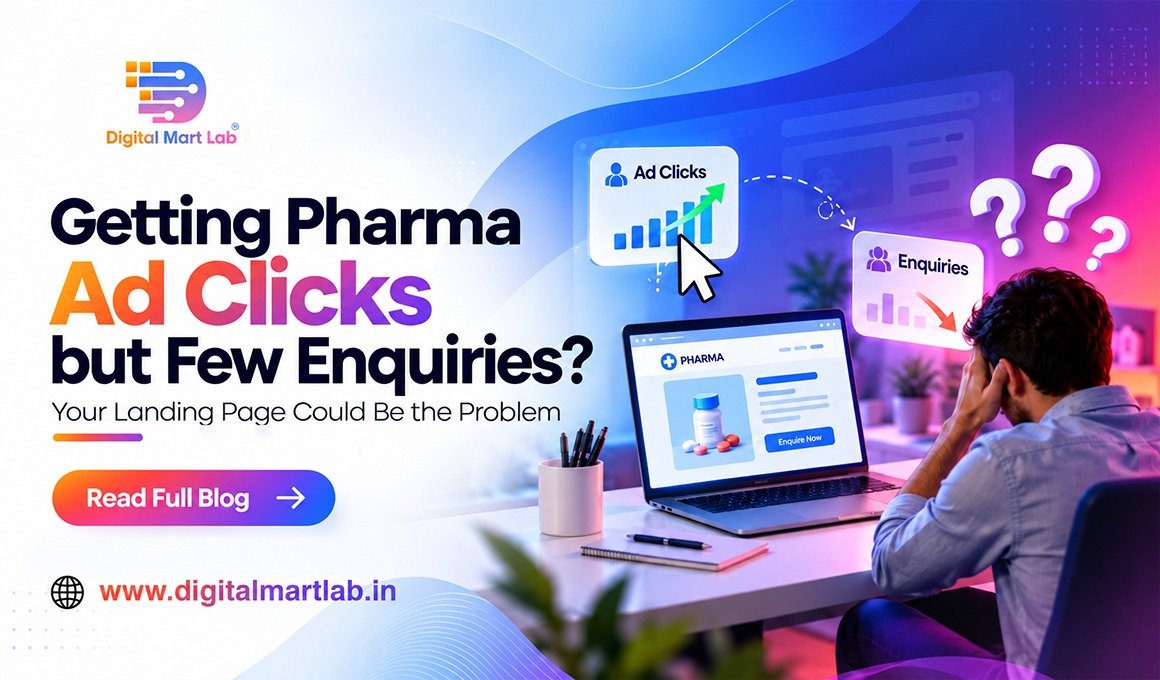
Getting Pharma Ad Clicks but Few Enquiries? Your Landing Page Could Be the Problem
Your advertisements are getting clicks. People are visiting your website. But your phone is quiet, and the enquiries are fewer than you expected.
It is tempting to increase the budget or change the advertisement immediately. Before you do, check what happens after someone clicks.
Does the visitor find the product range or manufacturing service they were interested in? Can they understand your offer? Is it easy to ask a question?
Effective pharma landing pages continue the message in the advertisement and make the next step clear. If the advertisement promises one thing and the page opens with something general, the visitor has to search again.
Some buyers will make that effort. Others may leave before speaking with your team.
What is a pharma landing page?
A landing page is the page someone reaches after clicking your advertisement.
For a focused campaign, it should explain the specific offer that attracted the click. That could be a derma franchise opportunity, capsule manufacturing or another range or capability your business provides.
Your homepage introduces the wider company. A campaign landing page helps a particular buyer assess a particular requirement.
For example, someone clicking an advertisement about capsule manufacturing should quickly find relevant capability information and a way to share their requirement.
They should not have to search through franchise offers and unrelated product categories first.
Why ad clicks may not turn into enquiries
A click shows that something attracted attention. It does not tell you whether the visitor understood the offer, found a suitable match or decided to contact you.
Your landing page may lose that interest when:
- The headline does not match the advertisement.
- Relevant range or capability information is difficult to find.
- The page makes broad claims without useful details.
- The enquiry form asks too much too early.
- Buttons or forms do not work properly.
- The page is difficult to read or use on a phone.
The landing page is not always the only problem. Irrelevant traffic, unclear advertising or an unsuitable offer can also reduce enquiries.
Start by checking the complete journey: advertisement → page → enquiry → sales conversation.
First, confirm that enquiries are actually being received
Before rewriting the page, submit a test enquiry.
Check whether the form confirms submission, the message reaches the right person and any notification works. Test the call and WhatsApp buttons too.
Then compare your advertising report with actual form submissions, calls and messages. A reporting problem can make enquiries appear missing, while a delivery problem can prevent your team from receiving them.
Fix these issues before judging the content.
Make the landing page match the advertised offer
The visitor should recognise the offer immediately after the page opens.
If your advertisement mentions a derma franchise, the headline should explain that opportunity. If it promotes a manufacturing capability, the page should introduce that capability.
This does not mean copying the advertisement word for word. It means continuing the same conversation.
| Advertisement focus | What the visitor should find on the page |
| Derma PCD franchise | Relevant range information, actual partner support and a territory enquiry option |
| Capsule manufacturing | Supported capability details, information needed for review and a manufacturing enquiry form |
| A specific packaging capability | Accurate information about the supported format and how to discuss the requirement |
| Distributor opportunity for a particular range | Portfolio details, intended partnership and a clear business enquiry option |
Each page should reflect what the company actually offers.
Did You Know? Paying for a capsule-manufacturing click and sending the buyer to a general homepage creates an extra step. A matching landing page helps them assess the relevant capability and submit a clearer requirement.
Example: a franchise advertisement opening a general homepage
Imagine a buyer clicks an advertisement for a derma franchise.
The page opens with “Welcome to Our Pharma Company,” followed by a long company introduction and a catalogue covering every range.
The information may be accurate, but the visitor still needs to find the offer that interested them.
A more useful page would begin with the derma franchise opportunity, introduce the relevant portfolio and explain how to discuss territory and partnership details.
The company introduction can support that offer further down the page.
Give one clear offer enough space to be understood
A manufacturing advertisement covering tablets, capsules, liquids, ointments, packaging, franchise opportunities and exports may leave the buyer unsure what the message is about.
The same problem can continue on the landing page.
For a campaign built around one capability or range, keep that subject prominent. Include related information where it helps the buyer assess the offer.
A focused page does not need to hide the wider company. It should simply make the advertised requirement easy to understand first.
For a PCD franchise landing page
Answer the questions a potential partner is likely to bring:
- Which range is being offered?
- What information is available about the portfolio?
- What support does the company actually provide?
- How are territory requests reviewed?
- What should the applicant share to begin the discussion?
Do not imply that a district is available before your team has checked it.
For a manufacturing landing page
Explain the capability and what is needed to assess a request:
- Which dosage forms or relevant formats are supported?
- What product and packaging details should the buyer provide?
- Are there verified order requirements they should know?
- How does the requirement move towards a quotation discussion?
Where feasibility depends on specifications, explain that your team will review the details.
This helps buyers prepare a useful enquiry without treating the page as an automatic technical approval.
Explain what the photograph means for the buyer
A machine photograph may look impressive, but it cannot explain the manufacturing offer by itself.
The buyer still needs to understand what the equipment or facility image is showing and how it relates to their requirement.
Use genuine, authorised images with accurate explanations. Connect the visual to a supported capability, rather than expecting the buyer to make that connection.
For a franchise page, product images should also have a purpose. Show the relevant range with readable information instead of filling the page with unrelated boxes.
Illustrative example: A capsule-manufacturing advertisement uses a facility photograph. The destination page explains the relevant capability, identifies the information needed for a review and provides a requirement form.
The image now supports a business explanation. It is no longer carrying the whole message.
Did You Know? A machine photograph cannot explain your manufacturing offer on its own. Clear wording about the supported requirement helps buyers understand why the capability may be relevant to them.
What should appear at the top of the landing page?
The first visible part of the page should help visitors answer three questions:
Am I in the right place? What can I discuss here? What should I do next?
A practical starting layout includes:
- A headline matching the advertised offer.
- A short explanation of the relevant range or capability.
- An appropriate image.
- A clear enquiry button.
- A concise, factual reason to consider the company.
Avoid placing a long company history before the offer.
Example headline for a franchise page
“Explore Our Derma PCD Franchise Range”
Supporting text:
“Review our available range and speak with our team about your preferred district, partnership requirements and support.”
Button:
“Discuss Your Preferred Territory”
Example headline for a manufacturing page
“Discuss Your Capsule Manufacturing Requirement”
Supporting text:
“Share your product requirement, estimated quantity and packaging preference so our team can review suitability.”
Button:
“Send Your Manufacturing Requirement”
These are sample wording options. Use them only where they accurately represent the business.
If your campaign page makes the offer difficult to understand, Digital Mart Lab’s website design and development services can help organise the content and enquiry process around the buyer’s requirement.
Make the enquiry form useful and easy to complete
The form should collect enough information to start a worthwhile conversation.
For a franchise enquiry, that may include a name, contact number, preferred district and range of interest.
For a manufacturing enquiry, it may include company details, product requirement, estimated quantity and packaging preference.
Avoid demanding every possible detail at the first step. Allow buyers to indicate that something is undecided.
Someone unsure about packaging may still have a relevant manufacturing requirement. Your team can clarify it during the conversation.
Explain what happens after submission
A simple note can reduce uncertainty:
“Share your requirement. Our team will review the details and contact you to discuss the next steps.”
Only promise a response time if your team can consistently meet it.
The confirmation message should also tell the visitor that the enquiry was received. Behind the page, assign responsibility so it does not remain unattended.
Use WhatsApp with enough context
Where WhatsApp is an appropriate enquiry option, help the buyer start with a relevant message.
For example:
“Hello, I would like to discuss your derma franchise range for my preferred district.”
This gives the conversation a clearer starting point than a message saying only “Hi.”
Use a verified business number and test the link on a phone before publishing.
Check the mobile experience before increasing spending
Open the landing page on your phone using an ordinary mobile connection.
Can you read the headline without zooming? Does the main image delay access to the content? Can you use the form comfortably? Does a popup cover the enquiry button?
Check the full journey, including error messages and the confirmation screen.
Prioritise readable text, suitable image sizes and working buttons. Remove unnecessary elements that get in the way of understanding the offer.
A page that looks good on a large desktop screen may still be difficult to use during a quick mobile visit.
Measure useful enquiries, not just button clicks
A button click does not always become a completed enquiry. A completed enquiry does not always match your business.
Track these stages separately:
| Stage | What to review |
| Page visit | Did the visitor reach the intended campaign page? |
| Enquiry action | Did they submit a form, call or start a conversation? |
| Relevant requirement | Does the enquiry concern a range, territory or capability you can potentially support? |
| Sales progress | Did it move to a useful discussion, requirement review or quotation? |
For a basic page enquiry rate, divide completed enquiries by visits to the same page over the same period. Keep the definitions consistent and avoid counting one person repeatedly across channels.
Review sales feedback alongside the numbers. A page generating fewer but more suitable requirements may be more useful than one collecting many unrelated phone numbers.

How Digital Mart Lab can help improve pharma landing pages
Digital Mart Lab can review the advertisement and the page together to identify where the buyer’s journey becomes unclear.
The work can include:
- Matching the headline and page content to the advertised offer.
- Planning separate pages for relevant ranges or capabilities.
- Writing clear descriptions and enquiry instructions.
- Improving mobile layouts and forms.
- Setting up agreed enquiry tracking.
- Using sales feedback to guide further changes.
Through performance marketing services, campaign messaging and landing-page decisions can be reviewed together. The aim is to improve the connection between the people clicking and the business requirements your team can serve.
Where a page is also intended to attract relevant organic searches, SEO services can support its content and technical setup.
For businesses receiving repeated questions, AI-enabled marketing and automation may help collect initial details and pass them to a salesperson. Any assistant should use approved information and refer uncertain technical or commercial questions to the team.
The required pages, tracking and integrations should be agreed around your campaign and sales process.
Frequently asked questions about pharma landing pages
1. Should every pharma advertisement lead to a separate page?
Not necessarily. Advertisements promoting the same offer to similar buyers may use one page. Separate pages become useful when the range, capability or buyer requirement is meaningfully different.
2. Can we use our homepage for advertising?
Yes, if it clearly answers the visitor’s requirement. For a specific range or manufacturing campaign, a focused page may make the relevant information easier to find.
3. Should we use a form or a WhatsApp button?
Choose the option your buyers can use comfortably and your team can manage properly. A form can collect structured details. WhatsApp can support a conversation. If you offer both, explain the next step clearly and avoid losing context between them.
4. Should we mention minimum order quantities?
Include accurate, relevant requirements when they help buyers assess suitability. If quantities depend on the product or packaging, explain that rather than publishing one figure that may be misleading.
5. How do we know whether the problem is the advertisement or the landing page?
Review the message, incoming traffic, page experience and sales feedback together. Irrelevant visitors may point towards targeting or messaging problems. Relevant visitors who struggle to find information or submit a form may indicate page issues.
6. Will a new landing page guarantee more enquiries?
No. Results also depend on the audience, offer, campaign setup and buyer interest. A clearer page removes avoidable confusion and gives suitable visitors a better opportunity to contact your team.
Help the buyer continue the conversation they clicked for
Your advertisement creates the initial interest. The landing page needs to explain the offer and make the next step easy.
Before increasing your budget, open the page your advertisement leads to. Check whether a buyer can quickly find the promised range or capability, understand its relevance and submit a useful enquiry.
Getting clicks but too few meaningful pharma enquiries?
Discuss Your Pharma Landing Page with Digital Mart Lab
Share your advertisement, its destination page and the questions your sales team receives. We can use them to identify where the message, information or enquiry process needs improvement.
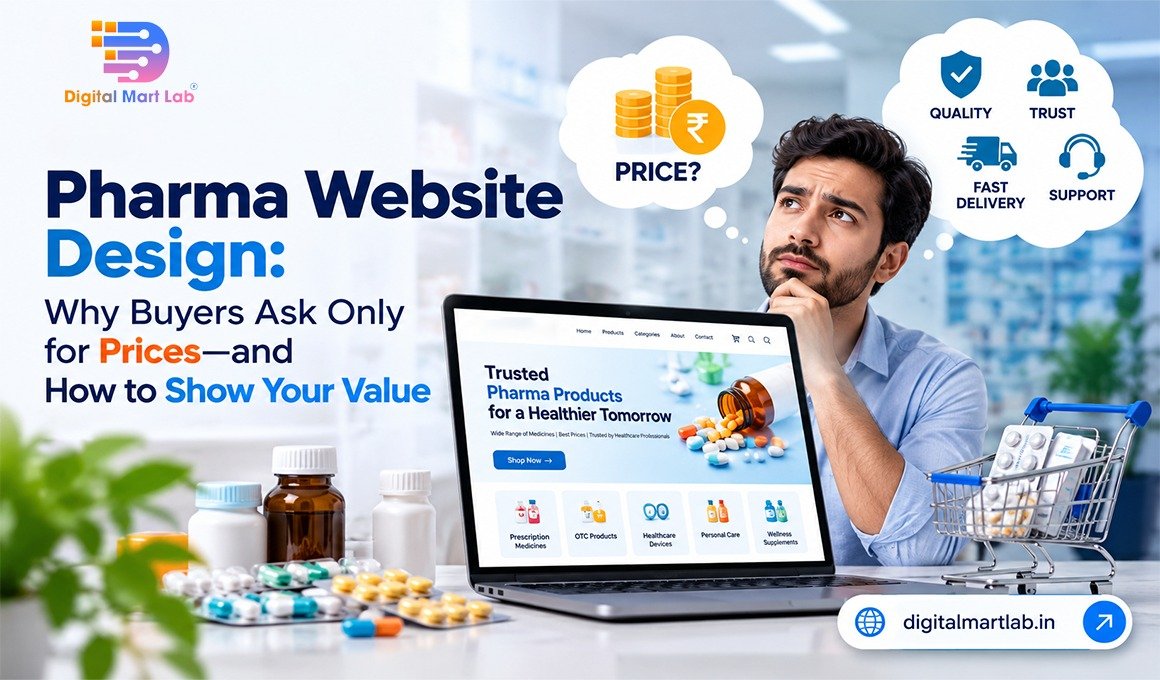
Pharma Website Design: Why Buyers Ask Only for Prices — and How to Show Your Value
If you run a PCD pharma company, you have probably heard this many times. Your team shares the catalogue and price list. Then comes another question: “Can you reduce the price?”
But did the buyer understand anything about your company beyond your rates?
They may not know what support you provide, which ranges suit their business or how your partnership process works. If your website does not explain these things, your salesperson has to introduce them in every conversation.
Good pharma website design brings your product information, actual strengths and enquiry process together so buyers can understand your offer before they call. It gives them more to discuss than price alone.
The starting point is understanding what your buyers need to know.
Why do pharma buyers compare only prices?
Price is a valid concern. A distributor needs workable margins. A franchise applicant needs to understand the investment. A manufacturing buyer needs a quotation that fits the requirement.
However, your website may unintentionally make price the main comparison.
Imagine a buyer visiting three pharma websites. All three promise “quality products,” “competitive prices” and “complete support.” Each displays product boxes and a catalogue download button.
How does the buyer tell them apart?
Your company may offer useful range-selection guidance, a clear ordering process or dependable partner communication. But if those strengths are missing from the website, buyers have little information to assess them.
Better communication helps a prospect decide whether your company deserves a detailed discussion.
It can also help your team identify the real objection. Once buyers understand the offer, their remaining concern may be price, availability, territory or another issue that needs a commercial discussion.

What should your pharma website explain before buyers ask for rates?
1. What your company does and whom you serve
A visitor should quickly understand whether you offer PCD franchise opportunities, seek distributors, provide third-party manufacturing or work across several of these areas.
Avoid making your introduction so broad that it could describe any pharma company.
“We offer complete pharmaceutical solutions” gives little direction.
For a company with the relevant offering, a clearer introduction would be:
“We work with franchise partners and distributors looking to expand their pharma product range. Explore our portfolio and speak with our team about your preferred territory and partnership requirements.”
The wording must reflect your actual business. If you are a marketing company working with manufacturing partners, describe that arrangement accurately.
2. Which product ranges match the buyer’s requirement
A complete catalogue is useful, but visitors should also be able to explore relevant ranges without opening a large file.
A prospect interested in a derma franchise should be able to find your derma range easily. An established distributor exploring another category should be able to see whether you offer it.
Organise your website around the ranges you actually supply. Use current product information and provide the relevant catalogue alongside each section.
This gives your salesperson a useful opening question: “Which products from this range are you considering?”
It also avoids sending every prospect a full catalogue when only one part is relevant.
3. What partner support actually includes
“Complete support” sounds positive, but it leaves the buyer to guess what is included.
Explain your support in practical terms. Depending on your business, this might include:
- Guidance on selecting an initial product range.
- Approved promotional materials.
- Assistance with the ordering process.
- A contact person for order-related questions.
- Updates about relevant additions to your portfolio.
Describe what you provide and any applicable conditions. If certain assistance is available only under a particular arrangement, explain that clearly.
Did You Know? Your product range may be strong, but your website may not explain why a distributor should choose you. Clear information about your range, actual support and partnership process gives buyers more to assess before the discussion becomes only about price.
4. What happens after the first enquiry
A new applicant may hesitate because they do not know what happens after requesting the price list.
Explain the steps in simple language. For example:
- Share your preferred district and product range.
- Discuss suitability and availability with the team.
- Review the commercial terms and responsibilities.
- Complete the agreed requirements before placing an order.
Use your company’s actual process. Explain how territory requests are assessed rather than allowing visitors to assume that an enquiry confirms availability.
A clear process helps the buyer prepare and reduces repeated basic questions for your team.
Replace broad claims with useful pharma website content
You do not need complicated language to make your website persuasive. You need specific information.
The examples below show how familiar statements can become more useful. Adapt them to your actual offering.
| Common website statement | A clearer explanation |
| “Wide product range” | “Browse our available product categories and request the catalogue relevant to your business.” |
| “Complete promotional support” | “Our team will explain the promotional materials available under your partnership arrangement.” |
| “Monopoly franchise available” | “Share your preferred district so we can check availability and discuss the applicable territory terms.” |
| “Third-party manufacturing services” | “Send your required dosage form, estimated quantity and packaging preference for review.” |
| “Excellent customer support” | “Contact the assigned team member with your order reference so your query reaches the right person.” |
These explanations give buyers something concrete to discuss.
They also make it easier for your salesperson to share a relevant page instead of typing the same explanation repeatedly.
Give different pharma buyers the information they need
A franchise applicant and a manufacturing buyer arrive with different questions. Your website should help each find the right information.
Separate pages within the same website can provide that clarity.
PCD franchise applicants
Explain your ranges, actual partner support, territory review process and steps for getting started.
A useful enquiry button is “Discuss Your Preferred Territory.”
A first-time applicant may need an explanation of partner responsibilities. Someone already running a pharma business may prefer to move directly to the range and commercial discussion.
Allow both to find what they need.
Distributors and stockists
An established distributor may want to understand how your portfolio fits their existing business.
Provide relevant range information, explain how to discuss ordering arrangements and ask about their current coverage.
A useful enquiry button is “Enquire About Distribution.”
Their questions may differ from those of a new franchise applicant. The page should recognise those differences.
Third-party manufacturing buyers
Explain the capabilities you actually offer, the information needed to review a requirement and how the quotation discussion begins.
A useful enquiry button is “Share Your Manufacturing Requirement.”
Ask for the product requirement, estimated quantity and packaging preference. If the buyer has not decided something yet, allow them to say so.
An incomplete requirement may need a helpful follow-up question rather than immediate rejection.
Did You Know? An established stockist and a first-time distributor may need different information before enquiring. Relevant messages and website pages help each understand the opportunity that fits their business.
Show your business strengths with real details
Buyers need reasons to believe what your website says.
Use accurate company information, genuine business photographs and a clear explanation of how your team works. Where credentials are relevant, explain which entity, facility or activity they cover.
For a manufacturer, this may include factual information about supported capabilities and the requirement-review process.
For a pharma marketing company, it may include portfolio management, manufacturing arrangements, partner assistance and order communication.
Illustrative example: A PCD company already helps applicants select a relevant range, explains available promotional materials and assigns a contact for order questions. Yet its website says only “complete support.”
A page describing those services makes the existing offer easier to understand. It also gives the sales team a consistent reference to share with applicants.
Start by explaining the useful work your company already does.
If your website leaves these strengths unclear, explore Digital Mart Lab’s website design and development services. Your current catalogue and recurring buyer questions provide a useful starting point.
Make your advertisement and landing page tell the same story
The conversation often starts before the buyer reaches your website.
If an advertisement focuses entirely on “lowest prices,” enquiries are likely to begin with rates. Where your company has other relevant strengths, include them in the message.
An advertisement for established distributors could introduce a relevant product range. A message for new franchise applicants could explain the opportunity and available support.
The page they visit should continue that discussion.
Imagine an advertisement promoting your derma franchise. If it opens a general homepage, the buyer has to search again for the information that interested them.
A focused landing page can explain the derma range, partnership process and territory enquiry option together.
This is why performance marketing and landing-page planning should work together. Review the relevance of enquiries and their progress after contact, alongside the number of leads.
Make it easy to start a useful business conversation
Your contact form should help your team prepare for the first call.
For a franchise enquiry, useful starting details may include:
- Name and contact information.
- Preferred business district.
- Product range of interest.
- Whether the person is starting or expanding a business.
Keep the form manageable. Your team can collect further information during the conversation.
Give visitors a clear reason to contact you. “Discuss Your Territory” or “Request Details About This Range” tells them more than a general “Submit” button.
Then test the process yourself. Open the page on a phone, find a range and send an enquiry. Check whether the right person receives it and can see what you asked about.
A useful page needs a working handover to your sales team.
How Digital Mart Lab can improve your pharma website
Digital Mart Lab can help organise your business information into a website that is easier for pharma buyers to understand and use.
The discussion starts with your offer and the questions your team hears most often.
Clear website content and page structure
Your company information, product ranges, partner support and enquiry process should be organised into clear pages.
The purpose is to make your strengths visible and help buyers find answers before contacting your team.
Pages designed around your buyers
Franchise applicants, distributors and manufacturing buyers need relevant information and clear next steps.
The website can bring these together through straightforward navigation, mobile-friendly layouts and suitable enquiry forms. A dedicated landing page can also support a campaign focused on one range or service.
A B2B catalogue or ordering portal may be useful for repeat buyers, depending on your business needs and agreed project scope.
SEO that supports relevant business searches
Once the information is useful and accurate, SEO services for your business website can help improve how pages are organised and discovered.
The focus should be on the business requirements you serve. Content should help the right visitor understand your offering, rather than simply repeat broad pharma keywords.
AI assistance for suitable enquiry tasks
Where repeated questions or enquiry volumes justify it, AI-enabled marketing and automation can support initial conversations.
An assistant can explain approved information, collect requirements and pass the discussion to your team. It needs maintained information and clear human handover. Pricing, territory decisions and technical commitments should remain subject to authorised confirmation.
The required features and integrations should be agreed before implementation.
How to measure whether your website changes are helping
Start with feedback from your sales team.
Are buyers mentioning a specific range? Do they understand the support? Are more enquiries including a preferred territory or a useful manufacturing requirement?
Track progress from enquiry to discussion, quotation and first paid order. Record the source where available so you can connect website activity with business conversations.
A catalogue download alone does not tell you whether someone is suitable or ready to buy.
If enquiries become clearer but discussions still stop, investigate pricing, availability, response time and follow-up.
Your website supports the sale. The complete buying experience affects the final decision.
Frequently asked questions about pharma website design
1. Can a better pharma website reduce price-only enquiries?
It can give buyers more information to consider before contacting you. Some will still focus mainly on price. Look for improvement in enquiry relevance and the quality of discussions rather than expecting negotiation to disappear.
2. Should we display our pharma price list on the website?
That depends on how your business shares commercial information. If you offer a download, place useful range and company details alongside it. If prices require discussion, explain what information buyers should share to receive the relevant details.
3. What should a pharma marketing company show if it does not own a factory?
Explain your actual role, product portfolio, manufacturing arrangements and partner support. Buyers should understand what your company manages. Avoid presenting a partner’s facility as your own.
4. Do we need a complete website redesign?
Not always. Better wording, separate range pages and clearer enquiry options may address the main gaps. A redesign becomes more relevant when the existing website is difficult to use, maintain or organise.
5. Should experienced distributors and new applicants receive different information?
Yes, where their questions differ. A newcomer may need the process explained. An established distributor may want to discuss portfolio fit and ordering arrangements sooner. Let both access the information relevant to them.
6. Will a new pharma website guarantee more orders?
No. Orders also depend on your offer, commercial terms and sales handling. A well-planned website helps buyers understand the business and gives your team a better starting point for the discussion.
Give buyers a reason to discuss more than your rates
Your price list answers one question: “What does it cost?”
Your website can answer the questions around it: “Does this range fit my business? What support is available? How does the partnership work? Who should I speak with?”
When those answers are clear, buyers have a stronger basis for deciding whether to continue the conversation.
Want your pharma website to explain your business more clearly?
Discuss Your Pharma Website Requirements with Digital Mart Lab
Share your current website, product catalogue and the questions buyers ask repeatedly. We can use them to identify the pages, content and enquiry options your business needs.

How to Create a Social Media Strategy for Indian Businesses
In today’s digital age, social media has become one of the most powerful tools for businesses to connect with customers, build brand awareness, and drive growth. For Indian businesses, crafting an effective social media strategy is essential for reaching a diverse and dynamic audience. This post provides a comprehensive guide on how to create a social media strategy tailored to Indian businesses, and we’ll explore why Digital Mart Lab, located in Lucknow, is a preferred choice for businesses looking to excel in the digital marketing landscape.
Why Social Media Strategy Matters for Indian Businesses
A well-designed social media strategy enables businesses to:
- Enhance Brand Visibility: With a vast population on social platforms, businesses can reach potential customers nationwide.
- Engage With Targeted Audiences: By understanding customer interests and demographics, businesses can tailor their content to resonate with specific audiences.
- Boost Sales and Conversion Rates: Social media marketing can guide potential customers through their purchasing journey, from discovery to conversion.
Steps to Create a Social Media Strategy for Indian Businesses
Let’s dive into the steps needed to create an impactful social media strategy that can help your business thrive.
Define Your Goals and Objectives
Start by identifying clear goals for your social media efforts. Define what you want to achieve, like increasing brand awareness or generating leads.:
- Increasing Brand Awareness: Use social media to introduce your brand to a broader audience.
- Driving Website Traffic: Encourage social media followers to visit your website for more information.
- Generating Leads and Sales: Utilize social media ads to reach potential customers interested in your products or services.
For most businesses, a mix of these goals works best. Digital Mart Lab in Lucknow has worked with numerous clients across India to tailor strategies that align with specific business goals, ensuring measurable success.
Understand Your Audience of Social Media Strategy
Understanding your target audience is crucial in developing a social media strategy that resonates with Indian consumers. Look into:
- Demographics: Age, gender, and location of your audience.
- Interests and Preferences: Topics, products, or services they care about.
- Social Media Platforms: Popular platforms for Indian audiences include Instagram, Facebook, and WhatsApp.
Digital Mart Lab, located in Lucknow, offers data-driven insights that help businesses uncover their target audience’s preferences, needs, and behaviors. With years of experience, the team ensures that content strategies are finely tuned to attract and engage the intended audience.
Choose the Right Platforms
Not every platform may be suitable for your business. Select platforms where your audience is most active:
- Facebook and Instagram: Great for visual content and targeting a broad audience.
- LinkedIn: Ideal for B2B companies and professionals looking to network.
- Twitter: Useful for real-time updates, news, and connecting with influencers.
Most Indian businesses prefer Facebook and Instagram for their large user bases. For businesses in Lucknow, Digital Mart Lab ensures your presence on relevant platforms, helping you connect with audiences in India and beyond.
Develop a Content Plan
An effective content plan features different types of content, including:
- Images and Videos: Use visuals that capture attention and convey your message effectively.
- Blog Posts and Articles: Share helpful content related to your industry, which builds trust and credibility.
- User-Generated Content: Encouraging customers to share their experiences with your products or services can increase authenticity.
Digital Mart Lab, located in Lucknow, crafts content plans designed to appeal to diverse audiences, offering social media marketing and digital marketing services tailored to your business. They have a proven record of delivering content that resonates with your target demographic and supports your brand’s unique voice.
Schedule Your Posts of Social Media Strategy
Consistency is key to a successful social media strategy. By scheduling posts, you ensure a steady flow of content without overwhelming your audience. Popular scheduling tools include:
- Hootsuite
- Buffer
- Sprout Social
These tools help maintain a consistent posting schedule across time zones, essential for reaching audiences throughout India. Digital Mart Lab in Lucknow can help optimize your scheduling process, ensuring posts go live at the best times for maximum engagement.
Engage With Your Audience
Engaging with followers builds relationships, establishes trust, and encourages customer loyalty. Respond to comments, messages, and feedback to create an interactive experience for your audience. Here are some ways to engage:
- Reply to Comments and Messages: Prompt responses make followers feel valued.
- Encourage Feedback: Conduct polls and ask questions to encourage interaction.
- Share User-Generated Content: Acknowledge loyal customers by sharing their positive experiences.
At Digital Mart Lab in Lucknow, the team recognizes the importance of two-way communication and supports clients in building authentic relationships with their audience.
Invest in Paid Advertising
Consider using paid advertising to enhance your reach. Platforms like Facebook, Instagram, and LinkedIn offer options for targeted advertising, allowing you to reach a highly specific audience. This approach can provide particular benefits for:
- Increasing Brand Reach
- Promoting Specific Products or Services
- Driving Sales
Most clients who work with Digital Mart Lab, Lucknow, report a noticeable improvement in lead generation and conversion rates. The company’s experienced team ensures your ads reach the right audience and delivers better results than many other marketing options.
Measure Your Success of Social Media Strategy
Tracking your progress is essential to determine if your strategy is effective. Key metrics to monitor include:
- Engagement Rate: Likes, shares, comments, and views.
- Click-Through Rate: It measures the number of clicks on links against the number of impressions.
- Conversion Rate: It refers to the percentage of users who complete a desired action, such as purchasing a product.
Digital Mart Lab in Lucknow offers comprehensive analytics and reporting, helping businesses to track and adjust their social media strategy based on performance data.
Pros and Cons of Using Social Media Strategy for Business

To help you decide if social media marketing is right for your business, here’s a breakdown of its advantages and disadvantages:
Pros:
- Wider Audience Reach: Social media platforms can reach millions of users in India.
- Cost-Effective Marketing: Social media offers a more affordable option than traditional advertising.
- Enhanced Customer Engagement: Platforms allow direct interactions with customers.
- Improved Brand Loyalty: By consistently engaging with customers, brands can increase customer loyalty.
Cons:
- Time-Consuming: Creating and managing content can be time-intensive.
- Algorithm Changes: Platforms frequently adjust algorithms, affecting content reach.
- Reputational Risks: Negative comments or reviews can harm a brand’s image.
Digital Mart Lab, located in Lucknow, helps businesses navigate these challenges by providing solutions tailored to each client’s unique needs and goals.
Why Choose Digital Mart Lab for Social Media Strategy?
Digital Mart Lab in Lucknow has established a reputation for delivering exceptional social media and digital marketing services. Here are some reasons why businesses choose them over others:
- Customized Solutions: The team takes time to understand each client’s brand, audience, and goals.
- Expertise Across Platforms: With years of experience, Digital Mart Lab’s team knows the ins and outs of social media platforms.
- Results-Driven Approach: Their strategies are designed to drive measurable results, from engagement to conversions.
- Exceptional Customer Support: The team provides ongoing support, ensuring clients are fully satisfied with the services.
Most businesses find that Digital Mart Lab offers better service packages than other options, leading to improved results and stronger online presence.
Social Media Marketing Services Offered by Digital Mart Lab
Digital Mart Lab, located in Lucknow, specializes in various social media marketing services, including:
- Content Creation: Engaging and diverse content aligned with your brand.
- Social Media Advertising: Paid campaigns to reach targeted demographics.
- Analytics and Reporting: Detailed insights into social media performance.
- Brand Management: Building a strong, positive online presence for your brand.
With many years of experience in digital marketing, Digital Mart Lab ensures that services are provided according to client preferences, needs, and brand voice.
Creating Websites Tailored to Your Preferences
Digital Mart Lab in Lucknow provides website development solutions tailored to client specifications alongside social media services. Their team works closely with businesses to create websites that align with brand identity, user experience, and customer preferences. Businesses in India, especially in Lucknow, choose Digital Mart Lab for website development that aligns with their company objectives.
Conclusion
Building an effective social media strategy is crucial for Indian businesses in today’s competitive market. A well-rounded approach that includes content creation, audience engagement, and performance tracking can help your brand stand out. By partnering with Digital Mart Lab, located in Lucknow, you can leverage expert guidance and social media marketing solutions that resonate with Indian consumers.
At Digital Mart Lab, our team of seasoned professionals understands the nuances of the Indian market, offering social media and digital marketing services that deliver results. Digital Mart Lab in Lucknow offers customized social media strategies and website design to meet your business goals. To learn more about our services, visit our website at www.digitalmartlab.in and discover how we can help elevate your brand in the digital space.

The Future of Digital Advertising in India: Trends to Watch
Digital advertising is evolving rapidly in India, influenced by technological advancements, changing consumer behaviors, and innovative marketing strategies. As businesses navigate this dynamic landscape, it becomes essential to keep an eye on emerging trends. This blog post explores the future of digital advertising in India, focusing on trends to watch, the advantages and disadvantages of various strategies, and how Digital Mart Lab, located in Lucknow, can help businesses thrive in this competitive environment.
The Current Landscape of Digital Advertising in India
Before diving into the future trends, it’s essential to understand the current landscape of digital advertising in India. The digital marketing sector has experienced significant growth over the past few years, with increasing internet penetration, a rise in smartphone usage, and the growing popularity of social media platforms. According to recent studies, India’s digital advertising spending is expected to reach around ₹30,000 crores by 2024, driven by the growing number of online users and the demand for targeted advertising.
Key Features of Digital Advertising
Digital advertising encompasses various features that set it apart from traditional marketing methods:
- Targeted Advertising: Unlike traditional advertising, digital platforms allow businesses to target specific demographics, interests, and behaviors. This guarantees that the appropriate audience receives the right message.
- Real-Time Analytics: Marketers can track and analyze campaign performance in real-time, allowing for quick adjustments and optimization of strategies.
- Cost-Effectiveness: Digital advertising often provides better ROI compared to traditional media, making it a preferred choice for many businesses, including those seeking services from Digital Mart Lab in Lucknow.
- Engagement: Digital platforms foster direct engagement with consumers through comments, likes, shares, and direct messages, creating a two-way communication channel.
Trends to Watch in Digital Advertising
As we look to the future, several key trends in digital advertising are expected to shape the landscape in India. Understanding these trends will help businesses stay ahead of the competition and maximize their marketing efforts.
Increased Focus on Video Marketing
Video marketing is rapidly gaining traction in India, thanks to platforms like YouTube, Instagram, and TikTok. Consumers are increasingly drawn to video content, which is often more engaging and memorable than static images or text.
Pros of Digital Advertising
- Higher Engagement: Video content typically garners higher engagement rates, leading to increased brand awareness.
- Improved Conversion Rates: Product videos can significantly boost conversion rates by providing potential customers with a better understanding of products.
Cons:
- Production Costs: Creating high-quality videos can be more expensive and time-consuming than other forms of content.
- Requires Creativity: Businesses must invest in creativity to stand out in a crowded marketplace.
Digital Mart Lab, with its extensive experience in video marketing, can assist businesses in creating compelling video content that resonates with their audience.
The Rise of Influencer Marketing of of Digital Advertising
Influencer marketing continues to gain momentum in India, as more brands collaborate with social media influencers to reach their target audience. Influencers provide a personal touch and authenticity that resonates with their followers.
Pros:
- Enhanced Credibility: Partnering with influencers can enhance brand credibility and trust.
- Access to Niche Audiences: Influencers often have dedicated followers, allowing brands to tap into niche markets effectively.
Cons of of Digital Advertising
- Dependency on Influencer’s Reputation: A negative incident involving the influencer can impact the brand’s image.
- Cost Variability: Influencer fees can vary widely, and not all partnerships yield positive results.
As businesses look for the best offers, many turn to Digital Mart Lab in Lucknow, where expert guidance in influencer marketing helps them navigate this space effectively.
Personalization of Digital Advertising
Personalized advertising is becoming crucial for brands looking to connect with their audience. Tailoring ads based on user behavior, preferences, and demographics increases the chances of engagement and conversion.
Pros of Digital Advertising
- Higher Relevance: Personalized ads are more likely to resonate with users, leading to improved engagement.
- Increased Customer Loyalty: Brands that personalize their marketing efforts tend to foster stronger customer relationships.
Cons:
- Privacy Concerns: Increased personalization requires data collection, raising privacy issues that businesses must address.
- Complex Implementation: Effective personalization can be challenging to execute and requires sophisticated technology.
At Digital Mart Lab, we specialize in crafting personalized advertising campaigns tailored to your business needs, ensuring your message reaches the right audience.
Growth of E-commerce and Digital Payments
The e-commerce industry in India is booming, with an increasing number of consumers opting for online shopping. This growth is supported by the rise of digital payment methods, making it easier for customers to complete transactions.
Pros of Digital Advertising
- Convenience: E-commerce provides convenience to consumers, allowing them to shop from anywhere, anytime.
- Broader Reach: Businesses can expand their reach beyond geographical limitations.
Cons:
- Competition: The increasing number of e-commerce players intensifies competition, making it challenging to stand out.
- Logistics Challenges: Managing logistics and delivery can be complicated for online retailers.
Digital Mart Lab, located in Lucknow, helps businesses capitalize on this trend by providing comprehensive digital marketing strategies tailored to the e-commerce landscape.
Emphasis on Data Privacy and Compliance of Digital Advertising

With growing concerns around data privacy, businesses must prioritize compliance with regulations such as the General Data Protection Regulation (GDPR) and the Personal Data Protection Bill in India.
Pros:
- Enhanced Trust: Prioritizing data privacy can build trust with customers, leading to better long-term relationships.
- Avoiding Legal Issues: Compliance helps businesses avoid legal repercussions and potential fines.
Cons:
- Increased Operational Costs: Ensuring compliance can lead to higher operational costs for businesses.
- Limited Data Access: Stricter data regulations may limit the data available for targeted advertising.
At Digital Mart Lab, we understand the importance of compliance and can help businesses navigate these regulations while optimizing their digital marketing strategies.
Integration of AI and Machine Learning
Artificial Intelligence (AI) and Machine Learning (ML) are transforming digital advertising by enabling more precise targeting, automation of ad campaigns, and improved customer insights.
Pros:
- Enhanced Efficiency: AI and ML can automate repetitive tasks, freeing up time for marketers to focus on strategic planning.
- Improved Targeting: Advanced algorithms can analyze vast amounts of data to identify the best audiences for ads.
Cons:
- Initial Investment: There may be a substantial upfront cost associated with implementing AI and ML technology.
- Complexity: The technology can be complex to integrate into existing systems.
Digital Mart Lab, with years of experience in digital marketing, can help businesses implement AI-driven strategies to enhance their advertising efforts.
Growth of Voice Search Advertising
With the increasing popularity of voice-activated devices like Amazon Alexa and Google Home, voice search advertising is emerging as a new frontier in digital marketing.
Pros:
- Convenience for Users: Voice search offers a convenient way for users to find information and products.
- Growing Adoption: As more consumers adopt voice technology, businesses can leverage this trend for targeted advertising.
Cons:
- Limited Understanding: Voice search queries can be less structured than text-based searches, making them harder to optimize for.
- Requires Adaptation: Businesses must adapt their SEO strategies to account for voice search behavior.
Digital Mart Lab, located in Lucknow, can assist businesses in optimizing their advertising strategies for voice search, ensuring they remain competitive in this evolving landscape.
Conclusion
The future of digital advertising in India is bright, with numerous trends set to shape the landscape in the coming years. From video marketing and influencer partnerships to personalization and voice search advertising, businesses must stay informed and adaptable to succeed.
At Digital Mat Lab, located in Lucknow, we understand the intricacies of digital marketing and are committed to helping businesses navigate these changes. Our experienced team offers a wide range of services, including social media marketing and comprehensive digital marketing solutions tailored to your preferences and needs. Most customers choose to take services from Digital Mart Lab rather than from others, and for good reason—we provide better offers and a personalized approach to every client.
Whether you’re looking to enhance your online presence, optimize your advertising strategies, or create a website tailored to your business preferences, Digital Mart Lab is here to help. Explore how we can elevate your brand in the digital space by visiting our website at www.digitalmartlab.in.
As India continues to embrace the digital age, staying ahead of these trends will be crucial for businesses aiming to thrive in this competitive landscape. With Digital Mart Lab by your side, you can confidently navigate the future of digital advertising in India.

The Importance of Consistent Branding on Social Media in India
In today’s fast-paced digital landscape, social media has become an essential tool for businesses of all sizes across India. From small startups to large enterprises, maintaining a consistent branding on social media is crucial. This consistency not only strengthens your brand image but also fosters trust and recognition among your target audience. For instance, if you’re based in Lucknow or anywhere else in India, you may already be aware of the importance of branding. In this context, Digital Mart Lab, a well-known digital marketing agency located in Lucknow, has mastered the art of social media branding, helping businesses thrive in a competitive environment.
In this blog post, we will explore the significance of consistent branding on social media. Furthermore, we will delve into why businesses in India, particularly in Lucknow, choose Digital Mart Lab to achieve their social media marketing objectives. Specifically, we’ll examine the key features of effective branding, highlight the advantages and disadvantages, and outline how a seasoned digital marketing agency like Digital Mart Lab can cater to your unique business needs. Additionally, we will discuss why most customers prefer Digital Mart Lab for their digital marketing services and the excellent value they receive.
Why Consistent Branding Matters on Social Media
Brand consistency refers to the alignment of every aspect of your brand—from visuals to messaging—across all social media channels. For businesses in India, particularly in culturally diverse markets like Lucknow, consistency can make a significant difference in building trust with your audience. Consequently, here’s why consistent branding on social media is essential:
- Brand Recognition: A consistent look and feel across social platforms ensure that customers can easily recognize your brand. For example, familiar colors, logos, and tones make your brand memorable, even in a crowded market.
- Trust Building: People are more likely to trust a brand that presents itself consistently. When your social media profiles align with your overall branding, it demonstrates professionalism and reliability—qualities that are crucial for Indian consumers.
- Customer Loyalty: Moreover, consistency fosters loyalty. When customers know what to expect, they are more likely to return, recommend, and engage with your brand.
- Enhanced Engagement: Additionally, social media algorithms often favor brands that effectively engage users. Therefore, consistent branding helps increase user engagement, which leads to better visibility and organic reach.
- Differentiation: In a market filled with choices, consistent branding helps you stand out. This differentiation is vital for capturing the attention of potential customers and making a lasting impression.
Digital Mart Lab in Lucknow understands these principles and applies them to help businesses create a cohesive and recognizable brand presence on social media.
Key Features of Effective Social Media Branding
Digital Mart Lab excels in assisting businesses across India in crafting a unique and consistent brand presence on social media. Here’s how:
Unified Brand Voice and Tone of Consistent Branding
Every social media post should reflect your brand’s personality. In this regard, Digital Mart Lab can help you define a brand voice that resonates with your target audience. Whether your brand is friendly, professional, or innovative, having a consistent tone is vital for gaining the trust of Indian consumers. For instance, if your audience appreciates humor, maintaining a light-hearted tone can enhance engagement.
Visual Consistency of Consistent Branding
Furthermore, visual elements such as logos, colors, fonts, and imagery must be cohesive across social channels. With this in mind, Digital Mart Lab’s graphic design experts can help you create visually compelling content that aligns with your brand identity. This consistency is essential for standing out on platforms like Instagram, Facebook, and LinkedIn. For example, using the same color palette across all posts creates a sense of familiarity and reinforces your brand image.
Content Strategy Alignment of Consistent Branding
Creating a cohesive content strategy is essential for consistent branding. In this context, Digital Mart Lab tailors content strategies based on business needs, ensuring that each post or story reflects your brand’s values and goals. This alignment means that all content serves a purpose and reinforces your brand message.
Audience-Centric Approach
Additionally, Digital Mart Lab’s social media marketing services are based on understanding what resonates with the Indian market. Therefore, their team uses audience insights to ensure that your brand messaging appeals to your target demographic, whether you’re reaching out to customers in Lucknow, Delhi, or across India. By focusing on audience preferences, you can create content that speaks directly to their needs and desires.
Regular Monitoring and Adaptation of Consistent Branding
Moreover, the digital landscape is constantly evolving. In light of this, Digital Mart Lab emphasizes the importance of monitoring social media trends and adapting branding strategies accordingly. By staying updated with the latest developments, they ensure your brand remains relevant and appealing to your audience.
Pros of Consistent Social Media Branding
Establishing a cohesive brand on social media offers numerous benefits:
- Increased Trust and Credibility: Customers are more likely to engage with a brand they perceive as trustworthy. Thus, consistent branding builds that trust over time, encouraging more interactions.
- Better Brand Recognition: A unified brand presence ensures your audience recognizes and remembers your brand among competitors. This recognition is particularly important in the crowded Indian market.
- Improved Customer Loyalty: Familiarity breeds loyalty. When customers see a brand they recognize, they are more likely to engage with it repeatedly, leading to higher retention rates.
- Higher Engagement Rates: Consistent branding on social media enhances engagement, as customers resonate more with brands they find reliable and relatable. This connection can lead to increased shares, comments, and likes.
- Competitive Advantage: In a market where consumers have numerous choices, consistent branding helps differentiate your business. This advantage is crucial for attracting and retaining customers.
Digital Mart Lab in Lucknow ensures that clients benefit from these advantages by maintaining brand consistency across all social media channels. Their social media marketing expertise helps brands grow organically in the competitive Indian market.
Cons of Inconsistent Social Media Branding
While consistent branding has numerous advantages, inconsistencies can hurt your brand in several ways:
- Loss of Credibility: A disjointed brand presence may confuse customers and damage your credibility. This confusion can lead to potential customers questioning your reliability.
- Lower Engagement: When users don’t identify with your posts, engagement rates drop. Consequently, reduced reach and visibility can result from inconsistent branding.
- Weakened Brand Image: Inconsistent branding dilutes your brand image, making it difficult to establish a solid presence. This dilution can lead to a lack of recognition among potential customers.
- Customer Distrust: Inconsistencies can cause potential customers to question your reliability, which is particularly detrimental in India’s competitive digital space. Trust is hard to earn but easy to lose.
Why Choose Digital Mart Lab for Social Media Branding?

Most customers in Lucknow and across India choose Digital Mart Lab for their digital marketing services. Here’s why:
Expertise in Social Media Marketing
Digital Mart Lab has years of experience in social media marketing, helping brands grow their presence online. Whether it’s Facebook, Instagram, or LinkedIn, they know how to create a strategy that ensures consistent branding across platforms. Their extensive knowledge of the Indian market enables them to tailor strategies that resonate with local audiences.
Tailored to Your Business Needs
Digital Mart Lab understands that every business is unique. Therefore, they provide customized branding solutions based on your industry, preferences, and goals. This personalization ensures that your brand resonates with your audience and stands out in the market. Whether you are a local restaurant or a tech startup, Digital Mart Lab can craft a strategy that reflects your brand’s identity.
Affordable and Competitive Pricing
Many clients find that Digital Mart Lab offers better value for their marketing budgets. Their packages are cost-effective, offering a wide range of digital marketing services, including SEO, graphic design, and content creation, without compromising on quality. As a result, businesses can achieve significant results without overspending.
Experienced Team of Consistent Branding
Digital Mart Lab in Lucknow is home to some of the best graphic designers, content creators, and social media strategists. In this regard, their team’s extensive experience means they understand market trends and can adapt to your brand’s needs with ease. This expertise allows them to create campaigns that are not only creative but also effective in driving results.
Holistic Digital Marketing Services
Beyond social media branding, Digital Mart Lab offers comprehensive digital marketing services. For example, from SEO and web development to content creation and social listening, they can handle every aspect of your digital presence, ensuring consistency across all online platforms. This holistic approach ensures that all elements of your marketing strategy work together seamlessly.
How Digital Mart Lab Delivers Value
Digital Mart Lab’s clients benefit from receiving better offers compared to many other agencies in India. Here’s what makes them a preferred choice for businesses looking to build a consistent brand presence on social media:
- Affordable Packages : Digital Mart Lab provides competitive rates, making them an ideal choice for businesses seeking high-quality marketing services without overspending. Their transparent pricing structure ensures that clients know exactly what they are paying for, leading to a strong sense of trust.
- Brand-Centric Approach : Their strategies are always centered around the brand’s vision and goals. In this way, Digital Mart Lab ensures that every piece of content aligns with the brand identity, leading to a consistent and recognizable presence online.
- Ongoing Support and Consultation : Once you partner with Digital Mart Lab, they don’t just set up your branding and walk away. Instead, they provide ongoing support and consultation, helping you navigate the ever-changing digital landscape. This continuous support allows for adjustments and improvements as needed.
Conclusion
In conclusion, consistent branding on social media is vital for businesses looking to establish a strong presence in India, particularly in diverse markets like Lucknow. The benefits of maintaining a cohesive brand identity are immense, from building trust and recognition to driving customer loyalty and engagement. By choosing Digital Mart Lab, you not only gain access to expertise in social media marketing but also benefit from tailored strategies that cater to your unique business needs.
Most customers prefer Digital Mart Lab for their digital marketing services because they offer a combination of affordability, experience, and a deep understanding of the Indian market. With years of experience, they provide services that align with your preferences and needs, ensuring that your brand stands out in a competitive landscape.
If you’re ready to elevate your brand’s presence on social media, consider partnering with Digital Mart Lab, located in Lucknow. They create websites tailored to your business based on your preferences, making your online presence as effective as possible. Visit www.digitalmartlab.in today to discover how they can help your business succeed in the digital realm.

Digital Marketing in 2025: Tips for Beginners
As we enter 2025, going digital is no longer an option—it’s a must. Businesses big and small are using digital tools to stand out in an increasingly competitive online space. If you’re new to this world, don’t worry, you’re not alone. With the right approach, digital marketing can be your secret weapon for growth. Let’s break it down step by step, creating a roadmap to help you navigate this exciting journey.
Stop 1: Understanding Digital Marketing
What exactly is digital marketing? Simply put, it’s the use of online tools, platforms, and strategies to connect with your target audience, build trust, and grow your brand. Imagine it as a way to meet your customers where they hang out most: social media, search engines, websites, and apps. Whether it’s through an Instagram reel, a Facebook ad, or showing up on Google search results, digital marketing is about becoming visible and valuable to your audience.
Think about it—when was the last time you searched for something online? If you found what you were looking for, it was probably because of effective digital marketing strategies working behind the scenes. As Bill Gates famously said, “Content is king.” The right content, combined with smart marketing, can make your business reign supreme.
Stop 2: Set Clear Goals
Every journey starts with a destination in mind, and digital marketing is no different. To begin with, before you start crafting content or running ads, ask yourself the following questions:
- What do I want to achieve? Is it boosting website traffic, increasing sales, improving brand awareness, or engaging more with your audience?
- Who am I targeting? Understanding your ideal customer’s age, interests, and online habits will help tailor your strategies.
- How will I measure success? Define specific goals, such as “increasing website traffic by 30% in six months” or “getting 500 new Instagram followers in three months.”
Therefore, setting these goals gives you a clear direction and keeps your efforts focused. In other words, think of them as the compass guiding your digital marketing adventure.
Stop 3: Choosing the Right Digital Marketing Platform
Not all platforms are created equal. Therefore, choosing the right ones for your business depends on your goals and audience. To clarify, let’s break it down:
- Instagram and TikTok: Ideal for businesses targeting younger audiences. Share visually engaging content like photos, videos, and reels to tell your brand’s story.
- Facebook: Perfect for building communities and running highly targeted ads.
- Google Ads: Essential for reaching people actively searching for your products or services.
- YouTube: A great platform for longer video content such as tutorials, reviews, and behind-the-scenes looks.
- LinkedIn: Best for B2B businesses or professionals looking to connect within their industry.
In essence, choosing the right platform is like picking the right vehicle for your journey. For example, if you’re a bakery, TikTok and Instagram might be your go-to, as they let you showcase your delicious creations visually.

Stop 4: Learn the Basics of Digital Marketing
You wouldn’t start a road trip without packing essentials, right? Similarly, the same goes for digital marketing. Here are some basics to load up before hitting the road:
- Content Creation: Your content is the voice of your brand. Blogs, social media posts, videos, and infographics help you engage with your audience. High-quality, engaging content builds trust and helps you stand out.
- SEO Basics: Search Engine Optimization is the art of getting your website to appear on search engines like Google. Focus on keyword research, on-page optimization, and building backlinks to drive organic traffic.
- Social Media Marketing: Mastering platforms like Instagram, Facebook, and LinkedIn can help you connect with your audience and grow your following. Engaging content + active interaction = success.
By mastering these fundamentals, you’re setting a strong foundation for your digital marketing efforts. After all, knowledge is your toolkit, and with the right tools, you’ll be ready for any challenge.
Stop 5: The Power of SEO
Let’s pause for a moment to appreciate the power of SEO (Search Engine Optimization). To explain, SEO is like the engine of your digital marketing vehicle. It ensures your business gets noticed by the right people at the right time.
For example, imagine someone searching for “best pizza near me.” If you own a pizzeria, you want your name to pop up on that first page. To achieve this, focus on:
- Keyword Optimization: Use relevant keywords in your content to align with what your audience is searching for.
- Fast Loading Speeds: A slow website can turn potential customers away. Optimize for speed.
- Quality Content: Create valuable, engaging content that answers your audience’s questions.
Here’s a pro tip: Think of SEO as a long-term investment. Consequently, the efforts you put in today will pay dividends down the road by bringing in consistent, organic traffic.

Stop 6: Advertising and Analytics
If SEO is the engine, paid advertising is the turbo boost. Platforms like Google Ads and Facebook Ads, in particular, help you reach your audience faster. The beauty of online ads is their precision. To illustrate, you can target specific demographics, locations, and even interests to maximize your impact.
However, don’t stop there. Track your campaigns using analytics tools like Web Analytics or Facebook Insights. These tools tell you what’s working and what’s not, allowing you to adjust your strategy on the fly. Ultimately, data-driven decisions lead to better results and a higher ROI.
Stop 7: Social Media Engagement
Social media is more than just a platform for posting updates—it’s where your audience connects with you in real time. It’s your chance to build relationships and create a space where people feel valued and engaged. To do this, start by being active in the conversation. Reply to comments, whether they’re compliments, questions, or even constructive feedback. Additionally, answer your direct messages with care and attention—it shows your followers that you’re listening. Sharing user-generated content, like customer photos, videos, or testimonials, is another great way to spotlight your audience and make them feel like part of your brand story.
Social media thrives on creativity, so don’t be afraid to mix things up! For instance, use Stories to share quick updates or behind-the-scenes moments that make your brand feel real. Reels are perfect for fun, bite-sized videos that grab attention, and Live Videos let you connect directly with your audience in a dynamic, interactive way. Each of these features can help keep your content fresh and exciting.
Pro Tip: Social media is your playground. Therefore, explore, experiment, and have fun with different content formats while staying professional. Authenticity is key—when people see the real you, they’ll want to stick around for the journey!
Stop 8: Telling Your Story
At its core, digital marketing isn’t just about selling products; it’s about storytelling. For instance, share your brand’s journey, mission, and values. If your business prioritizes sustainability, let your audience know. Authenticity builds trust and loyalty.
As Simon Sinek says, “People don’t buy what you do; they buy why you do it.” Therefore, let your story shine through your content.
Conclusion: Unlock Your Potential in 2025
Digital marketing in 2025 is your gateway to success. By understanding the basics, setting clear goals, leveraging the right platforms, and staying adaptable, you’re well on your way to building a thriving online presence. Remember, it’s a journey, not a sprint. Take it step by step, learn along the way, and most importantly, enjoy the process.

How to Design a Personal Portfolio That Gets You Noticed
In a world where everyone is competing for attention, making your mark is more important than ever. Whether you’re a freelancer, a job seeker, or a creative professional, having a personal portfolio is like having a unique business card which is far more powerful. A personal portfolio is your digital space to showcase your skills, experience, and projects, allowing potential clients or employers to see exactly what you’re capable of. But how do you create a portfolio that stands out from the crowd and gets you noticed? Let’s take note:
What is a Personal Portfolio?
Simply put, a personal portfolio is a collection of your best work and a representation of who you are as a professional. It’s like your online resume but with more flair, creativity, and personality. Whether you’re a designer, developer, writer, photographer, or any other professional, a portfolio is the best way to demonstrate your expertise and skills to the world. It helps you showcase not just what you’ve done, but also how you think and approach your work.
Think of it as your online storefront. It’s where people can check out your work, understand your capabilities, and get in touch with you for future opportunities. Having a personal portfolio can help you stand out in a competitive job market, attract clients, and even build your brand as a professional.
Why Should You Create a Personal Portfolio?
Now, you might be wondering, “Do I really need a personal portfolio?” The answer is YES! Here’s why:
- It Shows Your Skills in Action
Unlike a traditional resume that simply lists your qualifications and experience, a portfolio lets you show your skills in action. Employers and clients can see real examples of your work, which is much more powerful than just words on paper. It proves you have what it takes to get the job done! - It Reflects Your Personality
Your portfolio isn’t just about your work; it’s about who you are. It’s an opportunity to give a glimpse into your personality, your creative style, and your professional approach. A personal portfolio allows you to tell your story and make a strong, lasting impression. - It Builds Credibility and Trust
People are more likely to trust someone with proven experience. By showcasing your best work in an organized, clear, and professional way, you build credibility with potential clients, employers, or collaborators. - It Increases Your Visibility
Having an online portfolio increases your chances of being found by people looking for the exact services you offer. When optimized well, it can even show up in search engine results, helping you gain organic traffic and leads. - It Gives You Control
Your portfolio is yours to control. You can update it whenever you want, show only the projects you’re proud of, and tailor it to different audiences. It’s the perfect way to put your best foot forward!

How to Design a Personal Portfolio That Gets You Noticed
Creating a personal portfolio that stands out requires more than just uploading a few files and calling it a day. It needs to be well-thought-out, engaging, and visually appealing. Here are some tips to help you design a portfolio that will truly get you noticed:
- Keep It Simple and Focused
When it comes to designing a portfolio, less is often more. Keep your design clean and uncluttered, focusing on your best work. Your portfolio should highlight your skills and accomplishments without overwhelming the viewer with unnecessary details. Keep it simple, organized, and easy to navigate.
Choose a layout that draws attention to your work, not distractions like complex animations or heavy text. A simple, intuitive design ensures that visitors can focus on what matters most: your skills and portfolio pieces.
- Showcase Your Best Work
Your portfolio isn’t a place to display everything you’ve ever done—it’s a curated selection of your best work. Choose 5-10 pieces that truly highlight your skills and abilities. Quality matters more than quantity, so pick projects that show what you do best.
If you’re just starting out and don’t have many projects to showcase yet, consider doing personal projects or freelance work to build up your portfolio. Even small side projects can make a big impact if they showcase your skills in a creative and engaging way
- Add a Strong “About Me” Section
Your “About Me” section is your chance to introduce yourself and give visitors a sense of who you are. Keep it short and to the point. Share your background, experience, and what makes you unique. Include a professional photo of yourself, as this helps humanize your portfolio and make you more approachable.
It’s also important to let people know what kind of work you’re looking for and what kind of projects excite you. This gives potential clients and employers a clear idea of whether you’re the right fit for their needs.
- Include Testimonials or Reviews
Nothing speaks louder than a satisfied client or colleague. If you have worked with clients in the past, include a section with testimonials or reviews. Positive feedback builds credibility and trust with your audience and helps convince them that you’re the right person for the job.
If you’re just starting out, consider asking a friend or colleague to write a recommendation for you. Even a brief testimonial can make a big difference in boosting your portfolio’s credibility.
- Ensure It’s Mobile-Friendly
In today’s digital world, more people are browsing the internet on mobile devices than ever before. Make sure your portfolio is mobile-friendly so that it looks great on all screen sizes. A responsive design ensures that visitors have a smooth, seamless experience, no matter how they access your portfolio.
- Include Your Contact Information
Make it as easy as possible for potential clients or employers to reach out to you. Include a clear, visible contact form or your email address, as well as links to your social media profiles like LinkedIn, Twitter, or Instagram. Don’t make visitors work hard to get in touch!

Designing a personal portfolio is an important step in showcasing your skills and standing out from the competition. By keeping it simple, showing your best work, telling a story, and optimizing for search engines, you can create a portfolio that gets you noticed.
If you need help creating a portfolio that makes an impact, or if you want to take your digital marketing to the next level, reach out to Digital Mart Lab, the best marketing agency. Our experts are ready to help you create a portfolio that reflects your unique skills and boosts your online presence.

The Best Channels for Performance Marketing in 2025
In 2025, marketing is all about measurable results. Performance marketing focuses on driving action, whether it’s generating leads, making sales, or increasing brand awareness. But how do you know which channels will work best for your business? The key lies in understanding where your audience spends their time and how to engage them effectively. Let’s dive into the best performance marketing channels that can help you grow your business and achieve measurable results.
Google Ads for Performance Marketing
Google Ads is still one of the most powerful ways to reach potential customers. With Google, you can run ads that show up when people search for products or services like yours. This means you’re reaching people who are already looking for what you offer! A boutique in Lucknow, for example, could run an ad when someone searches for “fashionable clothes near me.” The best part? You only pay when someone clicks on your ad. It’s a cost-effective way to get noticed and drive traffic to your website. Plus, Google processes more than 63,000 searches every second, giving you endless opportunities to connect with people.
Facebook & Instagram Ads
Social media advertising is another highly effective channel for performance marketing, especially on Facebook and Instagram. These platforms are used by billions of people worldwide, and they allow businesses to reach audiences based on their interests, behaviors, location, and more. Facebook and Instagram ads are great for building brand awareness, engaging with potential customers, and driving sales. Instagram is especially powerful because it’s a highly visual platform, and users spend an average of 30 minutes a day browsing through photos and videos. You can use this time to show off your products with eye-catching images or videos.

Youtube Ads
Video is an incredibly engaging form of content, and YouTube is the perfect platform to use video ads to reach a wide audience. With over 2 billion active users worldwide, YouTube allows you to target people based on their interests, demographics, and even search history. Video ads are great for telling stories, showcasing products, and building emotional connections with your audience.
Whether it’s a tutorial, a product review, or a behind-the-scenes video, YouTube allows businesses to create compelling content that resonates with viewers. For example, a tech store in Lucknow could run YouTube ads showcasing their latest smartphones, targeting users who are searching for tech reviews. You can also choose from different types of ads, like skippable or non-skippable ads, to match your marketing goals. The best part is that you only pay when users engage with your ads, making it a performance-based channel.
Email Marketing
Email marketing is one of the oldest but still one of the most effective ways to connect with your audience. It allows you to communicate directly with your customers and prospects, sending them personalized messages about special offers, new products, or important updates. When done right, email marketing can generate a high return on investment (ROI). You can segment your email list based on customer preferences, behavior, or past purchases to send targeted messages that feel more personal and relevant.

Affiliate Marketing for Performance Marketing
Affiliate marketing is a great way to expand your reach without spending money upfront. You partner with influencers, bloggers, or other websites to promote your products, and you only pay when they bring you a sale or a lead. This is a pay-for-performance model, which makes it a low-risk option for businesses. For example, a local travel agency in Lucknow could work with a popular travel blogger who shares information about their services, and the agency would only pay when a booking is made through the blogger’s link. It’s a great way to tap into new audiences and grow your business with minimal upfront investment.
Conclusion
In performance marketing, the goal is to get real results from the channels you use. Whether it’s through Google Ads, social media, email marketing, or affiliate marketing, it’s important to pick the channels that best suit your business and help you achieve your goals.