
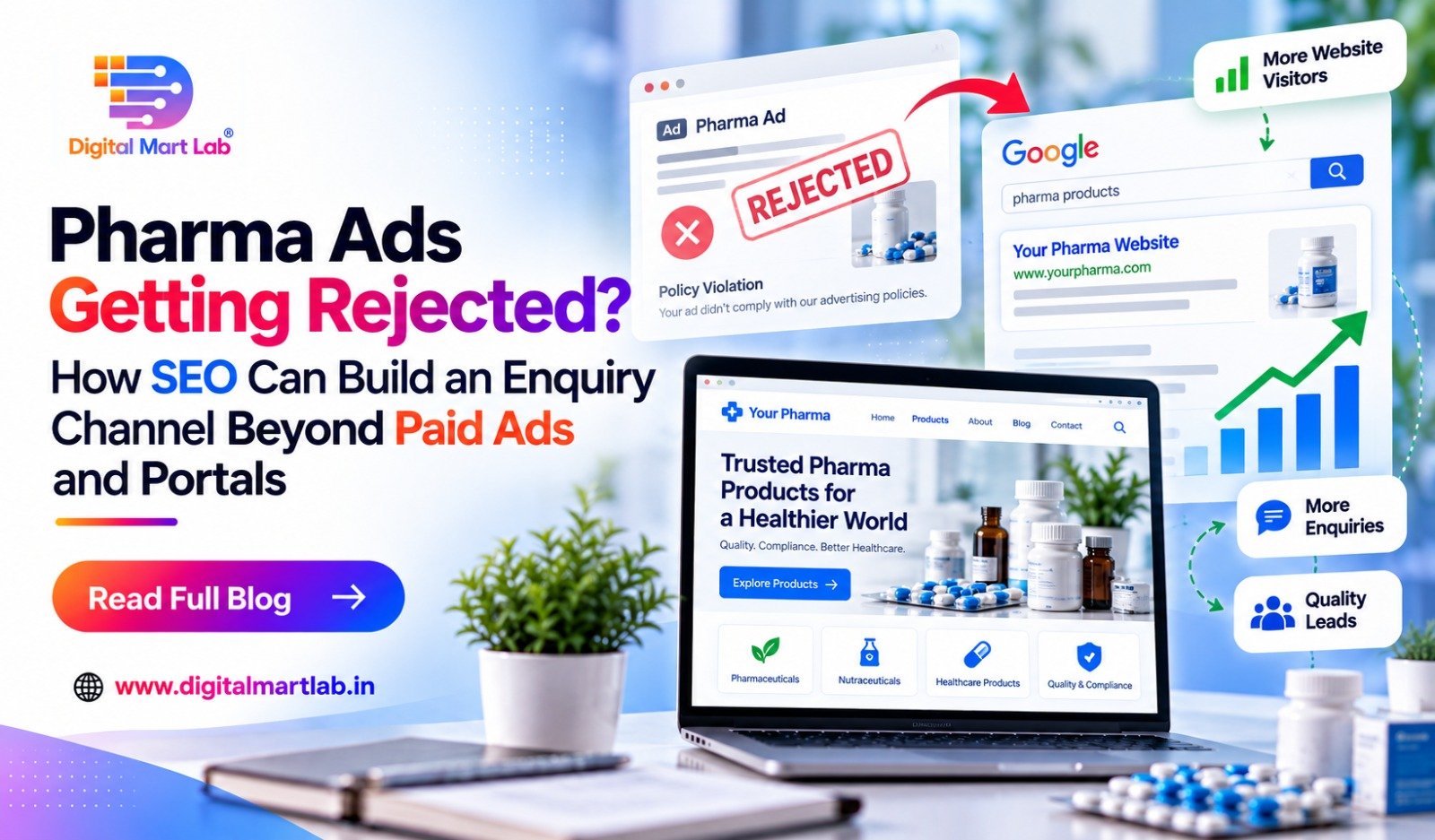
Your campaign is ready. The advertisement has been prepared, the budget is allocated and your sales team is waiting for enquiries.
Then the ad is rejected.
While your team investigates the issue, you continue depending on portal enquiries, referrals and existing contacts. It raises an important question: how else can a new buyer find your company?
Pharma SEO can help your business build another discovery route through organic search. When your website clearly explains your ranges, manufacturing capabilities and partnership process, relevant buyers have more information to find and assess.
This takes sustained work. It will not immediately replace enquiries from an interrupted campaign. But it can reduce your dependence on a single source over time.
Start by understanding why the advertisement was rejected
A rejected pharma advertisement does not automatically mean that every campaign for your business is prohibited.
Equally, describing an offer as “B2B” does not automatically make it eligible.
The reason depends on the platform, the specific offer, the destination page and the applicable requirements.
For example, Google’s healthcare and medicines advertising policy places restrictions on certain healthcare content, with conditions that vary by category and location. The destination website can matter as well as the advertisement.
Ask your campaign manager to identify the exact policy cited and review the relevant page before making changes.
SEO is a separate discovery channel. It does not resolve an advertising rejection or make inaccurate claims acceptable. Your website information still needs to be truthful and appropriate for the business you conduct.

How does pharma SEO create another route for enquiries?
SEO helps search engines discover and understand useful website pages so they can be considered for relevant searches.
For a pharma business, those pages should explain what you actually offer and whom you serve.
A prospective buyer might research:
- A particular PCD franchise range.
- A manufacturer supporting a specific dosage form.
- Packaging options for a manufacturing requirement.
- Information needed to request a quotation.
- Partner support before discussing a franchise.
If your website answers those questions clearly, it gives the buyer a reason to explore your company.
The journey may be:
A relevant search → a useful website page → a business enquiry → a sales discussion.
Being found is the beginning. Your offer, website experience and follow-up determine whether the conversation progresses.
Did You Know? Rejected ads do not have to leave your franchise business dependent on referrals alone. SEO can build a separate discovery route while your advertising issue is assessed and addressed where possible.
Why relying on one portal can leave a gap
A pharma portal may remain a useful source of business enquiries. Review its contribution based on the relationships and orders it helps create.
However, a portal listing gives you only part of the buyer’s discovery journey.
Your own website provides room to explain your company, relevant ranges, actual support and manufacturing capabilities in more detail. Buyers can return to those pages while comparing options or preparing questions.
It can also help someone who first sees your company on a portal and then searches your name before contacting you.
The aim is to give buyers several relevant ways to discover and evaluate the business. Decisions about portal spending should follow evidence, rather than the assumption that SEO will replace it immediately.
Give each channel a clear role
| Channel | What it can contribute |
| Paid advertising | Visibility for eligible campaigns and offers |
| Pharma portals | Discovery through the platform’s listings and enquiry process |
| Organic search | Discovery of relevant pages on your website |
| Referrals | Introductions based on existing relationships |
| Your website | A consistent place to understand the business and make contact |
These sources can support one another. A buyer may encounter your company through more than one before making an enquiry.
What does your website need before SEO can support enquiries?
Publishing more blogs is not always the right first step.
If your main pages are unclear, difficult to access or unable to receive enquiries, additional content may leave the underlying problem unresolved.
1. Pages that search engines can access
Your SEO team should check whether important public pages can be crawled and indexed.
In simple terms, search engines need to reach the pages and consider including them in search results.
Accidental blocking, incorrect indexing settings, broken pages or conflicting page versions may need attention. A sitemap and internal links can help discovery, but they do not guarantee indexing.
Private customer accounts and restricted commercial information should remain protected.
2. A clear explanation of your business
State whether you are a manufacturer, a pharma marketing company, a franchise business or a business providing several services.
Do not imply factory ownership when you work through manufacturing partners.
Accurate positioning helps visitors understand what they can request and who will handle it.
3. Useful range and capability pages
A homepage saying “complete pharma solutions” leaves too much unexplained.
Create relevant pages for the ranges or capabilities you genuinely offer. Explain the details a business buyer needs before contacting your team.
These pages form the foundation for focused SEO services for your pharma business.
4. A working enquiry process
Test your forms, phone links and contact options on a mobile device.
Confirm that submitted details reach the responsible person and that your team records the next action.
Search visibility creates an opportunity. A broken form can prevent that opportunity from becoming a conversation.
Build content around the questions business buyers ask
The purpose of pharma SEO is not simply to attract anyone searching for a medicine-related word.
A manufacturer seeking business buyers needs different content from a website answering consumer medicine questions.
Start with your actual customers and the requirements your company serves.
| Buyer question | Useful website content |
| “Do you support this dosage form?” | A factual capability page explaining the supported work |
| “Which franchise ranges do you offer?” | Organised range pages with partnership information |
| “Can you discuss this packaging requirement?” | Accurate packaging information and an enquiry route |
| “What details do you need for a quotation?” | A practical guide to preparing a manufacturing enquiry |
| “What support would I receive?” | A clear explanation of actual partner support and conditions |
Search research should help refine these subjects. Your sales team should check whether the content reflects questions buyers actually ask.
Example: a manufacturing capability page
Illustrative example: A business supports capsule manufacturing, but its website only has a general services page.
A dedicated capability page could explain the supported work, information needed for review and how to submit a requirement. It could also direct buyers to relevant packaging information.
This gives a visitor more substance to assess. It does not guarantee a ranking or establish that every submitted request is suitable.
Example: a franchise range page
A prospect researching a derma franchise may need range information, support details and an explanation of territory assessment.
A relevant page can answer those questions together and invite the visitor to discuss their preferred district.
Avoid creating numerous near-identical city pages that do not add useful information. Each page should have a clear purpose for the reader.
Can this also help buyers using AI search?
Buyers may use search engines and AI tools to research suppliers and compare business options.
Clear company information and useful service pages give these systems better material to understand. Technical accessibility also remains important.
For Google’s AI search features, its official website guidance explains that established SEO practices remain relevant. Pages must meet the applicable search requirements, and there is no special markup that guarantees inclusion.
No agency can reliably promise that an AI tool will recommend your company.
Focus on accurate company details, useful explanations and accessible pages. These are worthwhile improvements regardless of which discovery tool a buyer uses.
Did You Know? Buyers researching manufacturers through search and AI tools need clear information about your capabilities. Well-written pages can make your actual dosage forms, packaging options and credentials easier to discover and assess.
Why pharma SEO needs sustained work
SEO involves more than adding keywords to a page.
Your team may need to repair technical issues, improve existing content, publish missing information and review which searches lead to useful visits.
Search engines also need time to discover and reassess changes. Competitors continue improving their websites, and your own portfolio may change.
This is why “guaranteed enquiries next week” is not a sensible promise for an SEO project.
Google’s guidance on hiring an SEO advises that benefits typically take time to appear. The pace varies with the website and the work involved.
Expect progress in stages
| Stage | What the work should establish |
| Baseline review | Current visibility, website issues and enquiry sources |
| Foundation improvements | Accessible pages, clear content and working enquiry routes |
| Content development | Useful coverage of relevant buyer requirements |
| Performance review | Evidence about searches, visits and business conversations |
| Continued improvement | Updates based on results and changes in the business |
Discuss specific deliverables and review points with your agency. Avoid judging the entire project by one keyword position.

Measure organic enquiries as well as search visibility
A report showing more impressions or visitors can be encouraging. It still needs a connection to your business goals.
Review:
- Whether relevant pages are being discovered.
- Which searches and pages bring visitors.
- Whether visits produce completed enquiries.
- Whether those enquiries match your ranges or capabilities.
- Whether suitable discussions progress to quotations or orders.
Separate people searching your company name from those discovering you through broader business searches where the available data allows.
Both can be valuable, but they tell you different things about the website’s contribution.
Keep sales feedback in the report
If organic enquiries repeatedly ask for unsupported work, the content may need clearer positioning.
If relevant visitors enquire but conversations stall, review response time, commercial fit and follow-up as well.
Record available source information when buyers contact you by phone. Some will research online and call later, so website forms will not capture the full picture.
What should your business prepare for an SEO project?
Your marketing team needs accurate information from the business.
Prepare:
- Your actual service and product-range priorities.
- Documented capabilities and relevant credentials.
- Common buyer questions.
- Clear descriptions of partner support.
- The details needed to assess an enquiry.
- Someone who can review technical and commercial wording.
- Access to existing website and measurement systems where authorised.
This avoids publishing pages that sound persuasive but do not reflect what your company can deliver.
It also helps the agency prioritise commercially relevant subjects instead of producing general pharma articles simply to meet a content count.
How Digital Mart Lab can help build your organic enquiry channel
Digital Mart Lab can help organise SEO work around your business offering and the buyers you want to reach.
Review the website and its search foundation
The starting review can identify accessibility issues, unclear pages and gaps in the enquiry journey.
Where the site needs improvements, website design and development services can support clearer navigation, relevant pages and working forms.
Plan useful business-focused content
The proposed content can explain your ranges, capabilities and enquiry process in language buyers understand.
The work should include factual input from your team and clear priorities based on your actual offering.
Track relevant progress
Reporting should connect website work with visibility, enquiries and sales feedback where the information is available.
This helps identify what to improve next instead of treating a traffic increase as the final result.
Keep advertising decisions separate and informed
If ads have been rejected, a performance marketing review can examine the stated issue and relevant destination alongside the SEO work.
Neither service should promise approval or guaranteed enquiries. Each should have a clear scope and a practical role in your marketing plan.
Frequently asked questions about pharma SEO
1. Can SEO help if our pharma advertisements are rejected?
It can help build a separate route for buyers to discover your website. The rejection still needs its own assessment, and organic search requires sustained work rather than an immediate replacement promise.
2. Does an ad rejection stop the website from appearing in organic search?
An advertising rejection and organic search visibility involve different systems. The rejection alone does not establish whether a page will be indexed or ranked. The website must meet the relevant search requirements.
3. Should we stop using pharma portals once SEO begins?
Not automatically. Compare the relevant enquiries and business outcomes from each source. SEO can expand your options while useful portal activity continues.
4. Is a company homepage enough for pharma SEO?
Usually, a homepage cannot explain every range and capability in enough detail. Relevant supporting pages help buyers understand specific offerings, provided each page contains useful and accurate information.
5. Will SEO guarantee that AI tools recommend our company?
No. Clear, accessible content can support discovery, but inclusion or recommendation by an AI tool cannot be guaranteed.
6. How soon should we expect enquiries?
That depends on the starting website, demand, competition and implementation. Agree on progress reviews and measurable work, but avoid treating a fixed lead deadline as a reliable SEO promise.
Give buyers another way to find your pharma business
When one campaign stops or one enquiry source slows down, having another discovery route becomes valuable.
A useful website supported by sustained SEO work can help buyers find your actual offering, understand it and contact your team.
Start with clear pages, accurate business information and a working enquiry process. Build from there using evidence about the searches and conversations that matter.
Want to build a search presence that supports relevant pharma enquiries?
Discuss Your Pharma SEO Requirements with Digital Mart Lab
Share your website, priority ranges or capabilities and current enquiry sources. We can use that information to identify the website improvements and content your business needs first.