
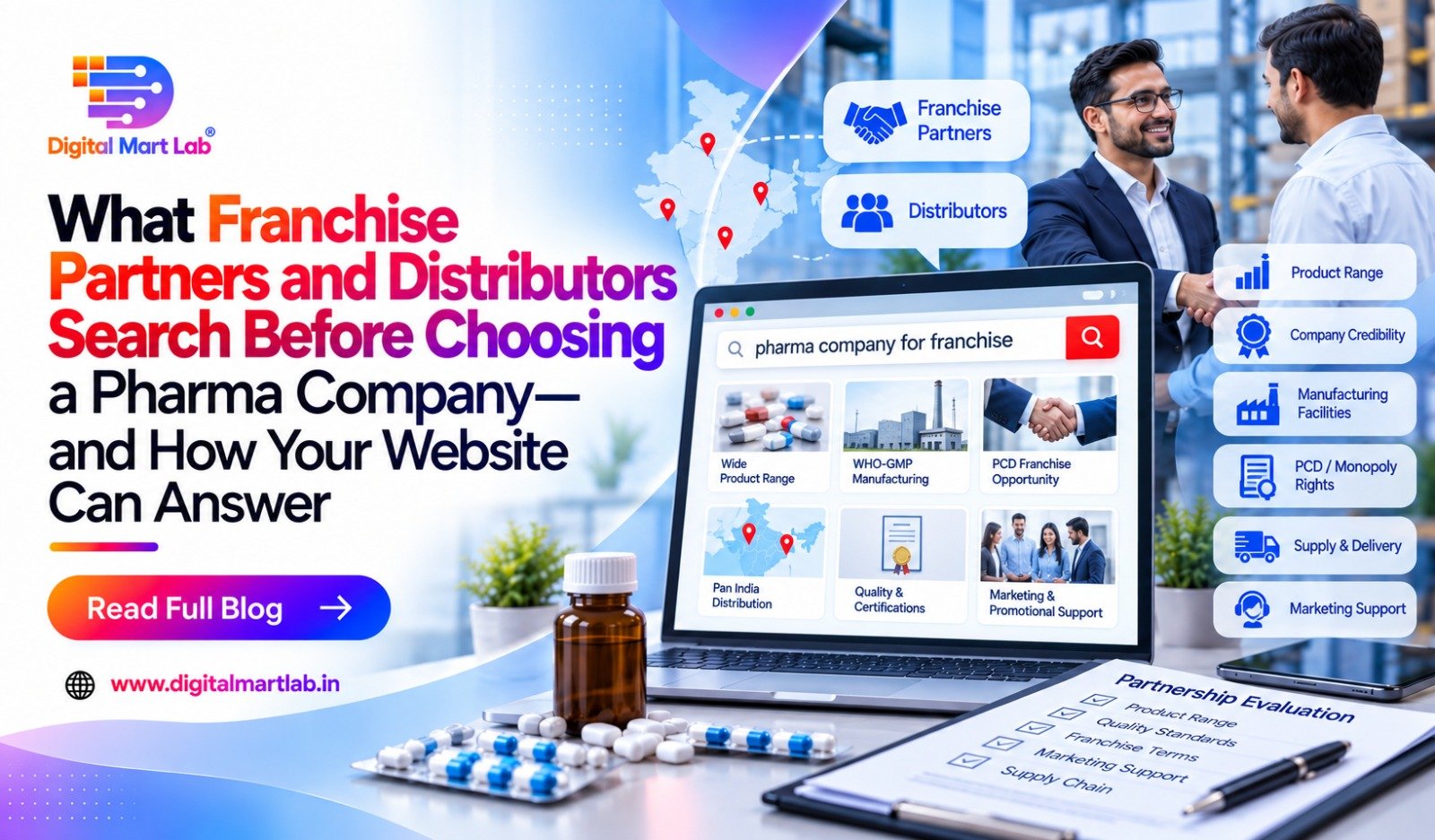
A potential franchise partner receives your catalogue. Before replying, they open your website.
They want to know more than the product names and prices.
“What support does this company provide?”
“How will they check my preferred territory?”
“What will I be responsible for?”
“Who will help if I have an order-related question?”
If your website leaves these questions unanswered, the prospect may contact your team for clarification. They may also continue researching other companies.
A useful PCD pharma SEO strategy turns these business questions into clear website content. It helps prospects understand your offer, assess whether it fits their plans and prepare for a more informed sales discussion.
The starting point is knowing what they need to evaluate.
Buyers need to understand the relationship before discussing the price
A price list explains the commercial offer only in part.
A franchise applicant or distributor also needs to understand the company behind it: its actual business role, portfolio, support and way of working.
Without that information, there is little to compare beyond rates and product counts.
Your website can provide the missing context.
For a pharma marketing company, this may include its sourcing arrangements, portfolio management and partner support. For a manufacturer, it may include its facility and relevant capabilities.
Explain the role accurately. Do not make a prospect guess whether they are speaking with a manufacturer, a marketing company or another type of business.
Did You Know? When distributors receive only your price list, they have little else to compare. A clear company profile explains your actual sourcing arrangements, portfolio strengths and partner support before negotiations begin.

Which questions should your pharma website answer?
Start with questions your sales team already receives. Review enquiry messages, introductory calls and discussions that stop after the catalogue is shared.
Look for repeated uncertainty, rather than assuming every prospect has the same priorities.
| Buyer question | Useful website content |
| “Does your range fit my business?” | Organised range pages and current catalogue information |
| “What support do you provide?” | Specific support details and applicable conditions |
| “Can I work in my preferred district?” | A clear territory-review process |
| “What will I need to handle?” | An explanation of partner responsibilities |
| “Who do I contact after joining?” | Relevant communication and support routes |
| “Why should I consider your company?” | Accurate company information and evidence of actual business value |
| “What happens after I enquire?” | A simple explanation of the next steps |
These answers can support both visitors arriving from search and prospects checking your company after a referral, advertisement or sales call.
Explain your product range in the context of the partnership
A long catalogue can show what is available, but a range page should help the buyer understand where to begin.
Organise the portfolio into relevant categories and explain how a prospect can discuss the range that interests them.
A visitor considering a derma franchise should be able to find the relevant information without reviewing every unrelated category first.
Help undecided applicants ask a useful question
Not every applicant will know which range to choose.
Give them an option to request guidance. Ask about their preferred territory, existing business and interests without pretending the website can decide commercial suitability automatically.
For example:
“Not sure which range to discuss? Share your preferred district and whether you are starting or expanding a business. Our team can explain the available options.”
Use this wording only where your team provides that assistance.
Keep the catalogue and page consistent
Review both when products or range details change.
A prospect should not receive different information from the website, downloadable profile and salesperson. Consistent material gives your team a reliable reference during the discussion.
Replace “complete support” with a clear explanation
“Complete promotional support” sounds reassuring, but it can mean different things to different people.
One applicant may expect printed materials. Another may assume local advertising or regular field assistance is included.
Your website should explain what your company actually provides.
Depending on your offer, that might include:
- Guidance on reviewing the available range.
- Approved promotional materials.
- Assistance with the ordering process.
- A designated contact for relevant questions.
- Updates about products in the partner’s area of interest.
Include the conditions that affect the offer. Explain whether something is standard, available on request or agreed separately.
Show how support is accessed
Naming a service is only part of the answer.
If partners can request promotional materials, explain whom they contact or how the request is made. If order questions go to a particular team, identify the correct route.
This makes the support easier to understand and use.
Avoid promises your team cannot consistently deliver
Do not publish a fixed response time or an unlimited support promise unless it reflects your operation.
A practical explanation of what happens is more useful than an impressive phrase that creates the wrong expectation.
Did You Know? A franchise prospect may hesitate because your support is unclear. A practical partnership guide explains what your company provides and what the partner handles, helping them evaluate the relationship before discussing terms.
Explain territory conditions before prospects make assumptions
Territory questions can become a source of confusion if the website relies only on phrases such as “monopoly rights available.”
A prospect may assume their district is open, that approval is automatic or that the arrangement has no conditions.
Explain how the review actually works.
A useful description could be:
“Share your preferred district and state. Our team will review the request and explain the availability and applicable partnership terms.”
This invites the discussion without confirming rights that have not been agreed.
Ask about the intended business territory
The applicant’s current location may differ from where they want to operate.
Use a clear form label such as:
“Which district and state would you like to discuss?”
This gives your team more useful context than a general “City” field.
Keep final terms tied to the agreement
The website can summarise the process and the questions to discuss. It should not replace the agreed documentation.
Have the responsible person approve any public description of territory conditions. If terms vary by arrangement, explain that variation instead of presenting one promise as universal.
Make partner responsibilities clear
A useful partnership explanation covers both sides of the relationship.
Applicants need to understand what your company handles and what they will need to organise.
Your website can introduce relevant subjects such as:
- Providing accurate business and requirement details.
- Reviewing the proposed range and terms.
- Understanding the agreed ordering and payment process.
- Using approved business information and promotional material appropriately.
- Contacting the right person for questions or changes.
Publish responsibilities that reflect your actual arrangement. Avoid presenting a generic checklist as though it applies to every partner.
Explain the next steps without overwhelming the reader
You do not need to place every detailed condition on the main page.
Give a clear overview, identify the points that need discussion and explain when the full terms will be shared.
This helps a serious prospect prepare while keeping the first visit manageable.
Recognise the difference between a new applicant and an existing distributor
A first-time applicant may ask how the partnership works from the beginning.
An established distributor may already understand the general process and want to discuss portfolio fit, ordering arrangements and ongoing communication.
Your website can serve both.
For someone starting a new business
Provide a short guide explaining:
- What information to prepare.
- How to explore the relevant range.
- How territory requests are reviewed.
- Which responsibilities and terms need discussion.
- What happens after the first enquiry.
Use simple language and avoid assuming prior experience.
For an established distributor
Make it easy to reach the portfolio, describe current coverage and request a relevant commercial conversation.
Do not force them through lengthy introductory content before showing the information they came to assess.
Clear navigation and enquiry choices can improve this experience without requiring separate websites.
Use real examples to demonstrate your support
Broad success claims may leave buyers unsure what your company actually does for partners.
A documented example can be more informative.
For instance, with the necessary permission, you might describe a partner’s specific question, how your team responded and what was resolved.
Keep the example factual
A useful case story explains:
- The situation the partner faced.
- The assistance your company provided.
- The documented outcome.
- Any relevant limits or context.
Do not invent revenue figures, partner comments or results. Avoid implying that one person’s outcome will apply to every applicant.
Illustrative example: A company could explain how its team helped a partner understand the ordering process and identify the appropriate contact for recurring questions.
If used as a real case story, the details would need verification and permission. As an illustration, it simply shows the kind of practical support a story can explain.
Connect the story to a buyer question
Place it near the relevant support information.
A story about order assistance belongs beside the ordering process. A general testimonial displayed without context may tell the reader less.
Let prospects learn before asking for their phone number
A visitor may want to understand your company before requesting contact.
Give them access to useful company, range and partnership information without requiring a form at every step.
Then offer a clear next action:
- Discuss your preferred territory.
- Ask about a product range.
- Request a partnership callback.
This respects the visitor’s stage in the decision and helps them make a more informed enquiry.
Make the contact request clear
If submitting the form means your team will call, say so.
Ask for the details needed to prepare that conversation, such as the preferred district and range. Allow the applicant to request guidance where something is undecided.
A review of your website design and enquiry process can help organise these steps around the buyer’s questions.
Turn these answers into a useful website structure
You do not need a separate article for every small question.
Start with a few strong pages that explain the main offering, then add supporting content where it provides useful detail.
| Page | Main purpose |
| Company profile | Explain business identity, role and relevant strengths |
| Franchise or distribution page | Introduce the relationship and enquiry process |
| Range pages | Help buyers explore the relevant portfolio |
| Partner support section | Explain actual assistance and conditions |
| Partnership guide | Clarify steps, responsibilities and questions to discuss |
| Contact page | Provide a clear route to the appropriate team |
Link related pages using descriptive text.
Your PCD pharma SEO strategy should help buyers discover and navigate this information. It should also avoid repetitive pages created only to target similar keywords.
Important explanations should appear as readable page content, even if you also offer a downloadable company profile.
How Digital Mart Lab can help prepare prospects for a sales discussion
Digital Mart Lab can help turn recurring buyer questions into clear website content that explains your actual offer.
The proposed work can include:
- Reviewing the questions your team receives.
- Improving your company profile and business positioning.
- Organising range and partnership pages.
- Explaining support and territory-review steps.
- Planning useful FAQs and approved case stories.
- Improving enquiry forms and internal links.
- Reviewing search performance alongside sales feedback.
Through website design and development, these explanations can be presented in a layout that is easy to use on a phone.
The same approved information can support eligible performance marketing campaigns, helping the advertisement and destination page describe the same opportunity.
Your team confirms the offer and terms. The content makes them easier for prospects to understand.

How will you know whether the content is helping?
Look at the quality of the opening conversation.
Do prospects understand which range they want to discuss? Are territory expectations clearer? Does your salesperson spend less time correcting assumptions about support?
Review:
- Enquiries mentioning relevant ranges.
- Preferred territories captured.
- Repeated questions that remain unanswered.
- Misunderstandings about company or partner responsibilities.
- Progress towards an agreed commercial discussion.
Website visits and downloads provide context, but they do not confirm partner suitability.
Use feedback from the people handling calls to improve the pages over time.
Frequently asked questions about pharma franchise website content
1. What information should a pharma franchise website explain first?
Start with your actual business role, available ranges, partner support and enquiry process. Visitors should understand what they can discuss and what information to prepare.
2. Should we publish all partnership terms online?
Provide an accurate overview of the important points and explain when full terms will be discussed. Detailed or arrangement-specific conditions should follow your approved process.
3. Can we advertise territory availability on the website?
Publish only information your team can maintain accurately. Where availability needs review, ask for the preferred district and explain that confirmation is required.
4. Should newcomers and established distributors see different content?
They may need different starting information. Provide an introductory guide for newcomers and a clear route to range and commercial discussions for experienced buyers.
5. Do case stories help explain partner support?
They can, when they are factual, permission-based and relevant to the question being answered. Do not invent results or imply that every partner will achieve the same outcome.
6. Should visitors share their number before seeing our company details?
Basic company and offering information should generally be easy to access. Let visitors understand the business, then provide a clear option to request a conversation.
Help prospects arrive with better questions
Your website should give a potential partner enough information to begin a useful discussion.
Explain your ranges, actual support, territory-review process and responsibilities. Show what your business provides and make the next step clear.
That helps your salesperson move beyond repeatedly sending a price list and explaining the basics.
Want your pharma website to answer the questions serious partners ask?
Discuss Your Pharma Website Content and SEO with Digital Mart Lab
Share your website, company profile and the questions your team hears most often. We can use them to plan content that helps prospects understand your offer before the first call.