
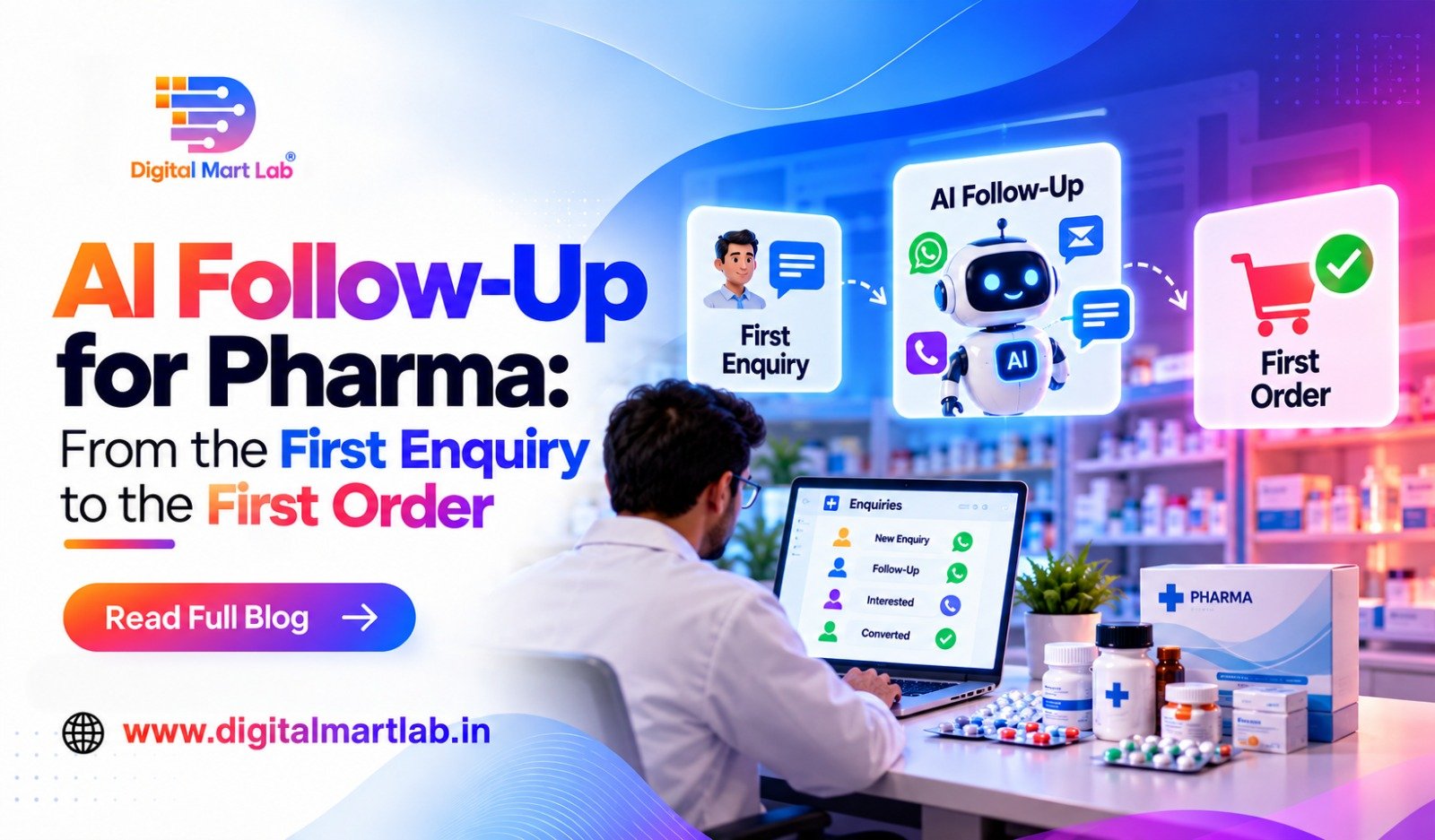
AI Follow-Up for Pharma: From the First Enquiry to the First Order
A prospect asks for a callback while your salesperson is unavailable.
Another wants a territory that is already assigned.
A promising buyer is discussing commercial terms. Meanwhile, a new franchise partner has signed an agreement but has not finalised the first product selection.
These enquiries are at different stages. Sending all of them the same reminder will not help your team manage the next step.
AI follow-up for pharma can help record requirements, coordinate callbacks, flag pending actions and support onboarding. During negotiations or decisions requiring judgement, it should hand over to your salesperson and pause routine messages.
Its role is to keep the process organised. Your team remains responsible for suitability, commercial commitments and order acceptance.
The practical question is simple: does every active enquiry have a clear next action and someone responsible for completing it?
An Interested Enquiry Is Only the Beginning
A prospect saying “interested” does not tell you whether they are ready to place an order.
They may need a territory check, product guidance, a quotation or a discussion with another decision-maker. Your own team may also owe them an answer.
For a franchise company, the first order may follow territory confirmation, product selection and agreed commercial steps.
For a third-party manufacturer, it may involve a detailed requirement, technical review, quotation and applicable approvals.
Do not force both into one identical process.
Start by reviewing recent enquiries that did not reach a first order. Identify the last completed step, what remained pending and whether anyone owned that action.
This gives you a practical starting point for automation.

Give Each Enquiry a Stage, an Owner and a Next Action
A shared record should show more than a name, phone number and “follow-up” label.
Useful information includes:
| Field | What to record |
| Enquiry type | Franchise, distribution or manufacturing |
| Current requirement | What the buyer has actually requested |
| Current stage | Callback, suitability review, negotiation or onboarding |
| Pending action | A specific task, such as confirming territory status |
| Responsible employee | The person accountable for the next step |
| Agreed timing | The buyer’s preference or an internally assigned review date |
| Automation status | Active, paused or stopped |
| Latest conversation | Relevant context and unresolved questions |
An AI assistant can help maintain this structure when connected to suitable systems. It cannot compensate for employees leaving important calls or decisions unrecorded.
Measure whether active enquiries have usable next actions—not simply whether every row contains text.
Step 1: Arrange the Callback Without Making the Buyer Start Again
When your team is unavailable, an assistant can collect the information needed for a useful callback.
Keep the initial questions proportionate:
- What would the buyer like to discuss?
- Is the enquiry about a franchise, distribution or manufacturing?
- When would a callback be convenient?
- Which language do they prefer?
Use information already provided instead of repeating questions.
Distinguish a requested time from a confirmed appointment
If the assistant cannot check the salesperson’s availability, it should record a preferred time without guaranteeing it.
Illustrative response:
“I have recorded your preferred callback time for tomorrow afternoon and shared it with our sales team. They will confirm availability.”
Only describe a slot as confirmed when the actual scheduling process supports that statement.
Notify the responsible employee and flag a missed callback. The buyer should not need to submit another enquiry because the first request was overlooked.
Track completed callbacks and missed commitments. An automated acknowledgement alone does not count as a conversation.
Step 2: Prepare the Salesperson for a Useful Discussion
Before the callback, the assistant can prepare a short summary from the buyer’s stated information.
For a franchise enquiry, this might include the preferred district, range interest and intended starting period.
For manufacturing, it might include the requested product, dosage form, approximate quantity and packaging questions.
Clearly mark missing or uncertain details.
“Quantity not yet decided” is more useful than an assumed quantity. “Territory availability pending” must remain separate from “territory available.”
The salesperson should have access to the original conversation and be able to correct the summary.
A good handover reduces repetition and gives the employee a clear opening question. It does not pre-approve the buyer.
Step 3: Hand Over Negotiations and Pause Routine Automation
Once a salesperson is discussing prices, terms or a specific commitment, routine automated follow-ups can become disruptive.
Imagine a buyer negotiating an initial range by phone while receiving:
“Are you still interested in our franchise opportunity?”
The message ignores the progress already made.
Define when the agent should step back
Pause routine sales messages when:
- A salesperson takes ownership of an active negotiation.
- The buyer requests an authorised commercial discussion.
- A revised quotation is being prepared.
- A technical or territory decision is pending internally.
- An employee asks for automation to pause.
The assistant may still help with internal summaries or reminders. Customer-facing communication should follow the agreed ownership rules.
Restart only after the record is updated
After the discussion, the salesperson should record the outcome, unresolved issue and next agreed action.
Do not restart the old sequence simply because a fixed number of days has passed.
The agent must not invent discounts, change credit terms, approve quantities or promise production dates.
Did You Know?
Routine automation should pause when a salesperson is actively negotiating. Shared conversation status helps prevent contradictory messages and lets the person responsible lead the discussion.
Step 4: Keep Unavailable-Territory Enquiries Relevant—with Permission
An unavailable district does not always mean the conversation must be permanently discarded.
The prospect may want to hear if that specific territory becomes available later. Ask whether they would like such an update, then record their preference accurately.
Store the requested territory and contact preference
Keep the preferred district or area separate from the prospect’s current location.
Also record whether they would consider another territory. Do not assume that they will.
If they decline future contact, respect that decision.
Recheck availability before sending an update
A message should follow a verified change in territory status—not an old spreadsheet or an AI inference.
Illustrative message:
“You previously asked us to contact you if the territory you requested became available. Our team has confirmed a change in its status. Would you like to discuss your current requirement?”
Availability still needs to be discussed under the company’s applicable conditions. The message should not imply that a territory has been reserved or awarded.
Track relevant reconnections and incorrect alerts. Accuracy matters more than the number of reactivation messages sent.
Step 5: Turn Agreement into Clear First-Order Tasks
A signed agreement is a milestone. It does not necessarily mean the first order is ready.
A new partner may still need to select products, complete applicable documentation or clarify commercial steps.
Franchise and distributor onboarding
Depending on your actual process, pending actions may include:
- Finalising the initial product selection and quantities.
- Completing required business-document checks.
- Confirming billing and delivery details.
- Reviewing approved commercial terms.
- Completing applicable payment steps.
- Confirming who handles support questions.
Explain what is needed and why. Collect documents through an approved process rather than asking for everything in an initial chat.
Manufacturing first-order preparation
Manufacturing onboarding may require additional clarification of specifications, packaging, quotation acceptance and applicable approvals.
The AI assistant can track which actions are pending. Technical acceptance and order confirmation belong with authorised employees.
Avoid presenting every business as if it follows the same manufacturing process.
Did You Know?
A signed franchise agreement is not the same as a first order. Product selection, documentation and commercial actions may still be pending—and each needs a clear owner.
Use Onboarding Reminders to Resolve the Actual Delay
“Please complete your order” may be too vague to help.
If product selection is pending, ask whether the partner needs a discussion about the initial range.
If your team owes a clarification, remind the employee rather than repeatedly contacting the buyer.
Illustrative franchise example
This is a hypothetical example, not a Digital Mart Lab client result.
A new partner signs the agreement but has not confirmed the initial product selection.
The assistant checks the record and asks whether they would like help reviewing the range. The partner explains that they are unsure how to narrow their selection.
The request goes to the salesperson, who arranges a discussion. Routine reminders pause while that discussion takes place.
The useful result is identifying the missing decision. An order is recorded only when it is actually placed and accepted under the company’s process.
If enquiries regularly stall between agreement and first order, discuss a structured workflow through Digital Mart Lab’s AI-enabled digital marketing services. Bring your current stages and the tasks that most often remain unfinished.
Build Referrals After a Satisfactory Experience**
A referral process extends beyond the first order. It belongs later in the relationship, when your team has reason to believe the partner is satisfied.
Do not automatically request a referral because a payment was received or a delivery was recorded.
First check whether there is any unresolved issue.
Ask for an appropriate introduction
A referral request can invite a satisfied partner to introduce someone with a relevant business need.
For example:
“If you know another business owner who would find a conversation with our team useful, you are welcome to share our enquiry link with them.”
This lets the referred person choose whether to engage.
Avoid asking partners to provide large contact lists or assuming that an introduction authorises an automated promotional sequence.
Record the source of the introduction and the new prospect’s own contact preferences. If your company offers referral benefits, communicate only approved, documented terms.
How Digital Mart Lab Can Help Connect These Steps
Digital Mart Lab’s AI-enabled services include chatbots and conversational marketing. A pharma sales workflow can be scoped around your actual enquiry stages, approved information and employee responsibilities.
| Business problem | Proposed work | What to measure |
| Callback requests are missed | Record preferences, notify owners and flag overdue callbacks | Callback completion and missed commitments |
| Automation overlaps with negotiations | Define handover, pause and restart rules | Conflicting messages and handover errors |
| Territory enquiries are forgotten | Maintain permission-based preferences and verified-change checks | Relevant reconnections and incorrect alerts |
| Agreements do not progress to first orders | Track onboarding tasks and internal dependencies | Pending tasks and time between defined stages |
| New enquiries arrive without useful context | Improve website enquiry forms and buyer journeys | Completeness and relevance of initial information |
Where appropriate, completed sales stages can also inform performance marketing reviews, helping your team assess what happens after an enquiry arrives.
CRM connections, scheduling, WhatsApp or email delivery, territory records and onboarding dashboards depend on technical feasibility and agreed scope.
Your company must approve the rules and keep the underlying information current.

Measure Progress Between Stages**
Track the steps that matter to your business:
- Enquiries reaching a useful human discussion.
- Requested callbacks completed.
- Pending internal decisions resolved.
- Onboarding tasks completed.
- First orders placed and accepted.
- Payments received, recorded separately.
- Opportunities paused, declined or awaiting a future date.
Review the time spent between stages and the reasons for delay.
Do not count an agreement, a quotation or a positive reply as revenue. Also avoid assuming that every later order resulted solely from automation.
A Practical Checklist Before You Automate
- Define separate franchise and manufacturing stages.
- Assign an owner to every active opportunity.
- Record buyer-stated requirements and uncertain details separately.
- Distinguish requested callbacks from confirmed appointments.
- Pause routine messages during active negotiations.
- Verify territory changes before contacting waiting prospects.
- Track onboarding tasks after agreements.
- Respect contact permissions and stop requests.
- Make human help easy to request.
- Review errors, missed actions and stalled opportunities regularly.
Begin with the stage causing the most difficulty. Add more automation after the handovers and records work reliably.
Frequently Asked Questions About AI Follow-Up for Pharma
1. Can AI handle the entire journey from enquiry to first order?
It can assist with information collection, reminders and coordination. Suitability, negotiations, technical approvals and order acceptance require authorised human involvement.
2. Can an AI assistant arrange sales callbacks?
It can collect preferred times and notify the salesperson. Confirmed booking requires access to a dependable scheduling process; otherwise, it should describe the time as a request.
3. Should automated messages continue during negotiations?
Routine sequences should pause when a salesperson is actively handling the discussion. Restart only after the outcome and next action have been updated.
4. Can we contact a prospect when a territory becomes available?
Use their recorded permission and verify the territory’s current status first. An update should invite a discussion without promising reservation or allocation.
5. Why is onboarding necessary after an agreement is signed?
Product selection, documentation and commercial actions may still be incomplete. Clear tasks help both parties understand what remains before the first order.
6. How should AI support referrals?
It can help manage an approved referral process and record introductions. The referred person should choose whether to engage, and their own contact preferences should guide follow-up.
Give Every Promising Enquiry a Clear Next Step
A first order usually depends on several decisions and completed actions.
AI can help your team keep those actions visible—from the initial callback to the final onboarding task. Its value depends on accurate records, timely human decisions and clear ownership.
Discuss how Digital Mart Lab can help organise your pharma enquiry-to-first-order process. Bring your current sales stages and the points where prospects most often wait without a clear next step.
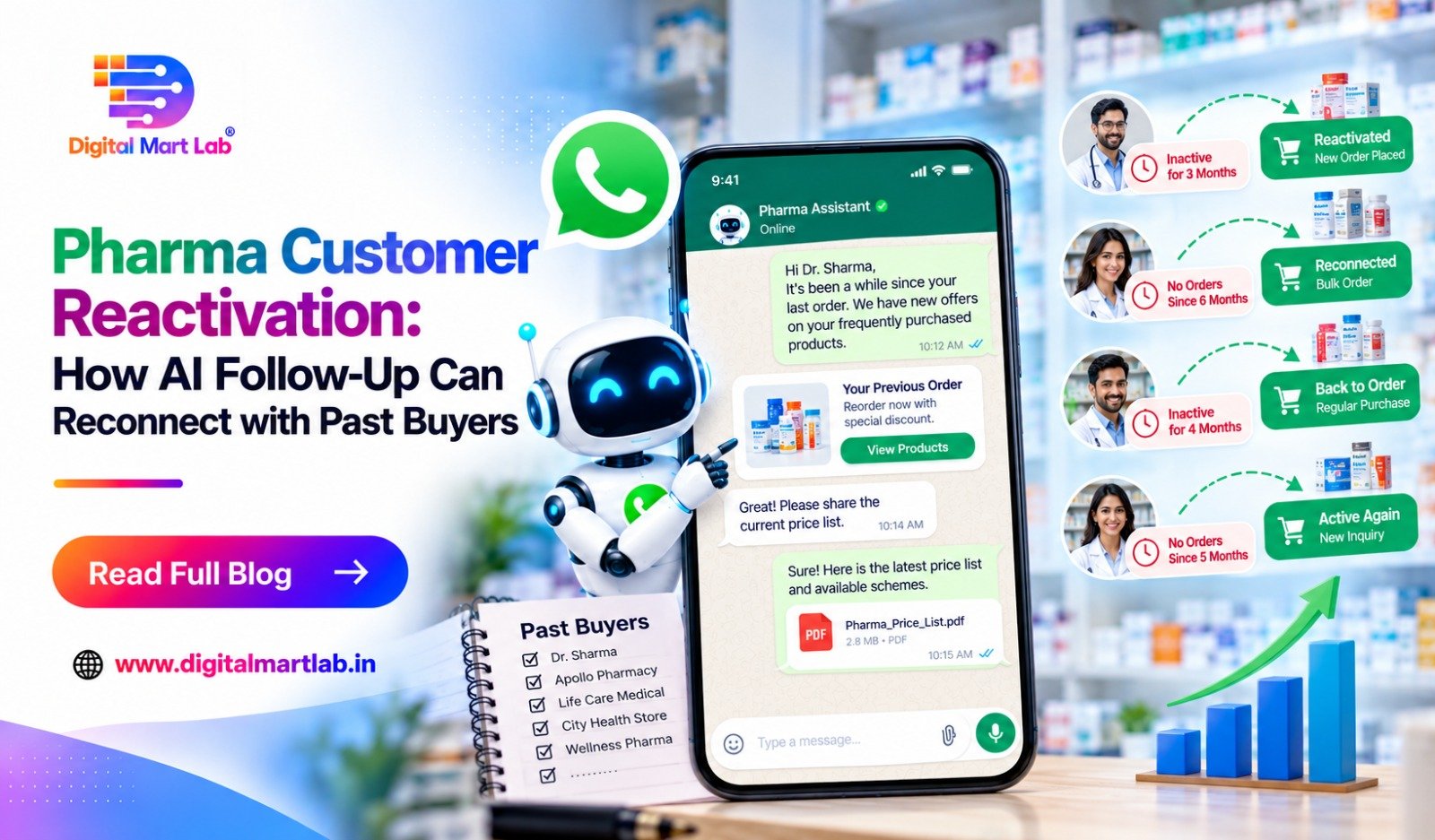
Pharma Customer Reactivation: How AI Follow-Up Can Reconnect with Past Buyers
A distributor used to order regularly. Now the orders have become smaller—or stopped.
A manufacturing buyer completed a project with your company but has not discussed another requirement.
Your team considers sending a new price list or a discount offer. But first, there is a more useful question:
What changed?
Pharma customer reactivation starts with understanding why a previous buyer is no longer ordering. AI-assisted follow-up can help your team identify changes in order patterns, prepare relevant questions and reconnect with buyers who have appropriate contact permission.
The conversation may reveal a new requirement. It may also uncover slow-moving stock, changed business priorities or an unresolved service problem.
Order history can show that something changed. Your team still needs the buyer’s perspective to understand why—and decide what to do next.
A Buyer Who Stops Ordering Is Not Always a Lost Customer
A gap between orders can have several explanations.
A distributor may still be selling the previous stock. A franchise partner may have changed their product focus. A manufacturing customer may purchase in project-based cycles rather than every month.
The buyer may also be unhappy about an earlier issue that never reached the right person.
Before labelling someone inactive, check:
- Their usual ordering pattern.
- The products or services they previously purchased.
- Any open complaint or commercial discussion.
- The last meaningful conversation.
- Whether your team agreed to contact them later.
- Whether recent purchases were recorded under another account or contact.
A single inactivity rule will not suit every customer.
A distributor who previously ordered monthly needs a different review from a manufacturing buyer whose last project covered a much longer requirement.

Use Order History to Identify Conversations Worth Reviewing
A connected system can flag changes such as longer gaps between orders, lower quantities or a previously purchased range disappearing from the order mix.
These are signals for review, not proof of dissatisfaction.
Compare buyers with their own history
Instead of treating every customer with no order in 60 days as equally inactive, consider their normal pattern.
Useful records include:
| Information | Why it matters |
| Last order date | Establishes the most recent purchase |
| Previous order intervals | Helps your team judge whether the gap is unusual |
| Products or ranges purchased | Supports a relevant conversation |
| Changes in quantity or frequency | Identifies something worth checking |
| Open service issues | Prevents a sales message from ignoring an unresolved problem |
| Last discussion and agreed timing | Helps avoid premature contact |
| Contact preferences | Guides appropriate outreach |
Your team should decide which changes deserve attention. AI can help summarise those changes, but the underlying records must be accurate.
Measure how many alerts lead to a useful review. Too many irrelevant alerts can create another list your team stops checking.
Did You Know?
A partner ordering less may need support rather than another offer. A change in purchasing can be a reason to ask about range suitability, demand or an unresolved service concern.
Ask What Changed Before Offering a Discount
A discount cannot resolve every reason for reduced ordering.
If the buyer had difficulty getting a dispatch update, a lower price does not address communication. If their current stock is moving slowly, another large order may not fit their needs.
Start with an open, relevant question.
Illustrative message:
Hello Mr Sharma, we wanted to check how the range you previously ordered is working for your business. Have your requirements changed, or is there anything from our side that needs attention?
This gives the buyer space to describe the situation without being pushed towards an immediate purchase.
Avoid questions that assume a cause:
“Have you stopped ordering because our prices are high?”
Unless the buyer raised pricing, that is only a guess.
Record the answer in practical terms: changed range requirement, existing stock, service issue, future buying date or no current need.
Approach Distributors and Franchise Partners with Relevant Questions
For a distributor or franchise partner, the conversation may concern the range they handle, local demand, available stock or the support they receive.
Focus on the products they actually purchased
An appropriate question could be:
“Are the products you previously selected still relevant to your current requirement, or has your focus changed?”
If the buyer says their focus has changed, ask what they are now looking for.
Do not automatically send the entire catalogue. First establish whether your available range is relevant.
Understand whether support is missing
A partner may need clarification about an earlier order, approved product information or the right support contact.
The assistant can collect the concern and direct it to the responsible employee. It should not invent partner benefits, promise exclusivity or change commercial terms.
Your team must maintain accurate range and support information. Track whether the conversation identifies a clear requirement or resolves an issue—not just whether the buyer replies.
Reconnect with Manufacturing Buyers Around Actual Capabilities
A former manufacturing buyer may not know that your company can now handle a relevant requirement.
An update can be useful when the capability is verified and the buyer has appropriate permission to receive it.
For example, a previous packaging discussion may make a newly confirmed packaging option relevant. But the connection should be genuine.
Illustrative email:
Subject: An update relevant to your earlier packaging enquiry
Hello Ms Verma,
You previously asked about a packaging option that was unavailable at the time. Our team has since confirmed that this option can be considered, subject to reviewing the product and order requirements.
Is this still relevant to your plans? If so, we can arrange a discussion.
Only use a message like this when the original question and the new capability are documented.
A pharma marketing company working with manufacturing partners should describe that arrangement accurately. It must not imply that it owns a facility or controls capacity that belongs to another business.
Technical feasibility, quantities, quotations and production commitments still need authorised review.
Share Relevant Range Updates Instead of Repeated Full Catalogues
Your customers may not know about every relevant product already available in your range.
AI-assisted selection can help your team identify possible matches between recorded interests and approved catalogue information. A person should review the match where context is uncertain.
Explain why the update may matter
A useful update refers to an expressed interest or previous requirement:
“You previously asked about expanding this range. We have an approved product list that may be relevant. Would you like our team to share it?”
It should not claim that the buyer will sell more or earn a particular margin.
A previous purchase also does not establish permanent interest. Ask whether the requirement still applies.
Keep the update accurate and manageable
Use the current approved catalogue. Check availability separately where necessary.
Avoid sending an extensive attachment when a short, relevant selection would answer the question more clearly.
Did You Know?
A previous buyer may be unaware of a relevant existing product or a newly verified capability. A permission-based update connected to their recorded interest can provide a useful reason to reconnect.
Resolve Service Problems Before Restarting the Sales Pitch
If the buyer reports an unresolved issue, the conversation should change direction.
Do not continue a product promotion while the person is explaining a shortage, delayed response or unresolved commercial concern.
A useful process is to:
- Acknowledge the reported issue.
- Collect the relevant reference and missing details.
- Assign a responsible employee.
- Pause routine promotional follow-up.
- Record the action taken and the buyer’s response.
The assistant can organise this handover. It should not decide who was at fault or promise an unapproved refund, replacement or concession.
Closing a support record does not automatically mean the relationship has recovered. Your salesperson may need to check whether the buyer considers the matter addressed before discussing future requirements.
What AI-Assisted Reactivation Looks Like in Practice
The following examples are hypothetical, not Digital Mart Lab client results.
Example: A distributor’s order frequency falls
A distributor previously placed orders regularly but has recently ordered less often.
The system flags the change. A salesperson reviews the record and approves an appropriate check-in.
The buyer explains that a previous order issue remains unresolved. The assistant records the concern and passes it to the responsible employee. Promotional messages pause.
The useful outcome is identifying the issue that needs attention. A new order remains the buyer’s decision.
Example: A manufacturing buyer has a changed requirement
A previous customer is contacted with permission about a verified capability relevant to an earlier discussion.
The buyer replies that the original project is complete but another requirement may arise later.
The assistant records the new context and preferred follow-up timing. Your team can then prepare for the right conversation instead of repeatedly pursuing the old requirement.
Use Permission-Based Follow-Up and Clear Stop Rules
Having an old phone number does not mean every type of future message is welcome.
Use appropriate contact permission, respect channel preferences and make it easy for the buyer to decline further follow-up.
Keep separate records for:
- Buyers who welcome relevant updates.
- Buyers who request contact at a later time.
- Buyers with an unresolved issue.
- Buyers who decline further contact.
- Contacts whose details or role need verification.
Do not use artificial urgency or repeated “last chance” messages to force a response.
If the buyer remains silent, follow an agreed pause or review process. AI should not turn an old customer list into an endless automated sequence.
How Digital Mart Lab Can Help Reopen Relevant Conversations
Digital Mart Lab’s AI-enabled services include conversational marketing and chatbots. A customer-reactivation workflow can be discussed around your order records, approved information and sales responsibilities.
The proposed work can connect specific problems to clear actions:
| Business problem | Proposed work | What to assess |
| Changes in ordering go unnoticed | Define order-history alerts and review summaries | Relevant alerts and completed reviews |
| Every past buyer receives the same message | Prepare follow-up based on recorded interests and current status | Useful replies and changed needs identified |
| Service concerns remain mixed with sales chats | Create a support handover and pause promotional contact | Issue ownership and resolution |
| Buyers cannot find current range or capability details | Improve website catalogue and capability information | Clarity of follow-up discussions and repeated questions |
Connections to order systems, CRM records, WhatsApp or email require separate scope and feasibility checks. AI cannot identify reliable patterns from incomplete or disconnected information.
Discuss an appropriate reactivation process through Digital Mart Lab’s AI-enabled digital marketing services. Bring your existing follow-up process, the records you maintain and common reasons buyers stop ordering.
Measure More Than the Number of Replies
A polite reply is not the same as a returning customer.
Track outcomes separately:
- Buyers whose current requirements were clarified.
- Service problems identified and assigned.
- Relevant discussions arranged.
- Quotations requested.
- New orders actually placed.
- Subsequent purchases over an appropriate period.
- Opt-outs and complaints about contact.
Also record why a buyer did not proceed. “No current requirement” is different from “unresolved service issue.”
Do not attribute every later order entirely to the AI message. Your team’s work, the buyer’s timing and other interactions may also have contributed.

A Practical Checklist Before Contacting Past Buyers
- Check the buyer’s normal purchasing pattern.
- Confirm that order history is complete enough to use.
- Review open complaints and pending commitments.
- Verify that the contact still handles the requirement.
- Check appropriate contact permission and preferences.
- Select one relevant reason to reconnect.
- Use approved, current range or capability information.
- Assign a salesperson to handle the reply.
- Pause promotion when a service issue emerges.
- Record the outcome and respect stop requests.
Start with a manageable group and review the conversations before expanding the process.
Frequently Asked Questions About Pharma Customer Reactivation
1. When should we consider a pharma buyer inactive?
Compare the gap with their usual purchasing pattern and business context. A fixed period will not suit every distributor or manufacturing buyer. Review the history before deciding to contact them.
2. Can AI explain why a buyer stopped ordering?
It can highlight changes and ask relevant questions. It cannot reliably determine the reason without evidence from the buyer or the business record.
3. Should we offer a discount in the first message?
Not automatically. First understand whether the issue involves pricing, range suitability, stock, timing or service. Any offer should follow authorised commercial decisions.
4. Can we send product updates to previous customers?
Use appropriate permission and relevant, approved information. A previous purchase does not mean the buyer wants every catalogue or promotional message.
5. What should happen when a buyer reports an old complaint?
Pause the sales sequence, collect the necessary details and assign the issue to a responsible employee. Address the concern before pushing for another order.
6. Does AI follow-up guarantee repeat orders?
No. It can help your team maintain records and reopen appropriate conversations. Repeat orders depend on the buyer’s needs, your offer, service experience and commercial fit.
Rebuild the Conversation Before Asking for the Next Order
A past buyer already has experience with your company. Understanding that experience is a useful starting point.
A relevant follow-up can reveal a changed requirement, an overlooked product interest or a problem your team needs to resolve.
AI can help your team notice the change and organise the response. The relationship improves through accurate information, useful support and responsible follow-through.
Discuss how Digital Mart Lab can help you reconnect with past pharma buyers. Bring your customer follow-up process and the points where repeat-order conversations commonly stop.
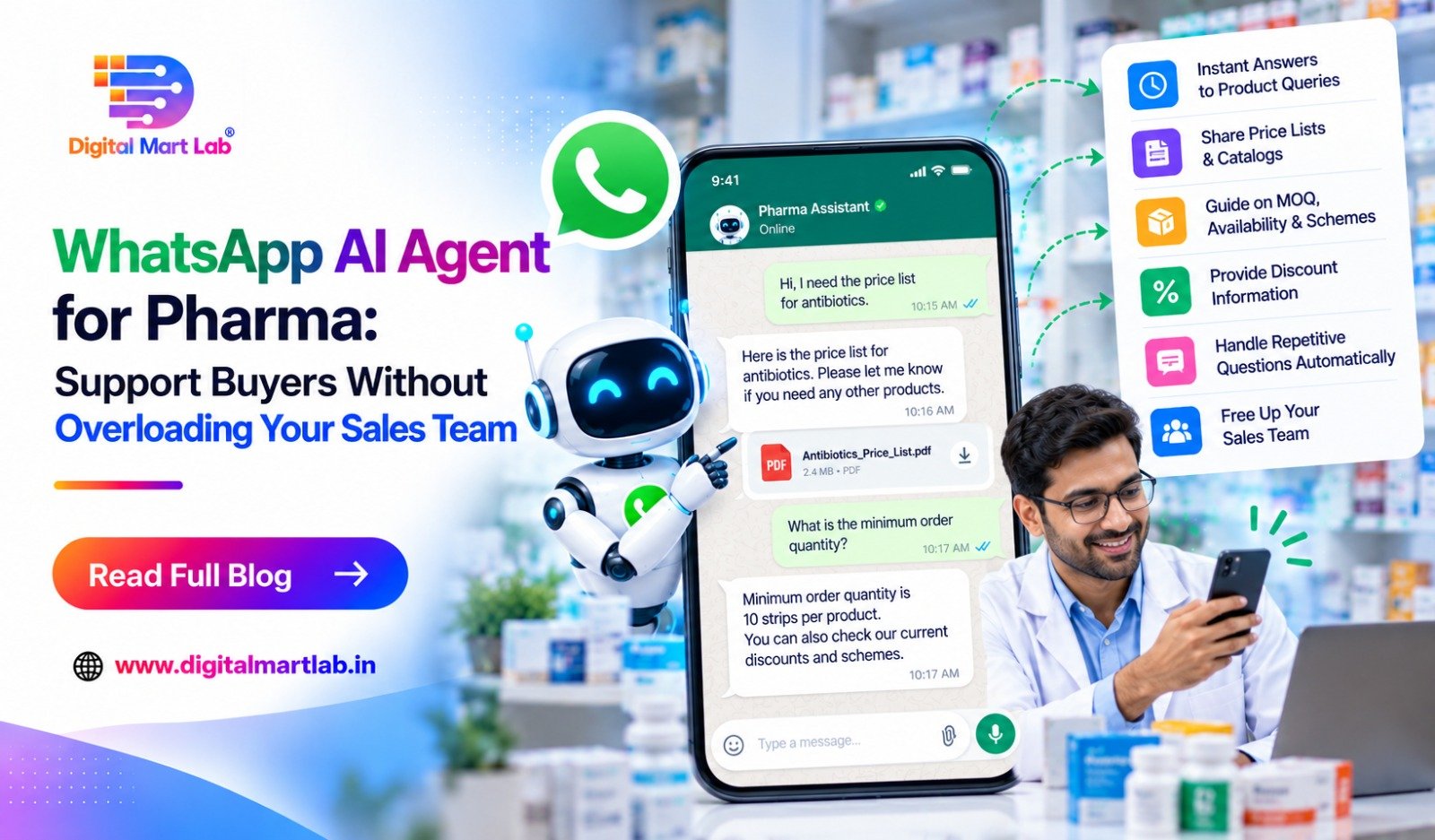
WhatsApp AI Agent for Pharma: Support Buyers Without Overloading Your Sales Team
“Has our order been dispatched?”
“Please send the invoice again.”
“We received fewer cartons than expected.”
“Who should we contact about the packaging issue?”
These are important questions. But when every support message reaches your salesperson, prospect calls and commercial discussions compete with order checks, document requests and complaint coordination.
Your customers still need answers. Your sales team needs a reliable way to get those answers without personally chasing every department.
A WhatsApp AI agent for pharma can help answer suitable routine questions from approved information, collect support details and share verified order updates. When a request needs judgement or an unavailable answer, it should pass the conversation to the responsible employee.
The value comes from making support more organised—and giving customers a clear route to someone who can resolve their issue.
Why Support Questions Keep Returning to Your Sales Team
Customers often contact the person they already know.
A distributor who placed an order through a salesperson will naturally message that person about dispatch. A manufacturing buyer may ask the same executive about production progress, documents and packaging concerns.
The problem grows when support information is scattered.
The salesperson may need to check an order sheet, ask accounts for an invoice and contact another employee about dispatch. Meanwhile, the customer sends another message because they have not received an answer.
Before introducing automation, review recent support conversations:
- Which questions repeat most often?
- Where does the answer currently come from?
- Who is authorised to confirm it?
- Which requests require judgement?
- Which issues remain open because nobody owns them?
This review helps separate questions an assistant can safely handle from issues that need a person.

Which Pharma Support Questions Can an AI Agent Handle?
Start with requests that have clear answers and dependable information sources.
| Support request | Suitable assistance | When a person is needed |
| “How do I request an invoice copy?” | Explain the approved process or retrieve it through an authorised connection | Identity, access or invoice details need checking |
| “Has my order been dispatched?” | Share the verified recorded status | The record is missing, conflicting or outdated |
| “What information should I send about a shortage?” | Collect the order reference and issue details | Investigation and resolution |
| “Who handles packaging complaints?” | Explain the support route and create a request | Quality assessment and corrective action |
| “When will production finish?” | Share an authorised update if available | No confirmed date exists or a commitment is requested |
The assistant’s role depends on the systems connected to it.
An AI agent with access only to FAQs cannot provide live order information. It should explain that limitation and arrange a handover instead of presenting a guess as an update.
Share Verified Order Information—Not Assumed Progress
Order-status questions can consume time because the salesperson has to find the latest answer.
An assistant can help if it retrieves information from a reliable source, such as an authorised order system or a maintained internal record.
Show what the record actually confirms
An update should identify the relevant order and, where useful, when the information was last updated.
For example:
“The latest recorded status for order DML-EXAMPLE-104 is ‘ready for dispatch’, updated this morning. Dispatch confirmation is not yet recorded.”
This is an illustrative message using a fictional order reference.
“Ready for dispatch” does not mean dispatched. A recorded dispatch does not automatically confirm delivery.
Keep these stages separate.
Treat missing information as a reason to escalate
If the system has no current update, a useful response is:
“I do not have a confirmed update for this order. I’m passing your request to the responsible team.”
The assistant must not invent a production date, dispatch date or reason for delay.
Your team must maintain the underlying records and define which customers may access which information. Measure the accuracy of updates and how often requests require manual clarification.
Did You Know?
Routine manufacturing status questions can be answered from verified order information when the right connection exists. If that information is missing, the assistant should involve a person rather than guess a production or dispatch date.
Keep Distributor Support Separate from Manufacturing Support
Both groups need dependable communication, but their questions differ.
Distributor and franchise partner support
Common requests may concern invoice copies, order references, dispatch updates, shortages or approved partner-support processes.
The assistant can identify the request, collect the necessary details and route it appropriately.
It should not assume every distributor has the same commercial terms. Credit conditions, returns and partner commitments must come from the applicable approved record or an authorised employee.
Manufacturing buyer support
Manufacturing conversations may involve production status, packaging queries, documentation or changes to a confirmed requirement.
These questions can depend on technical review and internal approvals.
The assistant can share a verified update or record a request. It should not approve specification changes, accept revised quantities or interpret technical findings independently.
A pharma marketing company should also describe its role accurately. Its support messages must not imply ownership of a manufacturing facility when it works through manufacturing partners.
Collect Complaints Properly Before Passing Them On
A complaint scattered across several messages is difficult to investigate.
“Material issue.”
“Please check urgently.”
“I already told your salesperson.”
An assistant can turn these messages into a structured support request without deciding the outcome.
Ask for the minimum useful details
Depending on the issue, collect:
- Customer or company name.
- Order or invoice reference.
- Product and batch details, where relevant.
- Quantity affected.
- A short description of the issue.
- Relevant photographs or documents, where appropriate.
- Preferred contact method.
Use details already provided. Do not make the customer repeat the full complaint simply because the conversation changes hands.
Avoid collecting unnecessary personal or patient information in a general business-support chat.
Acknowledge the complaint without promising a resolution
A suitable acknowledgement could say:
“I have recorded your report about the packaging issue and passed it to the responsible team. They will review the details and contact you.”
Do not promise a replacement, refund or finding before an authorised person has assessed the case.
Potential product-quality or safety concerns should follow the company’s approved escalation process promptly. The assistant should not attempt to resolve them through generic reassurance.
Give Every Unresolved Issue a Responsible Employee
“Forwarded to the team” is not enough if nobody knows who should act.
A useful handover includes:
| Handover field | What it should contain |
| Customer and order reference | Enough information to identify the relevant record |
| Issue summary | What the customer reported, without unsupported interpretation |
| Information already collected | References, documents and relevant conversation details |
| Information still missing | What the employee needs to check |
| Assigned owner | The person or team responsible |
| Next action | A clear task and any approved response target |
The receiving employee should be able to see the original conversation, not just an AI-generated summary.
Summaries can contain errors. Give employees a way to correct them and preserve the customer’s original wording where it matters.
Did You Know?
Collecting a complaint is only the first step. A clear owner, supporting details and a visible next action help prevent the issue from disappearing between chats and departments.
What a Better Support Conversation Looks Like
The following examples are hypothetical, not Digital Mart Lab client results.
Example: A distributor reports a shortage
A distributor messages: “Two cartons are missing from our delivery.”
The assistant asks for the order reference and relevant received-quantity details. It records the report and routes it to the employee responsible for checking fulfilment.
The salesperson can see that the issue has an owner. The customer receives an acknowledgement and a support reference if the system provides one.
The assistant does not conclude that the warehouse made an error or promise to dispatch replacements.
Example: A manufacturing buyer requests a production date
The buyer asks: “Will our order be ready on Friday?”
The connected record shows an earlier status but no confirmed completion date.
The assistant explains that it cannot confirm Friday and passes the request to the responsible person. Once an authorised update is recorded, the team can communicate it.
This is more useful than a confident answer that later proves incorrect.
If your salespeople spend much of their day collecting and forwarding these requests, discuss a support workflow through Digital Mart Lab’s AI-enabled digital marketing services. Bring your common support questions and the systems your team uses to answer them.
Make Human Support Easy to Reach
Customers should not have to complete a long automated conversation to request help from a person.
Define handover triggers such as:
- The customer asks for an employee.
- The assistant cannot find a verified answer.
- Information conflicts across records.
- The issue involves a disputed payment, quality concern or commercial exception.
- The customer says the previous answer did not resolve the problem.
Outside working hours, the assistant can collect details and explain the actual support arrangements. It should not promise an immediate response unless that service is genuinely available.
If a connection fails, provide a fallback message and alert the team. Automation needs a failure process as well as a normal process.
How Digital Mart Lab Can Help Organise Pharma Support
Digital Mart Lab offers AI-enabled services that include chatbots and conversational marketing. A WhatsApp support implementation should be scoped around your approved information, order records and employee responsibilities.
The proposed work can focus on practical improvements:
| Business problem | Proposed work | What to measure |
| Salespeople repeatedly answer the same process questions | Build an approved support knowledge source and suitable automated answers | Accuracy and repeat contacts for the same issue |
| Order updates require repeated internal calls | Assess a connection to an authorised, maintained order source | Verified answers and unresolved status requests |
| Complaints remain in separate chats | Design structured collection, ownership and handover | Unassigned cases and resolution time |
| Customers cannot find the correct support route | Improve website support information and contact journeys | Misrouted requests and incomplete submissions |
WhatsApp connectivity, document retrieval, order-system integration and support dashboards depend on the agreed implementation. They should not be assumed to be included in a standard package.
Your company remains responsible for approving information and maintaining the records the assistant uses.
Measure Resolution, Not Just Automated Replies
An immediate acknowledgement can be helpful. It does not mean the issue has been resolved.
Review:
- Accuracy of answers in sampled conversations.
- Time until the right employee takes ownership.
- Number of open or unassigned requests.
- Time to resolution by issue type.
- Repeat contacts about the same unresolved problem.
- Incorrect closures and reopened cases.
- Salesperson time spent coordinating routine support.
Do not optimise only for fewer human handovers. Some requests should reach a person quickly.
A useful support system makes routine answers easier while keeping important exceptions visible.
A Practical Checklist Before Launching
- List the routine questions suitable for automated answers.
- Identify the approved source for each answer.
- Confirm how customer access to order information will be checked.
- Assign someone to maintain FAQs and operational records.
- Define complaint categories and responsible employees.
- Make human handover available.
- Set clear rules for missing or conflicting information.
- Test failed connections and incomplete requests.
- Apply appropriate data access, contact-permission and opt-out handling.
- Review real conversations and correct errors regularly.
Start with a limited set of dependable support tasks. Expand only when the answers, records and handovers are working reliably.

Frequently Asked Questions About WhatsApp AI Support for Pharma
1. Can a WhatsApp AI agent answer pharma order-status questions?
Yes, if it has an authorised connection to reliable order information. Without that connection or a current record, it should collect the request and involve the responsible employee.
2. Can it handle customer complaints?
It can acknowledge complaints, collect relevant details and route them. Investigation, quality assessment and decisions about refunds or replacements should remain with authorised employees.
3. Will customers still be able to speak with a person?
They should be. Human handover needs to be part of the workflow, especially when customers request it or the assistant cannot resolve the issue accurately.
4. Can the assistant promise production or dispatch dates?
Only an appropriately authorised, verified commitment should be communicated. The assistant must not calculate or invent a date from an incomplete status record.
5. Do we need to connect our order-management system?
Not for basic process questions. Verified order-specific answers usually require a suitable data connection or a maintained authorised source. The appropriate setup depends on your current systems.
6. How will we know whether the assistant is helping?
Check answer accuracy, ownership, resolution time and repeat requests. Also assess whether salespeople spend less time chasing routine updates while customers still receive effective support.
Give Customers Clear Answers and Your Team Clear Ownership
Your salesperson should not have to become the link between every customer and every department.
A carefully configured WhatsApp AI assistant can answer suitable routine questions, collect support details and pass unresolved issues to the right employee.
Its value depends on verified information and reliable human follow-through.
Discuss how Digital Mart Lab can help organise your pharma customer support. Bring your common support questions, current order-update process and the points where requests get delayed.

Pharma Sales Follow-Up: What to Ask After “Send the Price List”
“Send your price list. We’ll check and get back to you.”
Your team sends it. A few days later, the salesperson follows up:
“Any update?”
There is no reply.
Another reminder goes out. The conversation stays silent, and your team starts wondering whether the enquiry was ever serious.
Effective pharma sales follow-up starts with understanding what the buyer still needs to decide. An AI assistant can help ask relevant questions after a price list, quotation or sample—using recorded information and passing the response to your salesperson.
It cannot know why someone is silent. But it can help your team ask a more useful question than “Are you interested?”
For a franchise prospect, the unresolved issue might be range suitability or partner terms. For a manufacturing buyer, it may be packaging, quantity or sample feedback.
The next message should reflect that difference.

Silence After a Price List Does Not Explain the Problem
A buyer who stops replying may be comparing options, waiting for an internal discussion or unsure how to explain a concern.
They may also have postponed the requirement or decided not to proceed.
Your team should not assume either interest or rejection without enough information.
Before following up, check:
- What did the buyer originally request?
- Which price list, quotation or sample was shared?
- Did they mention a particular concern?
- Was a next step or date agreed?
- Does your company owe them an answer?
- Has another salesperson already spoken with them?
This short review prevents messages that ignore the conversation.
If the buyer asked a packaging question that remains unanswered, your next action is to resolve it. Another request for an order will not move the discussion forward.
Why “Any Update?” Often Gives the Buyer Little to Answer
“Any update?” is not always inappropriate. It can work when both parties know exactly what is pending.
But when a buyer has an unresolved question, it gives them no help in explaining it.
Compare these two messages:
“Hello, any update on our price list?”
“You were reviewing our general range. Is there a particular product or commercial term you would like our team to clarify?”
The second message provides a clear starting point—provided the range interest was actually recorded.
A useful follow-up usually includes three things:
- The relevant context.
- One clear question.
- An appropriate next step.
Avoid asking about pricing, quantity, territory, budget and timeline in the same message. One focused question is easier to answer and easier for your team to act on.
After a Franchise Price List, Ask About Range Fit and Pending Terms
A PCD franchise prospect or distributor is assessing a business relationship, not simply reading product prices.
Depending on the discussion, they may need clarity about the relevant range, available territory, initial selection or partner responsibilities.
Continue from what the prospect already told you
If they identified a range, ask whether they have shortlisted products within it.
Illustrative WhatsApp follow-up:
Hello Mr Sharma, you were reviewing our general range price list. Have you shortlisted any products, or is there something you would like our team to clarify before you decide the next step?
If no range preference is recorded, do not invent one.
Illustrative email follow-up:
Subject: Any clarification needed on the price list?
Hello Mr Sharma,
Following up on the price list we shared. Is the range relevant to your current requirement, or are there particular products or terms you would like to discuss?
We can arrange a conversation with the relevant person.
These messages invite a specific response without assuming price is the only concern.
Record the answer as a business issue
“Need clarity on territory conditions” is useful information.
“Buyer replied” is not enough.
Your salesperson should receive the concern, the relevant products and the next agreed action. Track whether the discussion moves towards a range review or commercial conversation, rather than measuring replies alone.
Did You Know?
A distributor who goes quiet after receiving a price list may still have questions about range suitability or pending terms. A relevant follow-up can invite clarification without assuming that a discount is needed.
After a Manufacturing Quotation, Refer to the Recorded Concern
Manufacturing enquiries need a different follow-up approach.
A quotation may depend on a particular quantity, dosage form, packaging specification or other agreed requirement. If the buyer changes these details, the commercial discussion may need review.
Ask about the issue already raised
If the buyer previously asked about packaging, your message can refer to that question.
Illustrative follow-up:
Hello Ms Verma, you had asked about the packaging option in the quotation. Is there a specific detail our team should clarify before your review continues?
If your company still owes the answer, do not ask the buyer to repeat the question. Flag the pending response internally.
When no concern is recorded, use a neutral question:
Is there any detail in the quotation you would like our team to explain before you complete your review?
Do not negotiate automatically
An AI assistant can collect a request for a revised quantity or commercial discussion. It should not invent a lower price, approve revised terms or promise a production date.
Record the requested change and route it to the authorised person.
Your team must maintain the correct quotation version and status. Measure whether clarification requests are resolved and whether the next discussion happens—not merely whether another reminder was sent.
After Sending Samples, Confirm Receipt Before Asking for Feedback
Dispatching a sample does not establish that the buyer received it, reviewed it or shared it with the relevant person.
A sample-stage follow-up should reflect what is actually known.
First establish receipt
If receipt is unconfirmed, ask:
Hello Ms Verma, could you confirm whether the sample has reached you? If there is any delivery issue, I can pass it to our team.
If receipt is already confirmed, skip that question.
Ask about the review and next step
Once the sample is with the buyer, a useful question is:
Have you had an opportunity to review the sample, or would a later follow-up be more convenient?
If they have feedback, record it accurately and route technical observations to the appropriate person.
Do not translate “received” into “approved,” or “looks fine” into formal technical acceptance. Ask your team to clarify what the buyer means where necessary.
Did You Know?
Sample dispatch, receipt and review are different stages. Keeping them separate helps your team ask the right question instead of requesting an order before the buyer has completed their assessment.
Match the Follow-Up to the Buyer’s Actual Stage
Price-list, quotation and sample conversations should not all receive the same automated sequence.
| Buyer’s current stage | Useful follow-up focus | Avoid |
| Price list shared | Range relevance and pending questions | Assuming silence means prices are too high |
| Quotation under review | Clarification of recorded requirements or terms | Offering unapproved discounts |
| Sample dispatched; receipt unknown | Confirming receipt | Asking for approval immediately |
| Sample received; review pending | Review timing and feedback | Treating receipt as acceptance |
| Buyer requests a later discussion | Their stated timeline | Continuing the earlier reminder schedule |
| Active human negotiation | Supporting the assigned salesperson | Sending overlapping automated sales messages |
The agent needs an accurate stage to choose an appropriate question.
If the record is uncertain, the safer operational choice is to ask for clarification or send the conversation for human review.
How AI Can Help Your Team Prepare a Relevant Message
A configured AI assistant can use the recorded conversation to suggest or send a follow-up within agreed boundaries.
Useful inputs include:
- The buyer’s stated requirement.
- The latest document or sample shared.
- Questions already answered.
- Concerns still pending.
- The agreed follow-up date.
- The assigned salesperson.
- Contact preferences and permission status.
The system should distinguish what the buyer said from what your team inferred.
For example, “buyer asked whether smaller quantities can be considered” is a fact from the conversation. “Buyer cannot afford the order” is an assumption.
Start with human review of drafted messages if your records are inconsistent. As the process becomes reliable, selected routine messages may be suitable for automation.
If your team repeatedly sends the same reminder after every price list, discuss a contextual follow-up workflow through Digital Mart Lab’s AI-enabled digital marketing services. Bring your follow-up stages and the questions buyers commonly leave unresolved.
Turn the Buyer’s Reply into a Useful Human Conversation
A reply is only valuable if the next action follows.
Illustrative franchise example
This example is hypothetical, not a Digital Mart Lab client result.
A distributor receives a price list and stops responding.
A later, relevant question asks whether they need clarity on the range or terms. They explain that only part of the range fits their current business.
The assistant records the relevant products and alerts the salesperson. The salesperson can now discuss those products instead of resending the entire catalogue.
The useful outcome is a clearer requirement—not an automatic promise of an order.
Illustrative manufacturing example
A manufacturing buyer receives samples but has not completed their internal review.
The assistant asks about review timing. The buyer requests contact the following week.
The record is updated, routine reminders pause and the salesperson receives the agreed date. When feedback arrives, technical comments go to the appropriate team.
The automation helps preserve context. Human judgement determines the response.
Avoid Follow-Up That Makes the Conversation Harder
More messages do not automatically create more interest.
Common mistakes include:
- Asking for an update while your own answer is overdue.
- Repeating a question the buyer already answered.
- Sending the wrong quotation or an outdated price list.
- Assuming every concern can be solved with a discount.
- Contacting the buyer through several channels without coordination.
- Continuing automated messages during a salesperson’s active discussion.
- Treating silence as permission for unlimited reminders.
Use an appropriate channel and contact permission, respect opt-outs and keep a clear limit on unanswered follow-ups.
If the prospect asks to reconnect later, record that preference. If they decline, close or update the enquiry appropriately.

How Digital Mart Lab Can Help Improve Pharma Sales Follow-Up
Digital Mart Lab’s AI-enabled services include chatbots and conversational marketing. A pharma-specific follow-up workflow can be discussed around your approved information, buyer stages and sales responsibilities.
The proposed work can connect practical problems to measurable improvements:
| Business problem | Proposed work | What to assess |
| Every prospect receives the same reminder | Define separate price-list, quotation and sample-stage questions | Relevance of replies and concerns identified |
| Replies remain in individual chats | Plan summaries, shared records and salesperson handover | Unresolved questions and completed next actions |
| Buyers repeatedly ask for missing information | Review website content and enquiry journeys | Repeated basic questions and clarity of requirements |
| Campaign reports ignore why discussions stop | Include confirmed sales feedback in performance marketing reviews | Reasons for stalled enquiries by source |
WhatsApp and email connections, CRM updates, document access and automated sending depend on technical feasibility and agreed scope.
AI can assist with the question and the record. Your team remains responsible for technical answers, revised quotations and commercial commitments.
A Practical Checklist Before Your Next Follow-Up
Before sending a message, check:
- Do we know the buyer’s current stage?
- Are we using the correct price list or quotation?
- Has the buyer already answered this question?
- Are we waiting for them—or are they waiting for us?
- Does the message contain one relevant question?
- Is the timing consistent with their stated preference?
- Is someone responsible for handling the reply?
- Should automation pause because a salesperson is already involved?
- Are contact permissions and opt-out preferences respected?
Review a sample of conversations regularly. Look at concerns clarified, actions completed and progression to the next stage. Also check incorrect assumptions, complaints and opt-outs so message quality remains visible.
Frequently Asked Questions About Pharma Sales Follow-Up
1. What should we ask after sending a pharma price list?
Ask about range relevance or a pending question, using the buyer’s actual requirement. If no concern is known, invite clarification without assuming price is the obstacle.
2. Can an AI agent find out why a buyer stopped replying?
It can ask an appropriate question and record the response. It cannot reliably determine the reason for silence without information from the buyer.
3. Should quotation follow-up and sample follow-up be different?
Yes. Quotation discussions may involve quantities, packaging or terms. Sample follow-up should establish receipt, review timing and feedback. Each stage needs a relevant next question.
4. Is WhatsApp or email better for pharma follow-up?
Use the buyer’s preferred, appropriate channel and the context of the discussion. Avoid duplicating the same follow-up across channels without coordination.
5. Can AI offer a discount when the buyer says the price is high?
It should record the concern and involve an authorised person. It must not invent a discount or change approved commercial terms.
6. What should happen if the buyer still does not respond?
Follow your agreed pause or closure process. Repeated silence is not a reason to send messages indefinitely. Keep the record accurate without claiming to know why the buyer did not continue.
Give the Buyer a Clear Reason to Reply
“Any update?” asks the buyer to restart the conversation alone.
A relevant question makes that easier. It connects to the range they are reviewing, the quotation detail they raised or the sample assessment still pending.
An AI assistant can help your team maintain that context and prepare the next conversation—provided the information is accurate and a responsible person acts on the reply.
Discuss how Digital Mart Lab can help improve your pharma sales follow-up. Bring your current process and the points where price-list, quotation or sample discussions commonly stop.

AI Follow-Up for Pharma Leads: Keep Catalogue and Quotation Conversations Moving
Your team sends the product catalogue. The prospect says they will check it.
A manufacturing buyer receives a quotation and asks a packaging question. Your salesperson plans to respond after speaking with the production team.
Another franchise prospect says, “Please contact me next month.”
Then fresh enquiries arrive, existing partners need support and these conversations slip down the list.
AI follow-up for pharma leads can help your team remember the next action, continue discussions using recorded requirements and contact prospects according to their stated timeline. It works best when every enquiry has a responsible salesperson and clear rules for when automation should pause.
The aim is to make sure a relevant conversation does not stop simply because someone forgot what needed to happen next.
Why Pharma Follow-Ups Get Missed
A missed follow-up is not always a salesperson’s lack of effort.
The information may be spread across WhatsApp, email, spreadsheets and personal notes. One person knows the buyer’s requirement, another has the quotation and nobody has recorded the next action.
“Catalogue sent” becomes the final update.
Before introducing automation, review recent open enquiries. Ask:
- What did the buyer last say?
- What is the next useful action?
- Who needs to complete it?
- When is it due?
- Are we waiting for the buyer or our own team?
That last question matters. If your company has not answered a packaging query, sending another “Are you interested?” message does not resolve the delay.
An AI agent needs this context to assist meaningfully.

What an AI Follow-Up Agent Can Help Your Team Do
With the right setup, an AI agent can use recorded conversation details to prepare or send appropriate follow-ups, flag overdue actions and update the enquiry record.
Its role should be defined around the sales process.
| Situation | Useful assistance | Human responsibility |
| Catalogue sent; range not selected | Ask which range the prospect wants to discuss | Recommend suitable options using approved information |
| Quotation sent; packaging question pending | Record the question and alert the owner | Confirm the technical and commercial answer |
| Buyer plans to start later | Schedule contact around the stated timeline | Review the opportunity when the buyer is ready |
| Callback promised but missed | Flag the overdue callback | Make the call or arrange another time |
| Salesperson is actively negotiating | Pause routine automated messages | Lead the discussion and record the next step |
The agent should support agreed actions. It should not invent an answer simply to keep the conversation going.
Continue the Conversation After Sending a Pharma Catalogue
A catalogue gives the prospect information. It does not tell your team what the prospect found relevant.
A useful follow-up should help identify that interest.
Ask about the range, not just whether they saw the PDF
For a franchise prospect who has agreed to follow-up contact, a message could say:
“You mentioned interest in our general range. Have you shortlisted any products, or would you like our team to help you understand the available options?”
This gives the buyer a clear way to respond.
If they ask about partner support, the agent can share approved information or pass the question to the salesperson. If they have not reviewed the catalogue, record that without treating it as rejection.
Avoid repeatedly sending the full catalogue when the person has already identified a specific range.
Keep the next action visible
After a reply, update the record with something useful:
- Initial range discussion requested.
- Territory check pending.
- Commercial discussion needed.
- Buyer reviewing products; contact on agreed date.
Your team must maintain the current catalogue and approved support information. Measure how many catalogue conversations reach a relevant discussion, rather than counting catalogue deliveries alone.
Did You Know?
Sending a franchise catalogue does not complete the enquiry. With appropriate permission, a follow-up can identify the prospect’s range interest and prepare a more useful conversation with your salesperson.
Follow Up on Manufacturing Quotations Using the Actual Question
Manufacturing quotation follow-up needs more context than a repeated “Any update?”
The buyer may be assessing quantity, packaging, terms or an internal approval. Your company may also owe them a clarification.
Refer to recorded concerns
If the buyer previously asked about packaging, a relevant follow-up might say:
“You had asked about the packaging option in the quotation. Is there a particular detail you would like our team to clarify?”
Use that wording only when the concern is actually recorded. The agent should not assume price or packaging is the obstacle.
When no concern is known, a neutral question can invite clarification:
“Is there anything in the quotation you would like us to explain before your review continues?”
Keep quotation versions and commitments under control
The agent should use the correct quotation reference and know whether a revision is pending.
If the buyer changes the quantity or packaging, record the change and notify the responsible person. Do not automatically treat the original quotation as valid for the revised requirement.
Pricing, feasibility, production schedules and negotiated terms need authorised confirmation.
Track whether pending questions receive an answer and whether the buyer reaches the next agreed stage. Sending more reminders is not evidence of progress.
Follow the Buyer’s Timeline Instead of One Fixed Schedule
A prospect planning to begin next quarter does not need the same follow-up pattern as someone requesting a discussion this week.
Ask when contact would be useful. Record the answer as clearly as possible.
If someone says “next month,” your team or assistant can ask whether there is a preferred week. If they remain uncertain, record the uncertainty rather than inventing a deadline.
Illustrative franchise example
This is a hypothetical example, not a Digital Mart Lab client result.
A prospect wants to explore a franchise after completing arrangements for their business premises. They ask for contact in the first week of December.
The enquiry record should show the intended timing, relevant range and assigned salesperson. Routine sales reminders can pause until the agreed period, while the prospect can still contact the company earlier.
When the scheduled date arrives, the follow-up can check whether their plans remain the same.
This gives your team a useful reason to reconnect without treating a future opportunity as an immediate buying decision.
Did You Know?
A prospect with a later starting timeline may still be relevant. Recording when they want to continue helps your team follow up appropriately without repeatedly asking for a decision they are not ready to make.
Replace “Interested” with a Clear Next Action
“Interested” is too broad to manage a sales pipeline.
Interested in which range? Waiting for what? Who is supposed to act?
A useful record connects the current situation to a specific action.
| Current situation | Next action | Responsible person |
| Franchise prospect requests a district | Confirm territory status | Assigned sales executive |
| Buyer asks about partner terms | Arrange a commercial discussion | Authorised salesperson |
| Manufacturing packaging question remains open | Obtain and share clarification | Salesperson coordinating with the technical team |
| Prospect requests a callback | Call at the agreed time | Assigned sales executive |
| Buyer is reviewing a revised quotation | Follow up on the agreed date | Opportunity owner |
An AI agent can flag when these actions become overdue. It cannot complete a territory check or technical review unless it has a reliable, authorised source and an appropriately designed workflow.
Keep the distinction between a reminder sent and an action completed.
Coordinate Automation with Your Salesperson
The buyer should not receive an automated reminder while your salesperson is already handling the same issue.
That can happen when calls and manual messages never reach the shared record.
Define simple coordination rules:
- Assign one primary owner to each opportunity.
- Record the outcome of meaningful calls and messages.
- Pause routine automation during active human discussions.
- Update the next action after a buyer replies.
- Stop the scheduled sequence when the enquiry is closed or the person opts out.
- Flag records that have no owner or no next step.
A CRM—a shared system for managing customer relationships—can support this process. A simpler shared record may also work, depending on your volume and requirements.
The important part is that both the salesperson and the automation use the same current information.
If catalogue and quotation follow-ups are spread across separate chats, discuss a coordinated workflow through Digital Mart Lab’s AI-enabled digital marketing services. Bring your current follow-up process and examples of where actions get missed.
Recognise When Your Own Team Is Holding Up the Conversation
Sometimes the buyer is waiting for you.
An agent should be able to flag internal pending actions instead of sending the prospect another reminder.
Illustrative manufacturing example
This example is hypothetical.
A buyer receives a quotation and asks whether an alternative packaging option can be considered.
The salesperson forwards the question internally but does not record a due date. Three days later, an automated message asks the buyer to confirm the order.
That message is premature.
A better workflow records “packaging clarification pending with our team,” assigns an owner and flags the unresolved action. Once an authorised answer is available, the salesperson can continue the discussion.
Measure the time taken to resolve these internal actions. Faster automated replies do not compensate for unanswered commercial or technical questions.

Set Boundaries for Useful, Responsible Follow-Up
Before activating an agent, decide what it may send independently and what requires review.
Use approved information, appropriate contact permission and the buyer’s recorded preferences. Provide a clear way to stop further follow-ups and make sure that request reaches the shared record.
The agent must not invent:
- Discounts or revised quotations.
- Territory availability.
- Stock or production availability.
- Delivery commitments.
- Answers to technical questions outside approved information.
If a prospect asks something uncertain, acknowledge it and route it to a person.
Repeated silence also needs a limit. Agree on a reasonable review or pause point for each process rather than running an endless sequence. Silence alone does not explain why someone has stopped replying.
How Digital Mart Lab Can Help Improve Pharma Follow-Ups
Digital Mart Lab offers AI-enabled marketing services, including conversational marketing and chatbots. A pharma follow-up implementation should be scoped around your sales process, approved content and existing systems.
For this problem, the proposed work can focus on three areas:
| Business problem | Proposed work | What to measure |
| Catalogue and quotation discussions are forgotten | Define stage-specific follow-ups, next-action dates and overdue alerts | Missed actions and progress to useful discussions |
| Salespeople and automation send overlapping messages | Plan shared records, ownership and pause rules | Duplicate messages and handover errors |
| Campaign reports show leads without sales context | Connect recorded sales outcomes to performance marketing reviews | Enquiry progression and reasons conversations stall |
Where important requirements are missing at the start, website enquiry forms and buyer journeys can also be reviewed.
WhatsApp or email delivery, CRM connections, quotation access and automated status updates depend on the agreed scope and technical setup. They should not be assumed to be included in a standard package.
Your team remains responsible for commercial decisions and for keeping the underlying information accurate.
A Practical Checklist for Better Pharma Follow-Ups
Before adding more automation, check that your process includes:
- An assigned owner for each active enquiry.
- The buyer’s latest requirement and stated timeline.
- The last meaningful conversation.
- A specific next action and due date.
- A distinction between buyer-pending and company-pending actions.
- Approved catalogue and quotation references.
- Rules for pausing automation during human discussions.
- Appropriate contact permissions and opt-out handling.
- Alerts for overdue tasks and unassigned enquiries.
- Regular reviews of errors and stalled conversations.
Start with one process, such as catalogue follow-up. Check actual conversations before extending the system.
Assess completed next actions, overdue tasks, useful buyer replies and sales progression. Message volume alone cannot tell you whether follow-up is improving.
Frequently Asked Questions About AI Pharma Follow-Up
1. Can an AI agent follow up after we send a catalogue?
Yes, a suitably configured agent can ask about range interest, record questions and help arrange a human discussion. It needs the correct catalogue context and appropriate permission to contact the prospect.
2. Can AI follow up on manufacturing quotations?
It can refer to the quotation and recorded concerns, collect clarification requests and remind the responsible salesperson. Revised prices, technical acceptance and delivery commitments should remain under authorised human control.
3. How often should we follow up with a pharma prospect?
Use the buyer’s stated timeline, enquiry stage and agreed next step. There is no single schedule suitable for every franchise and manufacturing discussion. Pause or review contact when there is no response rather than continuing indefinitely.
4. What happens if the salesperson calls the buyer directly?
The call outcome should update the shared record. The workflow can then pause or reschedule automation according to the agreed rules. Without this update, duplicate or outdated follow-ups remain possible.
5. Can the agent remind our team about pending work?
Yes, if internal alerts are included in the implementation. It can flag callbacks, territory checks or commercial discussions that are overdue. A responsible employee still needs to complete the action.
6. Will AI follow-up convert every interested lead?
No. Suitability, commercial terms, capability, territory and buyer readiness still affect the outcome. Its practical value is helping your team maintain continuity and complete the right next action.
Give Every Active Enquiry a Clear Next Step
A catalogue sent, a quotation emailed or a prospect marked “interested” should not be the end of the record.
Your team needs to know what happens next, when it should happen and who is responsible.
An AI agent can help maintain that continuity when it works from accurate information and stays coordinated with your salesperson.
Discuss how Digital Mart Lab can help organise your pharma follow-ups. Bring your current enquiry stages, follow-up method and the points where conversations commonly stop.
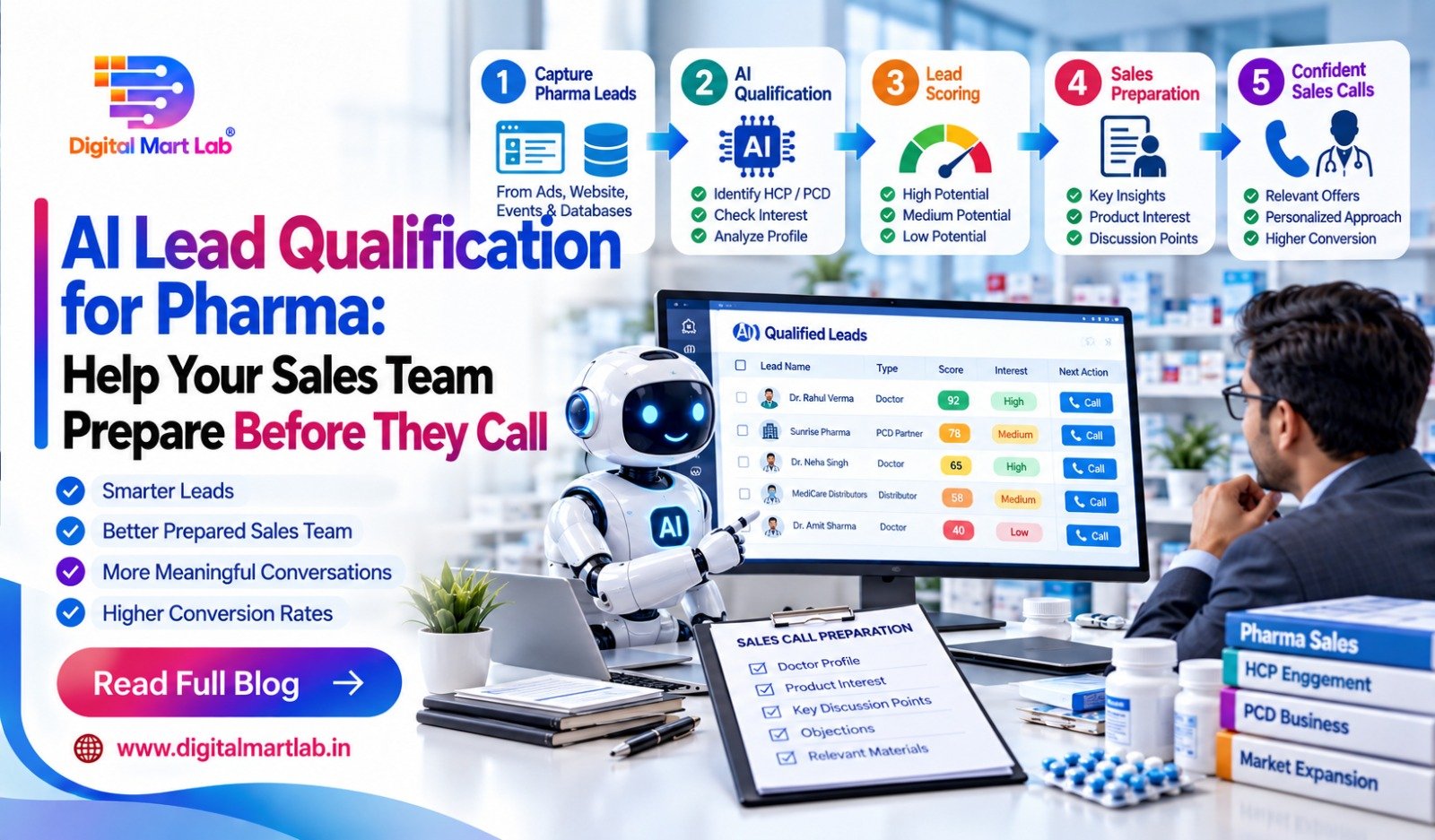
AI Lead Qualification for Pharma: Help Your Sales Team Prepare Before They Call
Your sales team opens the enquiry list and finds familiar messages:
“Send your franchise details.”
“Need third-party manufacturing.”
“Please share your products and prices.”
There may be a genuine business opportunity behind each message. But your team still needs to establish the preferred territory, product requirement, quantity or buying timeline before the conversation can move forward.
When enquiries arrive together, these basic checks become difficult to manage. Some prospects receive repeated questions. Others wait until someone has time to respond.
AI lead qualification for pharma can help by collecting a buyer’s stated requirements, recording what remains unclear and preparing a summary before your team calls. Your team still decides whether the enquiry fits your business.
The purpose is to make the first human conversation more useful—and keep promising enquiries from getting lost in an unorganised inbox.
Why More Pharma Enquiries Can Create More Work
An enquiry count tells you how many people contacted your business. It does not tell you whether your team has enough information to help them.
A franchise prospect may want a district where you already have a partner. A manufacturing buyer may need a dosage form your facility does not handle. Another prospect may be suitable but still deciding their initial product range.
These situations require different responses.
Before introducing automation, review a sample of recent enquiries. Check:
- Which questions your team asks repeatedly.
- Which missing details delay useful discussions.
- Whether the same prospect appears in several records.
- Where enquiries wait without an assigned salesperson.
- Why your team marks an enquiry as unsuitable.
If the records contain only “not interested” or “poor lead,” improve those explanations first. An AI assistant needs clear business rules, not vague labels.

What AI Lead Qualification for Pharma Should Actually Do
Think of the AI agent as an initial enquiry assistant.
With an appropriately configured workflow, it can ask relevant questions, answer from approved company information and organise the conversation for your team.
It should separate three things:
| Information type | Example | How to handle it |
| Buyer-stated requirement | “I want a franchise in Jaipur district.” | Record the requested territory accurately. |
| Approved company information | The current catalogue lists particular product ranges. | Share only the approved, current information. |
| Decision requiring confirmation | Whether that territory is available | Refer to an authorised person or a reliable, maintained system. |
A buyer requesting a territory does not make it available. A buyer mentioning a quantity does not mean your company has accepted the order.
Keeping these distinctions clear prevents an initial conversation from becoming an unintended commercial commitment.
Did You Know?
A manufacturing enquiry can sound relevant until the product, quantity and packaging requirements are understood. Collecting these details first gives your team a better basis for deciding what to discuss.
Ask Franchise Prospects About Their Intended Business
PCD franchise enquiries need a different conversation from manufacturing enquiries.
Start with the information that helps your team understand the proposed partnership.
Preferred territory and product range
Ask which state, district or area the prospect wants to serve.
Do not assume their current location is their preferred territory. Someone living in Delhi may be planning a business in another state.
Then ask about the range they want to discuss. If they are unsure, offer choices based on your actual catalogue and allow them to request guidance.
Business stage and starting timeline
Useful questions include:
- Are you exploring your first pharma business or expanding an existing one?
- When are you hoping to begin?
- Have you shortlisted an initial range?
- What would you like the sales team to clarify?
A new business owner may need more explanation than an experienced distributor. That does not automatically make the enquiry unsuitable.
Record uncertainty honestly. “Range not yet selected” is more useful than an invented assumption.
Contact preference and next step
Ask when the prospect would prefer a call and which language they are comfortable using.
Questions about documentation or commercial readiness should follow your approved process. Avoid making an initial conversation feel like a lengthy application before the buyer understands your offer.
Your team must maintain territory information and partner conditions. Track how many franchise enquiries reach a human conversation with the preferred territory and range already recorded.
Collect Manufacturing Requirements Without Pretending to Approve Them
Third-party manufacturing buyers need to explain what they want produced.
The assistant can collect an initial brief, but technical feasibility and commercial acceptance remain human decisions.
| Detail to collect | Why it helps your team |
| Product or formulation requested | Establishes what the buyer wants to discuss. |
| Dosage form and strength, where known | Helps route the enquiry to the relevant person. |
| Approximate quantity | Supports an initial discussion about order requirements. |
| Packaging preference | Identifies details that may affect feasibility and quotation preparation. |
| Desired timeline | Records the buyer’s expectation without promising delivery. |
| Current stage | Distinguishes exploration, quotation requests and active project discussions. |
| Pending questions | Helps your team prepare for the call. |
If your company has approved minimum order requirements, the assistant can explain them with the relevant qualifications. It should not apply one minimum quantity to every product unless that is genuinely your policy.
A pharma marketing company must also describe its role accurately. An assistant should never imply that the company owns a manufacturing facility when it works through manufacturing partners.
Measure how often the collected brief is useful to the person preparing the quotation—not simply how many fields were completed.
Ask Missing Questions Gradually
A prospect who writes “send details” may be using a phone between appointments. Presenting fifteen questions immediately can make the conversation harder.
A more practical sequence is:
- Establish whether the enquiry concerns a franchise, distribution or manufacturing.
- Ask the most relevant next question.
- Collect additional details as the conversation develops.
- Offer a human conversation when the buyer needs one.
For a franchise enquiry, the next question might be the preferred district. For manufacturing, it might be the requested product and dosage form.
Allow answers such as “not decided” or “need guidance.” Missing information should remain visible for follow-up rather than becoming a reason for automatic rejection.
Where supported by the implementation, the assistant should use information already provided instead of asking for it again.
Handle After-Hours Enquiries with Clear Expectations
A prospect may contact your company after the sales team has finished for the day.
An AI assistant can be configured to collect initial requirements during this period. It should explain that it is an automated assistant and make the next step clear.
For example:
“I can collect your preferred territory and product interest for our team. Please share a convenient callback time. Territory availability will need confirmation.”
This acknowledges the enquiry without promising an immediate call or an available territory.
Your team needs a morning review process, a named enquiry owner and a way to see pending callbacks. Otherwise, automation only creates a better-looking backlog.
Track the time from the enquiry to a meaningful human response. An instant automated acknowledgement is useful, but it is not the same as a sales discussion.
Give Your Salesperson a Summary They Can Trust
A useful handover should help the salesperson understand what is known, what is uncertain and what needs to happen next.
Illustrative franchise enquiry summary
This is a hypothetical example, not a Digital Mart Lab client result.
| Field | Recorded information |
| Enquiry type | PCD franchise |
| Preferred territory | Kota district |
| Product interest | General range; initial selection pending |
| Business stage | Planning a first venture |
| Stated timeline | Hoping to start next quarter |
| Buyer’s question | Wants to understand available partner support |
| Pending checks | Territory availability and applicable commercial requirements |
| Preferred next step | Hindi callback after 3 p.m. |
The salesperson can begin with the buyer’s actual concern instead of repeating the entire introduction.
An AI-generated summary can still contain mistakes. Keep the original conversation accessible, distinguish stated facts from assumptions and let the salesperson correct the record.
If your team repeatedly starts calls without this context, discuss an initial enquiry workflow through Digital Mart Lab’s AI-enabled digital marketing services. Bring your current enquiry process and the questions your team asks most often.
Keep Incomplete Enquiries Separate from Unsuitable Ones
These categories should not be treated as interchangeable.
An incomplete enquiry needs clarification. An unsuitable enquiry has a confirmed mismatch. A later-stage opportunity may fit your business but need time.
Useful statuses include:
- Ready for team review: Enough information is available for a useful call.
- Clarification needed: An important requirement is still missing.
- Human guidance requested: The buyer needs help defining the requirement.
- Later follow-up: The prospect has shared a future buying timeline.
- Possible mismatch: A stated requirement needs a person to check suitability.
Illustrative manufacturing example
A prospect asks about tablet manufacturing but does not know the packaging format.
The assistant records the product, approximate quantity and desired timeline, then notes “packaging guidance requested.”
That enquiry is incomplete, but it may still deserve a technical discussion.
If the buyer instead requests a dosage form outside the company’s approved capabilities, the assistant can flag the mismatch for review. It should not invent an alternative capability to keep the conversation moving.

Preserve Enquiry History When People Change
A distributor should not have to explain the same requirement again because a different salesperson answers the phone.
The same problem becomes more serious when an employee leaves and the enquiry history remains in individual chats.
A connected record can preserve:
- The original requirement and later changes.
- Information already shared.
- Open questions and pending decisions.
- The assigned salesperson.
- The agreed next action and date.
A CRM—a shared system for managing customer relationships—is one possible place to keep these records. The right setup depends on your existing tools, access controls and integration scope.
Did You Know?
A useful enquiry record protects continuity as well as convenience. When ownership changes, the next salesperson needs the buyer’s history, unresolved questions and promised next steps.
Record continuity depends on consistent use. Assigning an owner and maintaining the next action remain management responsibilities.
Set Clear Limits Before the Assistant Goes Live
Prepare an approved information source covering your actual ranges, business model, enquiry process and escalation contacts.
Make someone responsible for keeping it current.
The assistant should hand over when a conversation requires technical judgement, negotiated terms or information it cannot verify. It must not invent quotations, stock availability, production dates or dispatch commitments.
Collect only information needed for the enquiry. Explain its purpose, apply appropriate contact permissions, respect opt-outs and avoid requesting sensitive documents in an initial chat.
If the assistant cannot answer, a clear “our team needs to confirm this” is more useful than a confident guess.
How Digital Mart Lab Can Help Organise Pharma Enquiries
Digital Mart Lab lists smart chatbots and conversational marketing among its AI-enabled services. A pharma-specific qualification workflow should be scoped around your questions, approved information and handover process.
The practical work can be discussed in three connected areas:
| Business problem | Proposed work | What to assess |
| Salespeople repeatedly collect basic details | Design separate franchise and manufacturing question paths with structured summaries | Summary accuracy and time spent repeating questions |
| Visitors cannot identify the right enquiry route | Improve website enquiry journeys and forms | Completion, missing information and successful handovers |
| Campaigns repeatedly attract mismatched requirements | Feed confirmed sales findings into performance marketing reviews | Reasons for mismatch and suitability by campaign source |
CRM connections, WhatsApp workflows, multilingual conversations and access to live territory or order information require separate feasibility and scope checks. They should not be assumed to be included in every package.
AI can help organise the conversation. Clear offers, accurate website information and responsible sales follow-through still matter.
A Practical Checklist Before You Start
- Define separate franchise and manufacturing enquiry paths.
- Choose the minimum useful questions for each.
- Allow uncertainty and requests for human guidance.
- Approve the information the assistant may share.
- Identify decisions that always need human confirmation.
- Assign an owner to every enquiry needing action.
- Preserve conversation history and pending questions.
- Set appropriate contact permissions and opt-out handling.
- Test incomplete, unclear and out-of-scope enquiries.
- Review summaries for accuracy and missed opportunities.
Start with one manageable enquiry route. Review real conversations before adding more automation.
Measure useful information collected, human response time, summary corrections and progression to the next agreed step. A high number of completed chats alone does not prove better qualification.
Frequently Asked Questions About AI Pharma Lead Qualification
1. Can an AI agent decide which pharma leads are genuine?
It can organise stated requirements and flag possible mismatches against approved rules. It cannot reliably establish buyer credibility or commercial suitability from a short conversation. Your team should make those decisions.
2. Can one assistant handle franchise and manufacturing enquiries?
Yes, if it has separate question paths and approved information for each. Franchise conversations focus on territory and partnership needs; manufacturing conversations need product, quantity and packaging context.
3. Should we reject prospects who do not answer every question?
No. They may need guidance, be short of time or still be exploring. Record what is missing and offer an appropriate next step.
4. Can an AI assistant collect enquiries outside working hours?
A suitably configured assistant can collect initial requirements when your team is unavailable. It should explain callback expectations and route the enquiry into a process someone actually reviews.
5. Will the assistant need access to our CRM?
Basic information collection does not necessarily require a CRM connection. Shared history, duplicate checks, ownership and ongoing updates may require integration, depending on your systems and agreed scope.
6. How do we know whether AI qualification is helping?
Compare whether salespeople receive clearer requirements, repeat fewer questions and complete useful follow-ups sooner. Check summary accuracy and review enquiries marked as mismatches so suitable prospects are not overlooked.
Make the First Sales Call More Useful
Your sales team should begin a conversation knowing what the buyer has already said—and which questions still need attention.
A carefully configured AI assistant can help create that starting point. Its value comes from accurate information, sensible questions and a dependable handover to someone who can make the next decision.
Discuss how Digital Mart Lab can help you collect clearer pharma requirements before your team calls. Bring your website, current enquiry process and common qualification questions to the discussion.
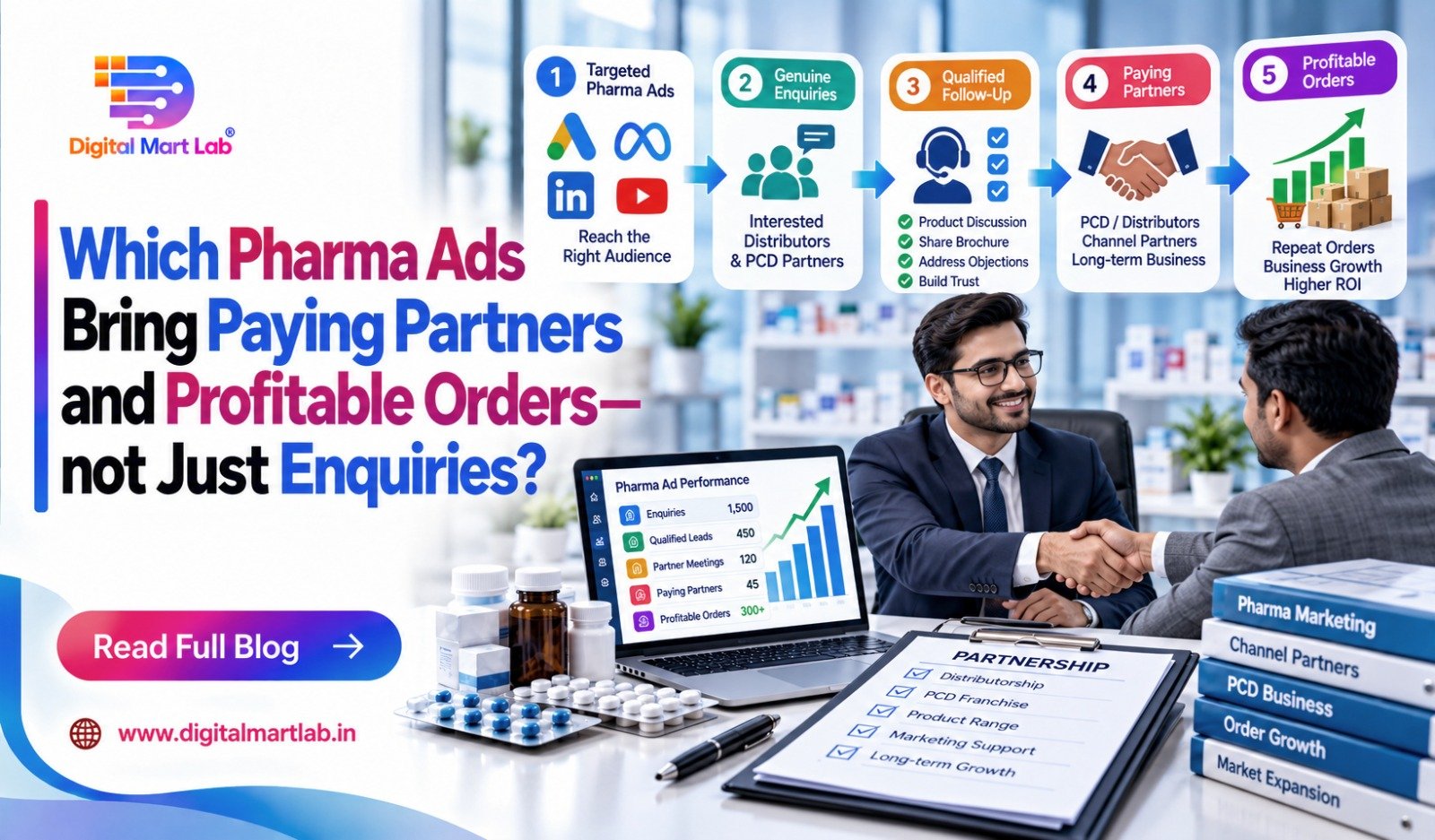
Which Pharma Ads Bring Paying Partners and Profitable Orders—not Just Enquiries?
Your monthly campaign report shows leads, clicks and cost per enquiry.
But as a pharma business owner, you want to know something more important:
“Which campaign brought customers who actually ordered?”
“And after the costs involved, was that business worthwhile?”
A campaign generating many enquiries may produce few active franchise partners. A manufacturing enquiry that looks inactive this month may become an order several months later. A large invoice may contribute less than expected after the costs of supplying it.
Understanding pharma ad ROI starts with connecting advertising sources to sales progress, paid orders and relevant commercial costs. You also need enough time to see what those enquiries become.
The lead report is the beginning of that review.

Separate enquiry activity from business outcomes
A form submission tells you that someone contacted your company. It does not establish that they became a customer.
Likewise, a quotation sent, an agreement signed and a payment received represent different stages.
Keep those stages visible.
| Stage | What it tells you |
| Enquiry received | A person has requested contact or information |
| Requirement reviewed | Your team understands the opportunity more clearly |
| Relevant sales discussion | The requirement may fit your offering |
| Quotation or terms shared | The buyer has information to assess |
| Order accepted | The business has agreed to proceed under the applicable process |
| Payment received | Money has been collected against the order |
| Repeat purchase | The customer has returned for further business |
Your process may use different labels. What matters is that everyone understands them consistently.
For credit orders, record order value and payment status separately. An accepted order is not the same as collected revenue.
Give each enquiry a source that stays with the record
If a lead enters the system without a campaign source, it becomes difficult to connect a later order with the advertising that helped generate it.
Record the available source when the enquiry arrives.
Useful fields include:
- A unique lead or opportunity reference.
- Enquiry date.
- Platform and campaign, where known.
- Advertisement or landing page, where available.
- Buyer and company details.
- Requirement and assigned salesperson.
Campaign-tagged links and form integrations can help capture this information where the setup supports them. Test the process rather than assuming the source is being stored correctly.
Preserve the original source when the conversation moves
A prospect may submit a website form and then continue on WhatsApp or email.
Keep those conversations connected to the relevant opportunity. Do not replace the original campaign source simply because the latest message arrived through another channel.
Avoid counting the same opportunity several times
One buyer may appear in multiple forms or channels.
Review possible duplicates while preserving separate projects where they are genuine. A repeat submission for the same requirement should not automatically become another acquired customer.
This makes campaign comparisons more reliable.
Connect the lead record with the order record
Your marketing system and order records need a shared reference.
When an enquiry progresses, record the customer or order reference against the opportunity. That allows your team to follow the connection without relying on memory.
A simple record might contain:
| Field | Example of what to record |
| Opportunity reference | A unique internal ID |
| Original enquiry date | When the discussion began |
| Campaign source | The available campaign information |
| Current stage | Quotation review, order accepted or another defined stage |
| First-order reference | The linked commercial record |
| Payment status | Pending, part-paid or received |
| Repeat-order references | Further purchases linked to the customer |
| Review date | When the record was last checked |
Do not force salespeople to maintain duplicate information in several places if a reliable connection can be established.
Start with a process your team can use consistently.
Measure paying partners, not only franchise enquiries
A franchise campaign may generate plenty of interest without producing active partners.
One applicant may enquire about an unavailable territory. Another may sign documents but not proceed to a first order. A third may place an initial order and continue purchasing.
These outcomes should remain separate.
Define what your business means by an active partner
Use a practical internal definition, such as a partner with an accepted and paid first order. If your business uses credit terms, define the relevant status clearly.
Track repeat activity separately instead of assuming every first-order customer remains active indefinitely.
Did You Know? The campaign generating the most franchise leads may not generate the most active partners. Linking enquiry sources with first orders and repeat purchases helps you assess which campaigns create ongoing business relationships.
Review why first orders do not happen
Where an interested applicant does not progress, record the reason if known.
It may involve range selection, territory, commercial terms, documents or timing.
These findings help distinguish an unsuitable enquiry from an incomplete onboarding process.
Allow time for manufacturing enquiries to become orders
Manufacturing buyers may need to clarify specifications, review quotations, assess samples or involve other colleagues before deciding.
A campaign can generate the initial enquiry well before the order is placed.
If you review only orders received in the same month as the advertising spend, you may miss that connection.
Follow groups of enquiries from the period they arrived
For example, continue reviewing the enquiries received in one month as they move through later discussions.
Compare them with other groups at a similar age. A group of enquiries received last week has not had the same opportunity to convert as one received several months ago.
Use a review period that reflects your actual buying process.
Keep delayed opportunities visible
Record what the buyer is waiting for and the next agreed action.
Do not mark an enquiry as lost simply because an order did not arrive immediately. Equally, do not leave it open forever without a meaningful reason.
Did You Know? A manufacturing enquiry may become an order months after the campaign starts. Connecting the enquiry with later quotations and purchases helps identify advertising contributions that an immediate-results report can miss.
A large order is not automatically a profitable advertising result
Order value matters, but it does not show how much the business retained.
A manufacturing order may involve production or procurement costs, packaging, logistics and other costs directly associated with fulfilment.
There may also be costs involved in acquiring and developing the customer.
A useful commercial review considers the relevant costs rather than treating the invoice amount as profit.
Agree on which costs your report includes
Depending on your business and reporting purpose, these may include:
- Advertising spend.
- Agency or campaign-management fees.
- Creative and landing-page costs.
- Direct sales-development expenses.
- Samples and dispatch costs.
- Product or manufacturing costs.
- Packaging and order-related logistics.
- Discounts, returns or adjustments.
Some costs are shared across customers or periods. Agree on a consistent allocation method with the person responsible for your commercial records.
Avoid double-counting a cost already included in another figure.
Keep revenue, cash collection and contribution distinct
Revenue records, customer payments and the contribution remaining after specified costs answer different questions.
Your marketing report should state which one it uses.
A useful contribution calculation is not automatically the company’s final net profit. Other operating costs may still need to be accounted for.
Use a simple example to see the difference
The following comparison is illustrative only. It is not a forecast, client result or industry benchmark.
Assume the figures relate to two campaigns reviewed over comparable periods, with order-related variable costs and acquisition costs defined consistently.
| Measure | Campaign A | Campaign B |
| New customers placing paid first orders | 10 | 6 |
| Net sales value from those orders | ₹5,00,000 | ₹4,00,000 |
| Direct order-related variable costs | ₹4,20,000 | ₹2,80,000 |
| Contribution before acquisition costs | ₹80,000 | ₹1,20,000 |
| Defined acquisition costs | ₹60,000 | ₹60,000 |
| Contribution after those acquisition costs | ₹20,000 | ₹60,000 |
Campaign A generated more first-order customers and higher sales value. Campaign B produced a larger contribution after the costs included in this example.
That does not establish a permanent winner. Repeat purchases, unresolved returns and further costs may change the picture.
The example shows why lead count and invoice value alone are insufficient.
Track repeat purchases without assuming future revenue
A first order may be the beginning of a valuable relationship.
Link subsequent orders to the customer record so you can review the business generated by customers originally acquired through a campaign.
Also record cancellations, returns or other adjustments that affect the result.
Use observed purchases in the main report
Do not treat hoped-for repeat orders as revenue already earned.
If you prepare a forecast, label it separately and explain the assumptions. Keep actual results visible alongside it.
Recognise that retention involves more than the original ad
A customer may reorder because of product fit, service, availability and the work of your team.
You can report repeat purchases from a campaign-acquired customer group without claiming the original advertisement alone caused every later order.
That distinction keeps the report useful and realistic.
Update qualification as the buyer’s requirement changes
The first enquiry is only a snapshot.
A distributor may change their preferred range or starting budget. A manufacturing buyer may revise the quantity, packaging or timeline.
If your team continues using the original information, the opportunity may be prioritised incorrectly.
Record the latest requirement and its date
Keep the current requirement visible while preserving important history.
An updated conversation may make an opportunity more suitable, less suitable or ready for a different next step.
Review AI-generated priorities
Where AI helps summarise or prioritise enquiries, make sure it uses the latest verified information.
A score based on an old enquiry should not override a recent conversation.
An agreed AI-assisted lead management process can support these updates, with your team checking commercial suitability and commitments.
Do not confuse more follow-up activity with better results
A report showing more calls or automated messages may indicate effort. It does not prove that opportunities are progressing.
Ask what changed after the activity.
Did the buyer clarify the requirement? Was a concern resolved? Did the discussion move to a quotation, approval or order?
A smaller number of relevant follow-ups can be more useful than repeated messages that do not address the pending decision.
Record the next action and outcome, not only the number of attempts.
What should your monthly pharma campaign review include?
Use a report that connects marketing and sales without becoming unnecessarily complicated.
Include:
- Spend and the costs covered by the report.
- Unique enquiries and relevant requirements.
- Progress through agreed sales stages.
- First orders and payment status.
- Repeat purchases from previously acquired customers.
- Important commercial costs and adjustments.
- Unresolved opportunities that need more time.
- Specific actions for the next review period.
Keep recent enquiry groups separate from older ones where the buying cycle makes this necessary.
Also acknowledge source gaps. If the campaign connection is unknown, label it unknown rather than assigning an order to whichever channel looks most convenient.

How Digital Mart Lab can help connect campaigns with commercial results
Digital Mart Lab can help plan the link between enquiry capture, sales updates and campaign reporting.
Through performance marketing services, the proposed work can include:
- Capturing available campaign sources.
- Reviewing lead and order-reference connections.
- Defining meaningful enquiry and sales stages.
- Separating activity from commercial progress.
- Reviewing results with your sales team.
- Using updated requirements to guide campaign decisions.
Where enquiry details are being lost at submission, website and form improvements can support better records.
Your business supplies and validates order, payment and cost information. The marketing review uses that information to make more informed campaign decisions.
The aim is to identify what is producing useful business and what still needs attention.
Frequently asked questions about pharma ad ROI
1. Is cost per lead enough to judge a pharma campaign?
No. It shows the cost of generating an enquiry under your reporting definition. You also need to review relevance, sales progress, paid orders and the costs of serving the customer.
2. Should we count a signed franchise agreement as a paying partner?
Keep agreement status and first-order status separate. Use a clear internal definition of a paying or active partner and apply it consistently.
3. How should we record an order received months after the enquiry?
Link it to the original opportunity and available campaign source. Review it with the group of enquiries from that period, while also recording the actual order and payment dates.
4. Does a high return on ad spend prove profitability?
No. Sales value compared with advertising spend does not include every relevant cost. Review fulfilment costs and other acquisition expenses before drawing a profitability conclusion.
5. Can we include repeat orders when reviewing acquired customers?
Yes. Show them separately from first orders and use actual purchases. Avoid claiming that the original advertisement was the only reason for every repeat order.
6. What if we cannot identify the campaign behind an order?
Record the source as unknown or partially known. Ask for available context and improve future tracking, but do not invent an attribution.
Find out which enquiries become worthwhile business
A useful campaign report should help you move beyond “How many leads did we get?”
Connect the original enquiry with the buyer’s progress, first order, payment status and repeat activity. Then review the relevant costs over a realistic period.
That gives you a stronger basis for deciding which campaigns to improve, continue or expand.
Want a clearer view of what your pharma advertising is bringing to the business?
Discuss Your Pharma Campaign Tracking with Digital Mart Lab
Share how you currently record enquiries, orders and campaign sources. We can use that process to identify the connections your reporting needs.

Your Pharma Ads Bring Leads, but Few Become Orders: Where Is the Sales Process Breaking Down?
Your campaign is generating enquiries. Your team is calling prospects, sending catalogues and preparing quotations.
But when you review the month, relatively few discussions have become orders.
The immediate reaction may be, “We need better leads.”
Sometimes that is true. But before changing the campaign, check what happened to the enquiries already received.
Did every relevant prospect have an assigned salesperson? Was the requirement clarified? Did someone record the next action? Was the buyer waiting for another person to approve the decision?
Improving pharma lead conversion means reviewing the full journey after an enquiry arrives. Advertising creates an opportunity for contact. Ownership, qualification, follow-up and buyer decisions determine how that opportunity progresses.

Find the stage where enquiries are stopping
A report showing total leads and total orders leaves most of the story unexplained.
Separate the stages your team actually uses.
| Stage | What you need to know |
| Enquiry received | Has it reached the responsible team? |
| Contact attempted | Has someone tried to reach the prospect? |
| Requirement understood | Do you know what the buyer wants? |
| Suitability reviewed | Can your business potentially serve the requirement? |
| Details or quotation shared | What was sent, and what response is needed? |
| Decision pending | What remains unresolved, and who is involved? |
| Order confirmed | Has the buyer completed your agreed acceptance process? |
Keep your definitions consistent. Sending a price list should not automatically move an enquiry into “quotation discussion” if the requirement is still unclear.
Review where enquiries accumulate. That is where to begin asking questions.
Check 1: Does every enquiry have a clear owner?
An enquiry can appear in a shared inbox or spreadsheet without anyone taking responsibility for it.
One salesperson assumes another will call. Someone sends a catalogue but does not record the conversation. When the prospect replies later, the message is missed.
Assign a named owner to each enquiry.
The owner should know what action is due, when it is due and who needs to help if the matter falls outside their role.
Separate ownership from access
Several employees may need to see an enquiry, but one person should coordinate the next step.
For example, a salesperson may own the buyer conversation while a technical colleague reviews a manufacturing requirement.
The record should make both responsibilities clear. This avoids leaving the prospect between departments.
Plan for absence and reassignment
If the assigned person is unavailable, another employee should be able to see the requirement, previous discussion and pending action.
A handover needs more than a phone number. It needs enough context to continue without asking the buyer to repeat everything.
Check 2: Has the requirement been clarified before follow-up begins?
A message saying “Send details” does not establish what the prospect needs.
If the team immediately sends a full catalogue, the next follow-up may become another general question: “Are you interested?”
Collect enough context to make the discussion specific.
For a franchise enquiry, this might include the preferred district, range and starting timeline.
For manufacturing, it may include the product requirement, dosage form, estimated quantity and packaging preference.
Distinguish missing information from a confirmed mismatch
A buyer who has not decided the quantity may need clarification. A buyer requesting a capability you do not provide has a different issue.
Use separate statuses, such as:
- Requirement incomplete.
- Suitable for further discussion.
- Technical review needed.
- Outside current offering.
- Planning for a later date.
This helps your team choose the next action instead of treating every unfinished discussion as a poor lead.
Review whether the form prepares the conversation
If the same basic details are missing from nearly every enquiry, improve the starting form.
A focused website and enquiry-form review can help collect useful information without making the initial request difficult to complete.
Check 3: Is your team treating every enquiry as equally urgent?
Not every relevant prospect needs the same action today.
One applicant may be ready to discuss an available territory. Another may be exploring a business they plan to start later. A manufacturing buyer may be waiting for clarification before the quotation can move forward.
Priority should reflect the stated requirement and the next decision.
Use practical priorities
| Situation | Useful next action |
| Relevant buyer waiting for an agreed callback | Complete the callback as arranged |
| Manufacturing request awaiting technical clarification | Obtain the required review |
| Prospect planning a later start | Agree on an appropriate follow-up date |
| Enquiry with missing details | Ask a focused clarification question |
| Confirmed mismatch | Explain the position and record the outcome |
An urgent message does not automatically indicate a strong opportunity. Similarly, a new business owner should not be dismissed simply because they need more guidance.
Let AI assist with organisation, not final judgement
An AI system can help summarise stated needs, flag missing information and suggest which records need attention.
Your team should check the priorities and retain responsibility for suitability decisions.
Did You Know? Treating every franchise enquiry as equally urgent can overwhelm your sales team. AI-assisted prioritisation can organise stated requirements and pending actions, while employees remain responsible for checking business suitability.
Check 4: Is one buyer appearing as several different leads?
The same person may complete a website form, send a WhatsApp message and email a manufacturing requirement.
If these become separate records, different employees may contact the buyer without knowing about the other conversations.
The results can include repeated questions, conflicting updates and duplicate follow-up messages.
Keep one coordinated view of the opportunity
Where possible, connect the relevant conversations with a shared lead or opportunity record.
Useful details include:
- Contact and company information.
- The requirement being discussed.
- Enquiry sources.
- Conversation history.
- Assigned owner.
- Current stage and next action.
Preserve the source information when records are linked. It can help your marketing team understand how the buyer reached you.
Do not merge records blindly
One company may have several contacts. One buyer may also have multiple genuine requirements.
Matching a phone number or email address can suggest a duplicate, but the team should confirm whether the records concern the same opportunity.
The goal is to prevent repeated conversations without losing separate projects or decision-makers.
Keep automated messages coordinated
If a salesperson has taken over a negotiation, routine automated messages should reflect that status.
A buyer discussing final details should not receive a general introduction asking which service they need.
An agreed AI automation and enquiry-management setup can help connect records and pause unsuitable follow-ups when the sales stage changes.
Check 5: Does every follow-up have a reason?
“Any update?” is easy to send, but it may not help the buyer move forward.
A useful follow-up refers to the last discussion and asks about the next unresolved point.
For example:
“You mentioned that you wanted to review the derma range before discussing the territory. Is there a particular part of the portfolio you would like our team to explain?”
For manufacturing:
“You were reviewing the proposed packaging details. Is anything still needed from our team before you can continue the quotation discussion?”
These messages require an accurate conversation record.
Record the next action before closing the conversation
After a call, note:
- What was discussed.
- What remains pending.
- Who needs to act.
- When the next contact is appropriate.
“Interested” is not a complete next step.
“Buyer will review the range; salesperson to call on the agreed date” gives the team something actionable.
Did You Know? Your next franchise discussion may be waiting in an enquiry your team forgot. A connected follow-up process can keep pending conversations visible and help salespeople continue relevant opportunities.
Respect the buyer’s timeline
A prospect planning to start later may not need frequent calls today.
Agree on a suitable next contact where possible. Record requests to stop or postpone communication so the team and automation follow the same instruction.
Check 6: Is your contact waiting for another decision-maker?
The person discussing the requirement may not be able to approve the entire purchase alone.
A manufacturing contact may need technical, purchasing or management input. A franchise applicant may be discussing the business with a partner.
If your salesperson does not understand this, follow-up may repeatedly ask for a decision the contact cannot yet make.
Ask about the approval process naturally
Useful questions include:
- “Who else will review the requirement?”
- “Is there any information your colleague needs from us?”
- “What needs to be confirmed before the next step?”
- “Would a technical discussion help resolve the pending question?”
These questions should support the contact, not bypass them.
Share material that helps the internal discussion
Provide the relevant range details, capability information or quotation explanation.
A short, accurate summary may help more than repeatedly forwarding the entire company catalogue.
Illustrative example: A manufacturing enquiry appears inactive after a quotation. The salesperson learns that the contact is waiting for a colleague to review the packaging requirement.
The next step is to answer the packaging question or arrange the appropriate discussion. Another general reminder about the quotation would not address the actual delay.
Check 7: Is the issue actually commercial fit?
A well-managed sales process cannot make every opportunity suitable.
The buyer may need a price, quantity, territory or level of support your company cannot offer.
Record these reasons honestly.
Do not classify every lost discussion as a campaign problem. Equally, do not assume better follow-up can resolve a confirmed mismatch.
Separate:
- Irrelevant enquiry.
- Incomplete requirement.
- Delayed decision.
- Commercial mismatch.
- Lost contact.
- Confirmed order.
This gives both sales and marketing a clearer picture of what needs improvement.
Use a simple record your team will maintain
You do not need to begin with a complicated system.
A shared lead record can be useful if it is maintained, access is appropriate and ownership is clear.
| Field | What to record |
| Lead or opportunity ID | A consistent reference |
| Buyer and company | Who is involved |
| Requirement | Range, territory or manufacturing details |
| Owner | Who coordinates the enquiry |
| Stage | Where the discussion currently stands |
| Latest conversation | A short factual summary |
| Pending decision | What is preventing progress |
| Next action and date | Who will do what next |
| Other people involved | Relevant contacts and their roles |
| Outcome | Order, later follow-up or a documented reason for closure |
Choose a tool your team can use consistently. More fields do not help if the important ones remain empty.

Measure progress between stages, not only total leads
Review how enquiries move through your process.
Useful measures include:
- Enquiries assigned to an owner.
- Requirements successfully clarified.
- Relevant conversations started.
- Quotations or proposals awaiting a decision.
- Overdue next actions.
- Orders and documented closure reasons.
Compare enquiries that have had a reasonable opportunity to progress. A newly received manufacturing enquiry should not be judged against one that has been under discussion for several months.
Also remove duplicate counting where records concern the same opportunity.
Your performance marketing review should include these sales outcomes. They help distinguish campaign relevance from what happens after the enquiry arrives.
How Digital Mart Lab can help connect campaigns with sales follow-up
Digital Mart Lab can help review the journey from enquiry submission to the next sales action.
The proposed work can include:
- Mapping where new enquiries arrive.
- Improving forms and initial requirement collection.
- Defining enquiry ownership and handover steps.
- Connecting agreed lead records.
- Planning relevant reminders and follow-ups.
- Setting up AI-assisted summaries and review priorities.
- Bringing sales feedback into campaign reporting.
Automation features and integrations should be agreed around your existing process.
The aim is to make relevant opportunities easier to follow and reduce avoidable gaps. Your team still owns the commercial discussion and final commitments.
Frequently asked questions about pharma lead conversion
1. Why do pharma leads fail to become orders?
Possible reasons include unsuitable requirements, unclear ownership, missed follow-ups, commercial mismatches or pending buyer approvals. Review the stage where each discussion stopped before deciding on the cause.
2. Should every new enquiry receive the same follow-up sequence?
No. Follow-up should reflect the requirement, previous conversation and buyer timeline. A quotation review needs different communication from an initial catalogue request.
3. Can AI decide which enquiries are most important?
It can help organise information and suggest priorities. Your team should review the criteria and check uncertain cases rather than allowing a score to make every decision.
4. How should we handle duplicate enquiries?
Check whether they concern the same buyer and opportunity. Link the relevant history while preserving separate projects, contacts and source details where needed.
5. What if our contact is waiting for management approval?
Ask what information or decision is pending. Support the contact with relevant material and arrange further discussions through them where appropriate.
6. Do we need a new CRM immediately?
Not necessarily. Start by defining ownership, stages and next actions. Then assess whether your current tools can support the process reliably or whether an upgrade is justified.
Make every relevant enquiry easier to move forward
Before asking the campaign to produce more leads, review the opportunities already in your records.
Give each one an owner. Clarify the requirement. Keep conversations connected. Record the pending decision and the next action.
These steps help your team see which discussions can move forward and which need a different response.
Getting pharma enquiries but struggling to turn them into useful sales progress?
Discuss Your Pharma Lead Management and Follow-Up with Digital Mart Lab
Share how your team receives, assigns and follows up enquiries today. We can use that process to identify where better organisation and suitable automation may help.

Google Ads or Meta Ads for Your Pharma Business? Choose by Buyer Fit, Not Just Cheap Leads
One campaign gives you more enquiries at a lower cost. Another brings fewer enquiries, but the conversations seem more relevant.
Which one should receive more budget?
For a pharma business, the answer depends on what those people want.
A franchise enquiry for an unavailable district may go nowhere. A manufacturing request for an unsupported dosage form is unlikely to progress. Meanwhile, one suitable buyer may begin a useful quotation discussion.
When comparing Google Ads vs Meta Ads for pharma, review the buyer’s requirement and what happens after contact—not just the cost of collecting a phone number.
Both platforms need clear offers, suitable enquiry processes and feedback from your sales team. Neither automatically guarantees better buyers.
Start with the business opportunity you want to promote
“Generate pharma leads” is too broad to guide a useful campaign.
A PCD franchise company seeking partners for selected territories has a different requirement from a manufacturer seeking enquiries for a specific capability.
Before choosing a channel, define:
- The business relationship you want.
- The range or capability you are promoting.
- The territories or markets you can consider.
- Important commercial requirements.
- What information your team needs before a call.
- The next step a suitable prospect should take.
These details help you judge whether the campaign is attracting the right conversations.
Check advertising eligibility first
The actual offer and destination must be assessed against the relevant platform requirements.
For example, Google’s healthcare and medicines policy restricts certain content and sets conditions for particular categories and locations.
Calling an offer “B2B” does not automatically make it eligible. Approval on one platform also does not establish eligibility on another.
Once eligibility is understood, compare the channels for the business objective they can serve.
Understand the difference between an active search and an introduction
Google Ads includes several campaign formats. For this comparison, the search examples refer to Google Search campaigns.
A search campaign can reach someone expressing a requirement through a query. Meta campaigns can introduce an offer while someone is using Facebook or Instagram.
That starting point can affect the information a buyer needs next.
| Question | Google Search campaigns | Meta campaigns |
| How might the conversation begin? | A person searches for a company, range or service | A person notices an advertisement and responds to the offer |
| What needs particular attention? | Actual searches, their intent and the relevant destination | Clear creative messaging and what submitting an enquiry means |
| What can go wrong? | Searches may be unrelated, too broad or already brand-aware | People may respond without fully understanding the business offer |
| How should results be judged? | Requirement suitability and subsequent sales progress | Requirement suitability and subsequent sales progress |
These are starting differences, not fixed rules about lead quality.
A search visitor may still be researching. A person discovering your offer on Meta may have a suitable business requirement.
Separate people searching your company name from new discovery
A prospect searching your company name already has some awareness of your business.
They may have received a referral, seen a previous advertisement or spoken with your salesperson. A campaign that captures this search plays a different role from one introducing your company to someone new.
If both are combined in one report, the results can become misleading.
Review brand searches separately
Compare enquiries from company-name searches with enquiries from broader searches about your offering.
For example, a search containing your brand name differs from a search about a particular manufacturing capability.
Both can be valuable. However, the first does not prove that the advertisement created the initial interest.
Did You Know? People searching your company name already have some awareness of your business. Reviewing these campaigns separately from broader business searches helps you understand where advertising captures existing interest and where it introduces your offer.
Remember that channels can contribute to the same enquiry
A buyer might notice your company through Meta, research it later on Google and then call.
Record available source information and ask how the person first heard about you. Treat the answer as useful context rather than perfect attribution.
Do not simply add both platforms’ reported conversions together and assume they represent different buyers.
Define buyer fit before comparing cost per lead
Agree on what makes an enquiry worth further review.
For franchise campaigns, relevant details may include the preferred territory, range and expected starting timeline.
For manufacturing campaigns, they may include dosage form, estimated quantity and packaging requirements.
Use these details to assess the opportunity.
| Buyer type | Questions that help establish fit |
| PCD franchise applicant | Which district and range are they considering? |
| Distributor | Does the portfolio fit their stated business requirement? |
| Manufacturing buyer | Does the requirement match supported capabilities and quantities? |
| Early-stage prospect | What remains undecided, and what guidance do they need? |
A suitable enquiry is not a confirmed customer. It is a reasonable opportunity for the next business discussion.
Keep “not yet reviewed” separate from “unsuitable.” Otherwise, incomplete follow-up can make a campaign appear worse than it is.
Test the reasons buyers might choose your company
Your team may believe that one strength will attract the most interest. Buyers may respond more strongly to another.
For a franchise offer, you could test messages about:
- A relevant product range.
- Actual partner support.
- A clear partnership process.
For manufacturing, the message could focus on a supported capability or the information needed for a requirement review.
Use only claims your business can support.
Compare meaningful responses
An advertisement may receive plenty of reactions without producing relevant conversations.
Another may attract less attention but lead to clearer enquiries.
Review what people ask after responding. Are they interested in the advertised range? Do they understand the offer? Can the team move the discussion forward?
Keep tests understandable
When testing a message, avoid changing the audience, destination, form and follow-up process at the same time unless necessary.
Record what changed so you can interpret the result.
There is no universal message that wins for every pharma business. The useful answer comes from your offer and the buyers responding to it.
Do not dismiss a promising applicant because they are new
An established distributor and a first-time franchise applicant may need different conversations.
The experienced person may be ready to discuss portfolio fit. The newcomer may need the partnership process explained.
Experience is useful context, but it should not be the only basis for prioritisation.
Ask about the plan behind the enquiry
A new applicant may have a clear territory preference, a relevant range interest and a realistic starting plan.
An experienced applicant may request an unavailable area or have expectations your company cannot meet.
Review the stated requirement rather than treating one group as automatically better.
Check how AI scoring treats newcomers
If an automated scoring system gives most of its weight to previous experience, it may push suitable first-time applicants down the list.
Review the criteria with your sales team. Missing information should prompt clarification where useful, and uncertain cases should remain available for human review.
AI-assisted enquiry qualification can help organise requirements, but your team should retain responsibility for business suitability.
A lower lead count can still produce better manufacturing opportunities
Manufacturing enquiries can differ substantially in commercial relevance.
An enquiry requesting an unsupported dosage form may be inexpensive to generate but cannot become a suitable quotation.
A more costly enquiry that matches the capability and quantity requirements may deserve detailed review.
Did You Know? A manufacturing creative producing fewer leads may still create better quotation opportunities. Comparing enquiries with supported capabilities and suitable quantities helps you assess their business relevance.
Look at the cost of relevant enquiries
Illustrative example—not a forecast or platform benchmark:
| Measure | Campaign A | Campaign B |
| Advertising spend | ₹15,000 | ₹15,000 |
| Unique enquiries | 100 | 40 |
| Cost per enquiry | ₹150 | ₹375 |
| Enquiries meeting the agreed relevance criteria | 10 | 16 |
| Cost per relevant enquiry | ₹1,500 | ₹937.50 |
Campaign A looks cheaper when you count every enquiry. Campaign B costs less per relevant requirement in this example.
The same pattern could occur on either platform.
Neither result establishes profitability. You still need to review quotations, orders and the costs of serving those customers. The example includes advertising spend only.
Give both channels a suitable destination and follow-up process
A fair comparison needs more than campaign reports.
If one campaign sends visitors to a clear range page and another sends them to a confusing homepage, the destination may influence the outcome.
If one set of leads receives prompt contact and another waits unattended, the sales process may influence the comparison.
Match the page or form to the offer
A franchise advertisement should lead to relevant range and territory information.
A manufacturing advertisement should explain the capability and collect the starting requirement.
Where campaigns use different enquiry formats, acknowledge that difference when reviewing results.
A website and landing-page review can help remove avoidable confusion before judging the channel.
Use consistent sales handling
Agree on who contacts enquiries, what they ask and how outcomes are recorded.
Do not compare one channel’s fully reviewed leads with another channel’s uncontacted submissions.
Allow enough time for meaningful follow-up. A buyer considering a manufacturing project may not reach the same stage as a franchise applicant within a few days.
Should you start with Google Ads, Meta Ads or both?
Choose based on the offer, evidence and resources available.
| Situation | Planning approach |
| There is relevant search demand for a supported service | Consider an eligible Search campaign with a focused destination |
| Buyers need to understand a range or partnership offer | Consider testing clear discovery messages on Meta, subject to eligibility |
| Your company already receives brand searches | Review brand activity separately from new-buyer acquisition |
| The budget is limited | Start with a focused test rather than spreading spend across too many campaigns |
| Both channels produce suitable enquiries | Compare their roles and later sales outcomes before changing the split |
| Neither produces useful conversations | Revisit the offer, message, destination and follow-up before increasing spend |
These are planning directions, not automatic platform recommendations.
Avoid a fixed budget split without evidence
There is no reliable rule that every pharma company should allocate the same percentage to each platform.
Start with a clear objective, track the results and adjust based on relevant enquiries and commercial progress.
If your available budget cannot support a useful test across both channels, prioritise one clear campaign first.
How Digital Mart Lab can help compare pharma advertising channels
Digital Mart Lab can help plan the comparison around your business requirements.
Through performance marketing services, the proposed work can include:
- Assessing the offer and applicable campaign requirements.
- Separating brand interest from broader discovery.
- Planning relevant creative messages.
- Aligning landing pages and enquiry questions.
- Reviewing lead suitability with the sales team.
- Checking qualification criteria for unnecessary bias against newcomers.
- Reporting costs alongside meaningful sales progress.
Your wider marketing plan may also include SEO for business discovery, helping buyers research your company and capabilities over time.
The objective is to understand which activities create useful opportunities and how they work together.
Frequently asked questions about Google Ads vs Meta Ads for pharma
1. Which platform gives better pharma leads?
Neither is automatically better. Suitability depends on the offer, campaign setup, message, enquiry process and the buyer requirements your business can serve.
2. Are cheaper Meta leads always less useful?
No. Review the actual requirements and sales outcomes. Cost alone does not establish whether an enquiry is relevant.
3. Are Google Search enquiries always ready to buy?
No. A search may reflect research, existing brand awareness or an unsuitable requirement. Your team still needs to establish fit and the next step.
4. Should company-name searches be reported separately?
Yes, where possible. They help distinguish existing awareness from broader discovery, although several channels may have contributed to that awareness.
5. Should first-time franchise applicants receive lower priority?
Not automatically. Assess their stated plans, territory, range and remaining questions. Experience should be one consideration rather than the only deciding factor.
6. When should we increase spending on a channel?
After reviewing enquiry relevance, follow-up capacity and sales progress. A few inexpensive submissions are not enough evidence for a major budget change.
Choose the channel that supports useful business conversations
The important question is not simply which platform generates more forms.
It is which campaigns bring requirements your company can potentially serve—and help those discussions progress.
Separate brand interest from discovery, test relevant messages and review what buyers actually need. Give promising newcomers a fair assessment and compare costs beyond the first submission.
Want to choose a clearer advertising approach for your pharma business?
Discuss Your Pharma Advertising Strategy with Digital Mart Lab
Share your priority range or capability, current campaign results and sales feedback. We can use that information to plan a more useful channel comparison.

Getting Job Seekers, Patients and Price-Only Enquiries from Pharma Ads? How to Improve Lead Quality
Your campaign report shows new leads. Your sales team starts calling.
One person wants a job. Another wants to buy medicine for personal use. Several ask for the price list without explaining what they need.
By the end of the day, the team has made plenty of calls but had few useful business conversations.
Before deciding that advertising does not work, look at how these enquiries entered the system.
Improving pharma lead quality means making the business offer clear, reviewing the traffic behind the campaign and collecting enough information to understand each requirement.
It also means recognising an important difference: a job enquiry is unrelated to your franchise offer, but a price-list request may still come from a genuine buyer.
First, define what a relevant pharma enquiry looks like
Your campaign manager and sales team should agree on what they are trying to attract.
For a PCD company, a relevant enquiry might involve someone exploring a franchise range and a preferred territory.
For a manufacturer, it might concern a dosage form, quantity and packaging requirement your team can potentially support.
A relevant enquiry does not have to be ready to place an order immediately.
Separate these three questions:
- Is this a business enquiry?
- Could the requirement fit our offering?
- What needs to happen before a commercial discussion can progress?
This makes your review more useful than labelling every enquiry “good” or “bad.”
Use categories your team can act on
| Enquiry type | What it means | Appropriate next step |
| Recruitment request | The person wants employment | Direct them to the recruitment route, if available |
| Individual medicine enquiry | The person wants a product or personal-use information | Clarify the business service; do not treat it as a franchise lead |
| Relevant but incomplete requirement | Important details are missing | Ask a short clarification question |
| Confirmed business mismatch | The requirement falls outside your offering | Explain the limitation |
| Relevant, later-stage plan | The buyer is considering a future start | Agree on an appropriate next step |
| Ready for detailed review | Enough relevant information is available | Assign the sales or technical discussion |
Keep “not contacted” and “no response” separate. Neither proves that the requirement is unsuitable.
Why pharma ads can attract job seekers and patients
The advertisement may mean one thing to your team and something different to the person seeing it.
“Join a growing pharma company” could sound like recruitment.
A product photograph with a price may look like an invitation to buy medicine.
“Contact us for pharma opportunities” leaves the type of opportunity unclear.
The destination page can add to the confusion if it shows products without explaining whether the company seeks distributors, franchise partners or manufacturing customers.
Review the whole message from a new visitor’s perspective.
State the business relationship clearly
Where the offer is accurate and eligible to advertise, use direct wording such as:
- “Discuss PCD franchise opportunities.”
- “Enquire about distribution for this range.”
- “Share your third-party manufacturing requirement.”
The range, service and next step should be understandable before someone submits a phone number.
Review the actual searches behind your Google Ads
The keywords selected in the campaign do not tell the whole story.
A keyword is part of your advertising setup. A search term is what someone actually entered.
Google’s search terms report helps you review available searches that triggered advertisements. It does not expose every query, so combine it with enquiry feedback.
Look for patterns rather than reacting to isolated words.
Connect search activity with the enquiry problem
If your sales team repeatedly receives recruitment requests, check whether available searches show job-related intent.
If enquiries concern individual purchases, review whether search activity and page content are attracting that audience.
Also examine the keywords, matching choices and campaign settings behind the traffic.
A campaign containing “franchise” keywords can still need improvement. The campaign name or keyword list alone does not prove that the resulting conversations fit your business.
Did You Know? Franchise advertising can spend money on job searches and individual medicine enquiries. Regular search-term reviews help identify irrelevant traffic and guide campaign attention towards people researching a business partnership.
Use exclusions carefully
Google’s negative keyword guidance explains how exclusions can help prevent ads from appearing for unwanted searches.
Choose exclusions from evidence. Do not block a broad word just because it appears in one unsuitable enquiry.
For example, excluding “price” without considering the context could affect searches from genuine buyers researching commercial information.
Review the scope and matching behaviour of each exclusion before applying it.
Make Meta ad messages and forms clear before changing everything
People viewing a social advertisement may not have been actively searching for your service.
The creative therefore needs to explain the business opportunity clearly.
A product image alone may not establish that you want distributors. A broad opportunity message may not establish that you are discussing a franchise.
Explain what submitting the form means
Tell the person what they will receive or discuss.
If submission requests a sales callback, make that clear. If the offer is a catalogue, explain any contact that forms part of the request.
The advertisement, form and confirmation message should agree.
Ask a few relevant questions
A form can ask what the person wants to discuss before collecting further details.
Use options that match your actual offering, such as franchise, distribution or manufacturing.
Then collect the requirements relevant to that choice. Do not add questions merely to make the form longer.
Campaign eligibility and settings still need assessment for the platform and offer. Screening questions improve context; they do not make an ineligible advertisement acceptable.
Do not assume a price-list request is a poor lead
“Send your best price” tells you very little about the underlying requirement.
The person may be comparing suppliers, preparing a business plan or ready to discuss a specific range. They may also be outside your target market.
You need one or two useful questions before deciding.
For a franchise enquiry, you could ask:
“Which range and district are you considering? This will help our team share the relevant information.”
For manufacturing:
“Could you share the product requirement and approximate quantity, including the unit? Our team can then review what details are needed.”
Urgency does not establish buying readiness
“Send prices urgently” does not confirm the quantity, commercial fit or starting timeline.
Avoid prioritising a lead solely because the message sounds urgent. Collect the business context and assess the next step.
Did You Know? An urgent pharma price-list request does not establish buying readiness. An AI assistant can collect the underlying requirement and timeline, helping your team understand the opportunity before treating it as a priority deal.
Give each buyer a relevant landing page
An advertisement may be clear while the destination creates confusion.
A manufacturing buyer should find capability information and a manufacturing enquiry option. A franchise applicant should find the relevant range, support and territory discussion process.
The page should also explain the company’s actual role.
Use the page to answer basic questions
Before asking for contact details, explain:
- Who the offer is for.
- What the company provides.
- Which range or capability is relevant.
- What information is needed to begin.
- What happens after submission.
This gives people an opportunity to assess the offer before requesting contact.
A focused website and landing-page review can identify where the advertisement and page stop matching.

Use AI-assisted screening to organise enquiries
An AI assistant can help with initial questions and suggest enquiry categories.
For example, it can ask whether someone wants a franchise, a manufacturing discussion or another type of assistance.
For a business enquiry, it can collect relevant details and prepare a summary.
| Buyer type | Useful initial details |
| Franchise applicant | Preferred district, range and starting timeline |
| Distributor | Range interest, intended coverage and business requirement |
| Manufacturing buyer | Product, dosage form, estimated quantity and packaging preference |
The assistant should use approved information and make uncertainty visible.
Keep uncertain cases available for human review
A short or mixed-language message may be difficult to interpret.
If the assistant is unsure whether the person wants employment or a business partnership, it should ask for clarification or refer the conversation to your team.
Do not automatically reject a newcomer because they lack experience or write informally.
Avoid collecting unnecessary personal details
Screening should focus on the business requirement.
If someone asks a personal medical question, the assistant should explain that it handles business enquiries rather than attempting diagnosis or treatment advice.
Where contact details are requested for a callback, explain that purpose.
Pass the full context to the salesperson
A useful handover includes what the buyer wants, what has been collected and what remains unanswered.
AI-assisted enquiry qualification is valuable when it reduces repeated questions. Final suitability decisions should remain with the responsible team.
Give the campaign manager specific sales feedback
“Poor quality” is difficult to act on.
Useful feedback identifies the issue: individual purchase, recruitment, unsupported dosage form, unavailable territory or missing quantity.
It should also distinguish commercial objections from irrelevant enquiries.
A suitable distributor who does not accept the proposed terms is different from a person asking for a job.
Keep a simple lead-review record
Record:
- Enquiry date and available source.
- Campaign or page, where identifiable.
- Enquiry category.
- Stated requirement.
- Contact status.
- Reason the discussion could not progress.
- Agreed next action.
Do not guess why a prospect stopped responding. Mark the outcome as unconfirmed until you have evidence.
Use patterns to choose changes
Illustrative example: A campaign generates repeated job enquiries. Search activity shows recruitment intent, and the advertisement uses “Join our pharma team.”
The corrective work could include clarifying the partnership message, reviewing relevant search exclusions and adding an enquiry-type question.
Review the resulting conversations after those changes. Do not assume a new creative alone has solved the problem.
Measure relevant conversations alongside cost per lead
A low cost per submission may hide a high cost per useful conversation.
Agree on a working definition of a relevant enquiry, then compare campaign spending with the number meeting that definition.
Also track how many enquiries remain unreviewed. A campaign should not appear poor simply because nobody has contacted its leads.
Useful measures include:
- Unique enquiries received.
- Enquiries successfully contacted.
- Confirmed relevant requirements.
- Clear mismatches by reason.
- Progress to calls, quotation reviews or other agreed steps.
Keep pricing comparisons consistent. State whether a cost measure includes advertising spend alone or other fees.
Review trends over a suitable period rather than judging the campaign from a handful of enquiries.
How Digital Mart Lab can help improve pharma lead quality
Digital Mart Lab can review the connection between campaign traffic, the advertised offer and sales outcomes.
Through performance marketing services, the proposed work can include:
- Reviewing available search terms and campaign settings.
- Clarifying franchise, distributor and manufacturing messages.
- Improving landing pages and enquiry questions.
- Checking what the campaign counts as a lead.
- Organising sales feedback into useful categories.
- Testing changes based on confirmed patterns.
Where initial screening creates repeated work, an agreed automation setup can help collect requirements and prepare handovers.
The objective is to increase the share of useful conversations while keeping suitable but incomplete enquiries available for review.
No campaign can guarantee that every response will fit your business.
Frequently asked questions about pharma lead quality
1. Why are job seekers responding to our pharma advertisements?
The message, search activity or destination may suggest recruitment. Review the actual enquiries and campaign evidence before deciding which part needs changing.
2. Should we block every search containing “price”?
No. Price-related searches can come from genuine business buyers. Review the complete search and requirement before deciding whether an exclusion is appropriate.
3. Is a price-list request a qualified lead?
Not by itself. Ask about the relevant range, territory or manufacturing requirement. The answer helps establish suitability and the next step.
4. Can AI remove all unsuitable pharma enquiries?
No. It can collect information and suggest categories, but it may misunderstand incomplete messages. Keep uncertain cases and important decisions available for human review.
5. Will more form questions improve lead quality?
Only if the answers help your team assess the requirement. Unnecessary questions can make the form harder for suitable buyers to complete.
6. Should we stop a campaign because some leads do not answer?
Not on that fact alone. Review contact attempts, response timing and confirmed outcomes. An unanswered call does not establish that the person is irrelevant.
Give your team fewer assumptions and clearer requirements
The first message rarely tells the whole story.
Make the business offer clear, review the searches behind your campaigns and ask practical questions before assigning priority.
Then use actual sales outcomes to improve the next round of advertising.
Getting too many unrelated or unclear enquiries from your pharma ads?
Discuss Your Pharma Lead Quality with Digital Mart Lab
Share your campaign concerns, destination page and a summary of recent enquiry types. We can use that information to identify where messaging, traffic or screening needs attention.