
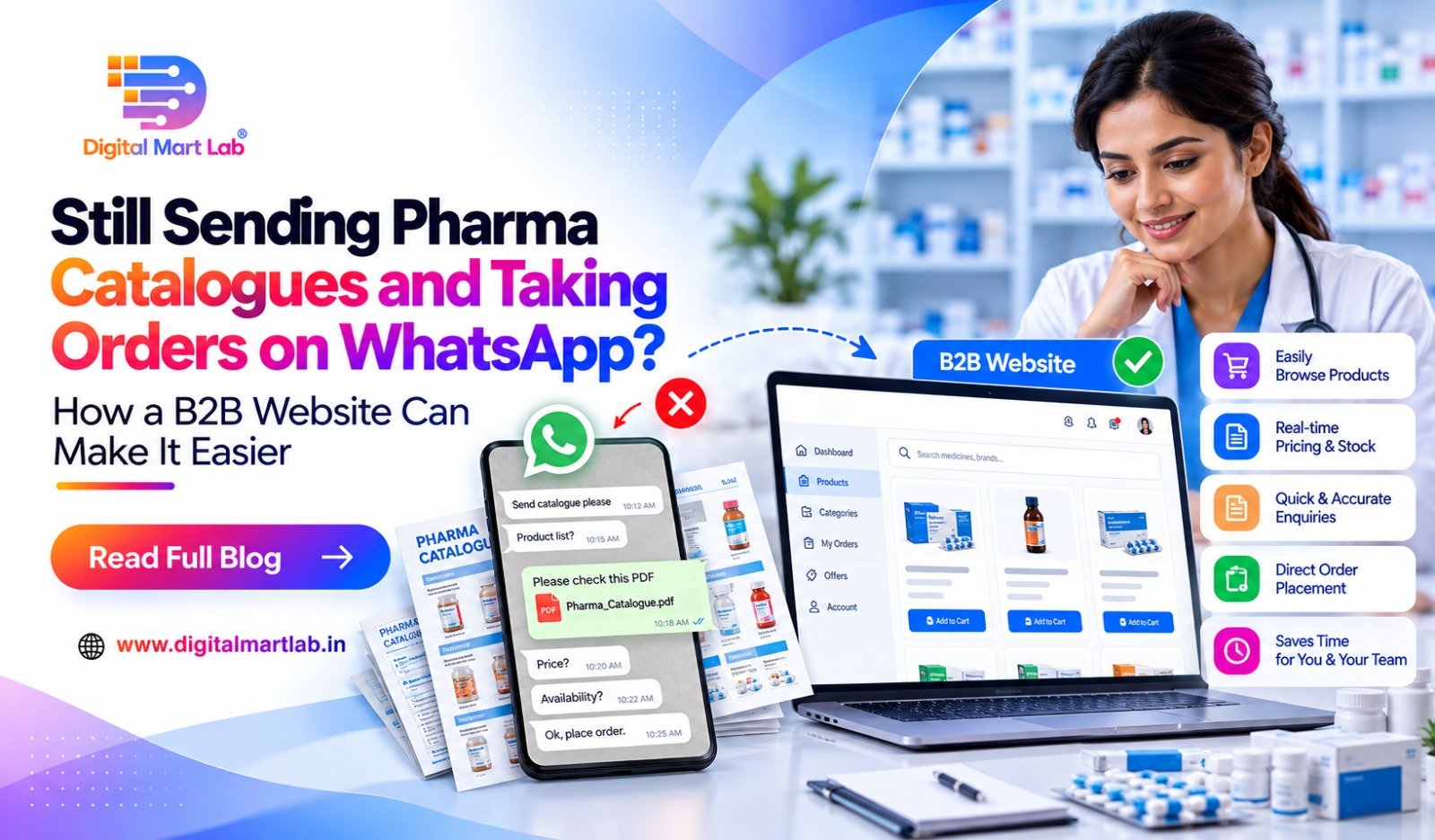
“Please send the latest catalogue.”
“Is this product available?”
“Add ten more boxes to yesterday’s order.”
If your pharma business works with distributors or franchise partners, these messages may be part of your daily routine.
WhatsApp makes communication convenient. But when catalogues, product selections, quantities and changes sit across different chats, your team has more information to check before processing an order.
A distributor may refer to an old PDF. A salesperson may need to clarify a pack size. An extra quantity may arrive after the original request has already been forwarded.
A pharma B2B website can give your business customers one organised place to find current product information and submit clear order requests. Your team can then review availability, pricing and terms before confirming the order.
WhatsApp can remain part of the relationship. The website gives the product and ordering information a more consistent place to live.
When does taking orders on WhatsApp become difficult?
For a small number of customers and products, a simple catalogue and chat may be manageable.
As the portfolio and repeat business grow, familiar problems can appear:
- Different customers use different catalogue versions.
- Product names are typed in different ways.
- Quantities arrive without clear units or pack sizes.
- Changes are spread across several messages.
- Salespeople repeatedly answer the same product questions.
- Someone has to copy the final request into another record.
The difficulty is often the amount of checking needed to turn a conversation into an accurate order request.
Before changing your system, ask your team where that work occurs. Do they spend more time finding products, clarifying quantities, checking old prices or collecting changes?
Those answers should guide what you build.

What is a pharma B2B website?
A pharma B2B website serves business customers such as distributors, stockists, franchise partners or manufacturing buyers.
Depending on your requirements, it may include:
- An organised product catalogue.
- Search and category filters.
- Product and pack information.
- Access for approved business customers.
- Product selection and quantity fields.
- A structured order-request form.
It does not have to begin as a complete online store with immediate payment.
For many businesses, a useful first step is letting approved customers select products and send a request that the team checks before acceptance.
That distinction matters: an order request records what the buyer wants; an order confirmation records what your business has agreed to supply.
Start with a digital catalogue your team can keep current
Moving the same PDF onto a website may make it easier to download, but buyers still have to search through the document.
An organised digital catalogue lets them browse relevant categories and open individual product details.
Use a consistent product reference
Each catalogue item should have a clear identity. Depending on the product, useful information may include:
- Product name and internal code.
- Category or range.
- Approved product details.
- Dosage form, strength and pack size where applicable.
- A current product image.
- The unit used when requesting a quantity.
Your team should approve the information before it goes live.
A product code can be particularly useful when names or packaging look similar. It gives the customer, salesperson and order-processing team a common reference.
Make relevant ranges easy to find
A distributor interested in one range should not need to scroll through the entire portfolio.
Let customers browse the categories you actually offer and use straightforward search options.
For example, a buyer could open the relevant range, review a product and add it to a request from the same page.
The purpose is to make selection easier, especially for repeat customers who already know what they need.
Assign responsibility for updates
A digital catalogue still needs someone to maintain it.
Decide who approves new products, changes pack details and removes discontinued items. Update downloadable catalogues alongside website information if you continue offering both.
If stock information is not connected to a reliable source, do not display it as live availability. Explain that availability will be checked when the request is reviewed.
Did You Know? Orders based on outdated product files can create unnecessary confusion. A maintained B2B catalogue gives approved buyers one current reference and lets them submit selected products for your team’s confirmation.
Let distributors select products instead of typing every item
A structured request can collect the product reference, pack and quantity together.
This reduces the need to interpret a message such as “Send the same tablets, twenty boxes, and add the other syrup.”
The buyer still needs to check their selection, but the information reaches your team in a consistent format.
| Information | How the request should capture it |
| Product | Selected from the current catalogue |
| Product code | Carried into the request automatically |
| Pack size | Shown clearly beside the selected item |
| Quantity | Entered against that specific product |
| Ordering unit | Clearly labelled, such as boxes or bottles |
| Special request | Added in a separate notes field |
Show the unit wherever the customer enters a quantity. “20” alone is not enough if the buyer means boxes and the team reads it as individual packs.
Give buyers a review screen
Before submission, show the complete selection so the buyer can check products and quantities.
For approved repeat customers, a saved list or previous-request feature may be useful. Any reused selection should still be checked against the current catalogue and applicable terms.
Keep changes attached to the original request
Once submitted, give the request a reference number.
If the buyer needs to make a change, direct them to quote that reference or use an agreed amendment process.
This helps your team distinguish the original selection from the latest instruction.
Did You Know? Repeat distributor orders can become time-consuming when every item is typed into WhatsApp. A B2B portal can collect product selections and quantities, leaving your team to verify availability and approve commercial terms.
Keep pricing and order confirmation under your team’s control
You do not have to publish every commercial detail openly to make the website useful.
Some businesses may show product information publicly and reserve ordering features for approved customers. Others may offer customer-specific access where the project supports it.
Choose the approach that matches how your business actually works.
Decide what the customer can see
Before development, agree whether customers should see:
- Product information only.
- Indicative information requiring confirmation.
- Approved customer-specific prices.
- Availability information from a maintained source.
If different customers have different terms, the website must handle those differences correctly. A general price should not accidentally appear to be an agreed customer rate.
Explain what happens after submission
Use clear wording such as:
“Your order request has been received. Our team will check availability and applicable commercial details before confirming acceptance.”
The team may need to check quantities, pricing, payment terms, delivery details and any relevant account requirements.
Avoid using “Order confirmed” as an automatic message if those checks have not happened.
Keep WhatsApp useful with more relevant messages
A B2B website does not remove the need for conversation. Distributors may still want to ask a question, discuss a change or speak with their contact person.
WhatsApp can direct them to the relevant information instead of carrying every part of the process.
For example, a message can link to:
- The product range the customer is interested in.
- An updated catalogue section.
- The approved customer login.
- A specific product page.
Illustrative example: A distributor has asked for updates about a particular range. With their permission, your team sends a short message linking to that range’s updated page.
The buyer can review the information and select products without receiving another unrelated full catalogue.
Relevant updates should reflect the customer’s stated interests and contact preferences. Provide a way to stop promotional messages.
This is one practical use of AI-enabled marketing and automation: helping organise approved information and appropriate follow-ups around the customer’s requirements.
Give manufacturing buyers a separate enquiry process
A manufacturing enquiry is different from a distributor selecting products for repeat supply.
The buyer may need to discuss a formulation, dosage form, quantity and packaging before a quotation can be prepared.
Use a separate form or conversation flow to collect:
- The product requirement.
- Dosage form.
- Estimated quantity and unit.
- Packaging preference, if known.
- Contact and company details.
A simple WhatsApp flow can also collect these opening details before passing the conversation to a person.
Allow buyers to say that a detail is undecided. The purpose is to prepare the discussion, not to assume that every submitted requirement is technically or commercially suitable.
Your team should review feasibility and confirm terms separately.
What should happen after an order request arrives?
The website is only useful if someone receives and handles the request.
A practical process is:
- The customer submits the selected products and quantities.
- The system records the request and sends an acknowledgement.
- The assigned employee reviews the details.
- The team clarifies anything missing and confirms the applicable offer.
- The accepted order moves into the agreed processing system.
Decide where the record will be maintained. It may begin in a shared system your team already uses, with further integration added where worthwhile.
Do not assume the website automatically updates accounting software, stock records or invoices. Those connections need to be planned and tested as part of the project.
Start with the features your business needs now
You may not need a large portal immediately.
| Current problem | Useful starting feature |
| Customers cannot find relevant products | Organised catalogue with search and categories |
| Buyers refer to outdated files | Maintained product pages and consistent downloads |
| Requests arrive without clear quantities | Product selection with labelled units |
| Commercial information needs restricted access | Approved customer accounts |
| Changes are scattered across chats | Request references and an amendment process |
| The team answers the same opening questions | Clear page content and a guided enquiry form |
Start with the problems causing the most repeated work.
A larger system may become useful later, but the first version should be manageable for your customers and staff.
If you are unsure where to begin, discuss your catalogue and website requirements with Digital Mart Lab. Bring your current catalogue and explain how your team receives and confirms requests today.

How Digital Mart Lab can help build your pharma B2B website
Digital Mart Lab can help translate your current process into a website that makes product selection and business enquiries easier.
The proposed work can include:
- Planning product categories and catalogue pages.
- Organising approved product information.
- Building mobile-friendly product selection and request forms.
- Setting up approved-customer access where required.
- Providing clear acknowledgements and team notifications.
- Connecting agreed systems where the project requires it.
- Explaining how your team will maintain the information.
Through website design and development services, the catalogue, customer experience and request process can be planned together.
For public pages intended to help new business buyers discover your offering, SEO services can support useful page content and search accessibility. Private customer details and restricted commercial pages should remain protected.
The project should define what the website does, what your team confirms and who maintains each part.
How to check whether the new process is helping
Compare the work involved before and after customers start using the website.
Look at:
- How often staff need to resend catalogues.
- How many requests arrive with missing product or quantity details.
- How much clarification is needed before confirmation.
- Whether customers can find and select products successfully.
- Whether staff and customers continue using the process.
Do not judge success only by account registrations.
A portal that customers rarely use may need clearer instructions, fewer steps or better product information.
Ask a small group of regular customers to try the process and explain where they get stuck. Their feedback can reveal practical problems before a wider rollout.
Frequently asked questions about pharma B2B websites
1. Do we have to stop taking requests on WhatsApp?
No. WhatsApp can remain a contact option. The website gives customers a more organised way to find products and submit details, while your team can still assist those who need help.
2. Can we start with a digital catalogue without online payment?
Yes. Customers can browse products and submit a request for your team to review. Payment features can be considered separately if they fit your process.
3. Can different distributors see different prices?
That can be built where required. It needs approved customer accounts, accurate pricing rules and maintenance. Define the requirement before development rather than assuming it is included.
4. Will the website show live stock automatically?
Only if it is connected to a reliable, maintained source. Otherwise, use wording that makes availability subject to confirmation.
5. Can manufacturing enquiries use the same ordering process?
They usually need a separate enquiry route because specifications, quantities and packaging require review. A structured form can collect the starting details without treating the submission as an accepted order.
6. Who will update the catalogue after launch?
Assign an authorised person or team to maintain it. Agree on training, access and any ongoing support when planning the website. An organised catalogue depends on accurate updates.
Give your distributors one clear place to find products and send requests
Your team should be able to spend more time helping customers and less time piecing together product lists from separate messages.
A pharma B2B website can provide a current catalogue, clear product selections and structured requests. Your team keeps responsibility for checking the details and confirming the order.
Want to make catalogue sharing and distributor order requests easier?
Discuss Your Pharma B2B Website with Digital Mart Lab
Share your current catalogue and explain how your team handles requests today. We can use that process to identify the website features your business actually needs.