
Your sales team opens the enquiry list and finds familiar messages:
“Send your franchise details.”
“Need third-party manufacturing.”
“Please share your products and prices.”
There may be a genuine business opportunity behind each message. But your team still needs to establish the preferred territory, product requirement, quantity or buying timeline before the conversation can move forward.
When enquiries arrive together, these basic checks become difficult to manage. Some prospects receive repeated questions. Others wait until someone has time to respond.
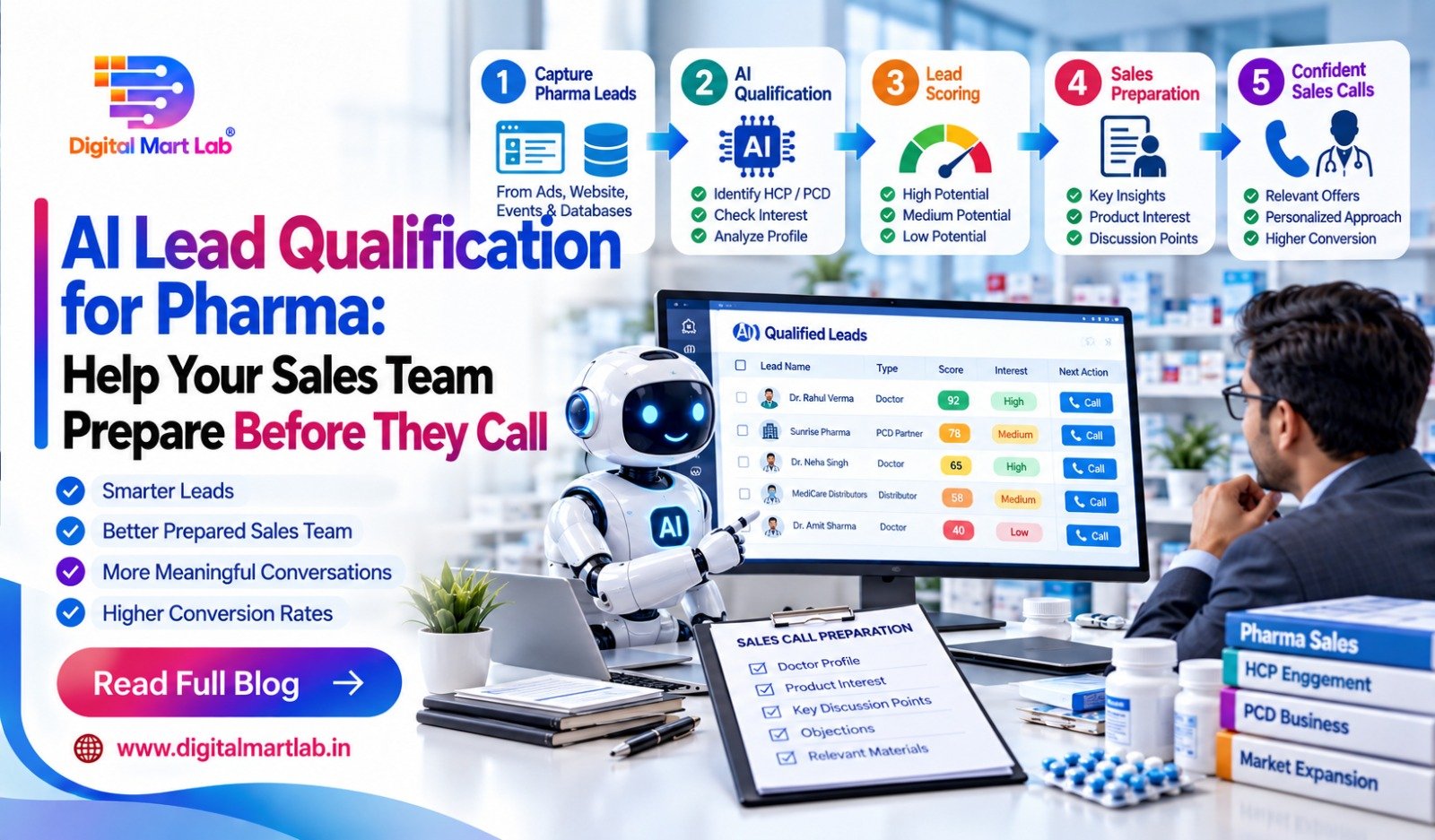
AI lead qualification for pharma can help by collecting a buyer’s stated requirements, recording what remains unclear and preparing a summary before your team calls. Your team still decides whether the enquiry fits your business.
The purpose is to make the first human conversation more useful—and keep promising enquiries from getting lost in an unorganised inbox.
Why More Pharma Enquiries Can Create More Work
An enquiry count tells you how many people contacted your business. It does not tell you whether your team has enough information to help them.
A franchise prospect may want a district where you already have a partner. A manufacturing buyer may need a dosage form your facility does not handle. Another prospect may be suitable but still deciding their initial product range.
These situations require different responses.
Before introducing automation, review a sample of recent enquiries. Check:
- Which questions your team asks repeatedly.
- Which missing details delay useful discussions.
- Whether the same prospect appears in several records.
- Where enquiries wait without an assigned salesperson.
- Why your team marks an enquiry as unsuitable.
If the records contain only “not interested” or “poor lead,” improve those explanations first. An AI assistant needs clear business rules, not vague labels.

What AI Lead Qualification for Pharma Should Actually Do
Think of the AI agent as an initial enquiry assistant.
With an appropriately configured workflow, it can ask relevant questions, answer from approved company information and organise the conversation for your team.
It should separate three things:
| Information type | Example | How to handle it |
| Buyer-stated requirement | “I want a franchise in Jaipur district.” | Record the requested territory accurately. |
| Approved company information | The current catalogue lists particular product ranges. | Share only the approved, current information. |
| Decision requiring confirmation | Whether that territory is available | Refer to an authorised person or a reliable, maintained system. |
A buyer requesting a territory does not make it available. A buyer mentioning a quantity does not mean your company has accepted the order.
Keeping these distinctions clear prevents an initial conversation from becoming an unintended commercial commitment.
Did You Know?
A manufacturing enquiry can sound relevant until the product, quantity and packaging requirements are understood. Collecting these details first gives your team a better basis for deciding what to discuss.
Ask Franchise Prospects About Their Intended Business
PCD franchise enquiries need a different conversation from manufacturing enquiries.
Start with the information that helps your team understand the proposed partnership.
Preferred territory and product range
Ask which state, district or area the prospect wants to serve.
Do not assume their current location is their preferred territory. Someone living in Delhi may be planning a business in another state.
Then ask about the range they want to discuss. If they are unsure, offer choices based on your actual catalogue and allow them to request guidance.
Business stage and starting timeline
Useful questions include:
- Are you exploring your first pharma business or expanding an existing one?
- When are you hoping to begin?
- Have you shortlisted an initial range?
- What would you like the sales team to clarify?
A new business owner may need more explanation than an experienced distributor. That does not automatically make the enquiry unsuitable.
Record uncertainty honestly. “Range not yet selected” is more useful than an invented assumption.
Contact preference and next step
Ask when the prospect would prefer a call and which language they are comfortable using.
Questions about documentation or commercial readiness should follow your approved process. Avoid making an initial conversation feel like a lengthy application before the buyer understands your offer.
Your team must maintain territory information and partner conditions. Track how many franchise enquiries reach a human conversation with the preferred territory and range already recorded.
Collect Manufacturing Requirements Without Pretending to Approve Them
Third-party manufacturing buyers need to explain what they want produced.
The assistant can collect an initial brief, but technical feasibility and commercial acceptance remain human decisions.
| Detail to collect | Why it helps your team |
| Product or formulation requested | Establishes what the buyer wants to discuss. |
| Dosage form and strength, where known | Helps route the enquiry to the relevant person. |
| Approximate quantity | Supports an initial discussion about order requirements. |
| Packaging preference | Identifies details that may affect feasibility and quotation preparation. |
| Desired timeline | Records the buyer’s expectation without promising delivery. |
| Current stage | Distinguishes exploration, quotation requests and active project discussions. |
| Pending questions | Helps your team prepare for the call. |
If your company has approved minimum order requirements, the assistant can explain them with the relevant qualifications. It should not apply one minimum quantity to every product unless that is genuinely your policy.
A pharma marketing company must also describe its role accurately. An assistant should never imply that the company owns a manufacturing facility when it works through manufacturing partners.
Measure how often the collected brief is useful to the person preparing the quotation—not simply how many fields were completed.
Ask Missing Questions Gradually
A prospect who writes “send details” may be using a phone between appointments. Presenting fifteen questions immediately can make the conversation harder.
A more practical sequence is:
- Establish whether the enquiry concerns a franchise, distribution or manufacturing.
- Ask the most relevant next question.
- Collect additional details as the conversation develops.
- Offer a human conversation when the buyer needs one.
For a franchise enquiry, the next question might be the preferred district. For manufacturing, it might be the requested product and dosage form.
Allow answers such as “not decided” or “need guidance.” Missing information should remain visible for follow-up rather than becoming a reason for automatic rejection.
Where supported by the implementation, the assistant should use information already provided instead of asking for it again.
Handle After-Hours Enquiries with Clear Expectations
A prospect may contact your company after the sales team has finished for the day.
An AI assistant can be configured to collect initial requirements during this period. It should explain that it is an automated assistant and make the next step clear.
For example:
“I can collect your preferred territory and product interest for our team. Please share a convenient callback time. Territory availability will need confirmation.”
This acknowledges the enquiry without promising an immediate call or an available territory.
Your team needs a morning review process, a named enquiry owner and a way to see pending callbacks. Otherwise, automation only creates a better-looking backlog.
Track the time from the enquiry to a meaningful human response. An instant automated acknowledgement is useful, but it is not the same as a sales discussion.
Give Your Salesperson a Summary They Can Trust
A useful handover should help the salesperson understand what is known, what is uncertain and what needs to happen next.
Illustrative franchise enquiry summary
This is a hypothetical example, not a Digital Mart Lab client result.
| Field | Recorded information |
| Enquiry type | PCD franchise |
| Preferred territory | Kota district |
| Product interest | General range; initial selection pending |
| Business stage | Planning a first venture |
| Stated timeline | Hoping to start next quarter |
| Buyer’s question | Wants to understand available partner support |
| Pending checks | Territory availability and applicable commercial requirements |
| Preferred next step | Hindi callback after 3 p.m. |
The salesperson can begin with the buyer’s actual concern instead of repeating the entire introduction.
An AI-generated summary can still contain mistakes. Keep the original conversation accessible, distinguish stated facts from assumptions and let the salesperson correct the record.
If your team repeatedly starts calls without this context, discuss an initial enquiry workflow through Digital Mart Lab’s AI-enabled digital marketing services. Bring your current enquiry process and the questions your team asks most often.
Keep Incomplete Enquiries Separate from Unsuitable Ones
These categories should not be treated as interchangeable.
An incomplete enquiry needs clarification. An unsuitable enquiry has a confirmed mismatch. A later-stage opportunity may fit your business but need time.
Useful statuses include:
- Ready for team review: Enough information is available for a useful call.
- Clarification needed: An important requirement is still missing.
- Human guidance requested: The buyer needs help defining the requirement.
- Later follow-up: The prospect has shared a future buying timeline.
- Possible mismatch: A stated requirement needs a person to check suitability.
Illustrative manufacturing example
A prospect asks about tablet manufacturing but does not know the packaging format.
The assistant records the product, approximate quantity and desired timeline, then notes “packaging guidance requested.”
That enquiry is incomplete, but it may still deserve a technical discussion.
If the buyer instead requests a dosage form outside the company’s approved capabilities, the assistant can flag the mismatch for review. It should not invent an alternative capability to keep the conversation moving.

Preserve Enquiry History When People Change
A distributor should not have to explain the same requirement again because a different salesperson answers the phone.
The same problem becomes more serious when an employee leaves and the enquiry history remains in individual chats.
A connected record can preserve:
- The original requirement and later changes.
- Information already shared.
- Open questions and pending decisions.
- The assigned salesperson.
- The agreed next action and date.
A CRM—a shared system for managing customer relationships—is one possible place to keep these records. The right setup depends on your existing tools, access controls and integration scope.
Did You Know?
A useful enquiry record protects continuity as well as convenience. When ownership changes, the next salesperson needs the buyer’s history, unresolved questions and promised next steps.
Record continuity depends on consistent use. Assigning an owner and maintaining the next action remain management responsibilities.
Set Clear Limits Before the Assistant Goes Live
Prepare an approved information source covering your actual ranges, business model, enquiry process and escalation contacts.
Make someone responsible for keeping it current.
The assistant should hand over when a conversation requires technical judgement, negotiated terms or information it cannot verify. It must not invent quotations, stock availability, production dates or dispatch commitments.
Collect only information needed for the enquiry. Explain its purpose, apply appropriate contact permissions, respect opt-outs and avoid requesting sensitive documents in an initial chat.
If the assistant cannot answer, a clear “our team needs to confirm this” is more useful than a confident guess.
How Digital Mart Lab Can Help Organise Pharma Enquiries
Digital Mart Lab lists smart chatbots and conversational marketing among its AI-enabled services. A pharma-specific qualification workflow should be scoped around your questions, approved information and handover process.
The practical work can be discussed in three connected areas:
| Business problem | Proposed work | What to assess |
| Salespeople repeatedly collect basic details | Design separate franchise and manufacturing question paths with structured summaries | Summary accuracy and time spent repeating questions |
| Visitors cannot identify the right enquiry route | Improve website enquiry journeys and forms | Completion, missing information and successful handovers |
| Campaigns repeatedly attract mismatched requirements | Feed confirmed sales findings into performance marketing reviews | Reasons for mismatch and suitability by campaign source |
CRM connections, WhatsApp workflows, multilingual conversations and access to live territory or order information require separate feasibility and scope checks. They should not be assumed to be included in every package.
AI can help organise the conversation. Clear offers, accurate website information and responsible sales follow-through still matter.
A Practical Checklist Before You Start
- Define separate franchise and manufacturing enquiry paths.
- Choose the minimum useful questions for each.
- Allow uncertainty and requests for human guidance.
- Approve the information the assistant may share.
- Identify decisions that always need human confirmation.
- Assign an owner to every enquiry needing action.
- Preserve conversation history and pending questions.
- Set appropriate contact permissions and opt-out handling.
- Test incomplete, unclear and out-of-scope enquiries.
- Review summaries for accuracy and missed opportunities.
Start with one manageable enquiry route. Review real conversations before adding more automation.
Measure useful information collected, human response time, summary corrections and progression to the next agreed step. A high number of completed chats alone does not prove better qualification.
Frequently Asked Questions About AI Pharma Lead Qualification
1. Can an AI agent decide which pharma leads are genuine?
It can organise stated requirements and flag possible mismatches against approved rules. It cannot reliably establish buyer credibility or commercial suitability from a short conversation. Your team should make those decisions.
2. Can one assistant handle franchise and manufacturing enquiries?
Yes, if it has separate question paths and approved information for each. Franchise conversations focus on territory and partnership needs; manufacturing conversations need product, quantity and packaging context.
3. Should we reject prospects who do not answer every question?
No. They may need guidance, be short of time or still be exploring. Record what is missing and offer an appropriate next step.
4. Can an AI assistant collect enquiries outside working hours?
A suitably configured assistant can collect initial requirements when your team is unavailable. It should explain callback expectations and route the enquiry into a process someone actually reviews.
5. Will the assistant need access to our CRM?
Basic information collection does not necessarily require a CRM connection. Shared history, duplicate checks, ownership and ongoing updates may require integration, depending on your systems and agreed scope.
6. How do we know whether AI qualification is helping?
Compare whether salespeople receive clearer requirements, repeat fewer questions and complete useful follow-ups sooner. Check summary accuracy and review enquiries marked as mismatches so suitable prospects are not overlooked.
Make the First Sales Call More Useful
Your sales team should begin a conversation knowing what the buyer has already said—and which questions still need attention.
A carefully configured AI assistant can help create that starting point. Its value comes from accurate information, sensible questions and a dependable handover to someone who can make the next decision.
Discuss how Digital Mart Lab can help you collect clearer pharma requirements before your team calls. Bring your website, current enquiry process and common qualification questions to the discussion.