
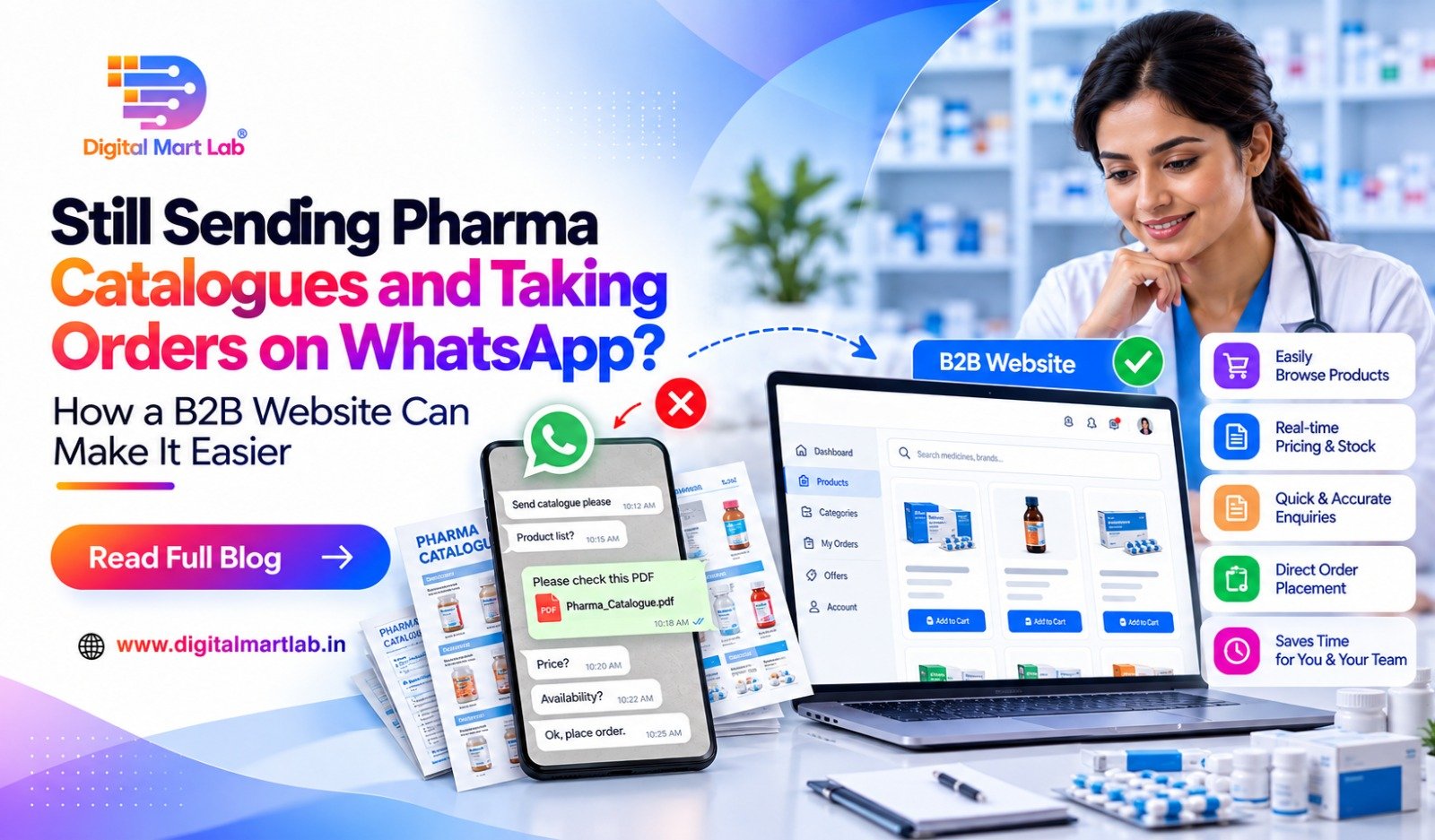
Still Sending Pharma Catalogues and Taking Orders on WhatsApp? How a B2B Website Can Make It Easier
“Please send the latest catalogue.”
“Is this product available?”
“Add ten more boxes to yesterday’s order.”
If your pharma business works with distributors or franchise partners, these messages may be part of your daily routine.
WhatsApp makes communication convenient. But when catalogues, product selections, quantities and changes sit across different chats, your team has more information to check before processing an order.
A distributor may refer to an old PDF. A salesperson may need to clarify a pack size. An extra quantity may arrive after the original request has already been forwarded.
A pharma B2B website can give your business customers one organised place to find current product information and submit clear order requests. Your team can then review availability, pricing and terms before confirming the order.
WhatsApp can remain part of the relationship. The website gives the product and ordering information a more consistent place to live.
When does taking orders on WhatsApp become difficult?
For a small number of customers and products, a simple catalogue and chat may be manageable.
As the portfolio and repeat business grow, familiar problems can appear:
- Different customers use different catalogue versions.
- Product names are typed in different ways.
- Quantities arrive without clear units or pack sizes.
- Changes are spread across several messages.
- Salespeople repeatedly answer the same product questions.
- Someone has to copy the final request into another record.
The difficulty is often the amount of checking needed to turn a conversation into an accurate order request.
Before changing your system, ask your team where that work occurs. Do they spend more time finding products, clarifying quantities, checking old prices or collecting changes?
Those answers should guide what you build.

What is a pharma B2B website?
A pharma B2B website serves business customers such as distributors, stockists, franchise partners or manufacturing buyers.
Depending on your requirements, it may include:
- An organised product catalogue.
- Search and category filters.
- Product and pack information.
- Access for approved business customers.
- Product selection and quantity fields.
- A structured order-request form.
It does not have to begin as a complete online store with immediate payment.
For many businesses, a useful first step is letting approved customers select products and send a request that the team checks before acceptance.
That distinction matters: an order request records what the buyer wants; an order confirmation records what your business has agreed to supply.
Start with a digital catalogue your team can keep current
Moving the same PDF onto a website may make it easier to download, but buyers still have to search through the document.
An organised digital catalogue lets them browse relevant categories and open individual product details.
Use a consistent product reference
Each catalogue item should have a clear identity. Depending on the product, useful information may include:
- Product name and internal code.
- Category or range.
- Approved product details.
- Dosage form, strength and pack size where applicable.
- A current product image.
- The unit used when requesting a quantity.
Your team should approve the information before it goes live.
A product code can be particularly useful when names or packaging look similar. It gives the customer, salesperson and order-processing team a common reference.
Make relevant ranges easy to find
A distributor interested in one range should not need to scroll through the entire portfolio.
Let customers browse the categories you actually offer and use straightforward search options.
For example, a buyer could open the relevant range, review a product and add it to a request from the same page.
The purpose is to make selection easier, especially for repeat customers who already know what they need.
Assign responsibility for updates
A digital catalogue still needs someone to maintain it.
Decide who approves new products, changes pack details and removes discontinued items. Update downloadable catalogues alongside website information if you continue offering both.
If stock information is not connected to a reliable source, do not display it as live availability. Explain that availability will be checked when the request is reviewed.
Did You Know? Orders based on outdated product files can create unnecessary confusion. A maintained B2B catalogue gives approved buyers one current reference and lets them submit selected products for your team’s confirmation.
Let distributors select products instead of typing every item
A structured request can collect the product reference, pack and quantity together.
This reduces the need to interpret a message such as “Send the same tablets, twenty boxes, and add the other syrup.”
The buyer still needs to check their selection, but the information reaches your team in a consistent format.
| Information | How the request should capture it |
| Product | Selected from the current catalogue |
| Product code | Carried into the request automatically |
| Pack size | Shown clearly beside the selected item |
| Quantity | Entered against that specific product |
| Ordering unit | Clearly labelled, such as boxes or bottles |
| Special request | Added in a separate notes field |
Show the unit wherever the customer enters a quantity. “20” alone is not enough if the buyer means boxes and the team reads it as individual packs.
Give buyers a review screen
Before submission, show the complete selection so the buyer can check products and quantities.
For approved repeat customers, a saved list or previous-request feature may be useful. Any reused selection should still be checked against the current catalogue and applicable terms.
Keep changes attached to the original request
Once submitted, give the request a reference number.
If the buyer needs to make a change, direct them to quote that reference or use an agreed amendment process.
This helps your team distinguish the original selection from the latest instruction.
Did You Know? Repeat distributor orders can become time-consuming when every item is typed into WhatsApp. A B2B portal can collect product selections and quantities, leaving your team to verify availability and approve commercial terms.
Keep pricing and order confirmation under your team’s control
You do not have to publish every commercial detail openly to make the website useful.
Some businesses may show product information publicly and reserve ordering features for approved customers. Others may offer customer-specific access where the project supports it.
Choose the approach that matches how your business actually works.
Decide what the customer can see
Before development, agree whether customers should see:
- Product information only.
- Indicative information requiring confirmation.
- Approved customer-specific prices.
- Availability information from a maintained source.
If different customers have different terms, the website must handle those differences correctly. A general price should not accidentally appear to be an agreed customer rate.
Explain what happens after submission
Use clear wording such as:
“Your order request has been received. Our team will check availability and applicable commercial details before confirming acceptance.”
The team may need to check quantities, pricing, payment terms, delivery details and any relevant account requirements.
Avoid using “Order confirmed” as an automatic message if those checks have not happened.
Keep WhatsApp useful with more relevant messages
A B2B website does not remove the need for conversation. Distributors may still want to ask a question, discuss a change or speak with their contact person.
WhatsApp can direct them to the relevant information instead of carrying every part of the process.
For example, a message can link to:
- The product range the customer is interested in.
- An updated catalogue section.
- The approved customer login.
- A specific product page.
Illustrative example: A distributor has asked for updates about a particular range. With their permission, your team sends a short message linking to that range’s updated page.
The buyer can review the information and select products without receiving another unrelated full catalogue.
Relevant updates should reflect the customer’s stated interests and contact preferences. Provide a way to stop promotional messages.
This is one practical use of AI-enabled marketing and automation: helping organise approved information and appropriate follow-ups around the customer’s requirements.
Give manufacturing buyers a separate enquiry process
A manufacturing enquiry is different from a distributor selecting products for repeat supply.
The buyer may need to discuss a formulation, dosage form, quantity and packaging before a quotation can be prepared.
Use a separate form or conversation flow to collect:
- The product requirement.
- Dosage form.
- Estimated quantity and unit.
- Packaging preference, if known.
- Contact and company details.
A simple WhatsApp flow can also collect these opening details before passing the conversation to a person.
Allow buyers to say that a detail is undecided. The purpose is to prepare the discussion, not to assume that every submitted requirement is technically or commercially suitable.
Your team should review feasibility and confirm terms separately.
What should happen after an order request arrives?
The website is only useful if someone receives and handles the request.
A practical process is:
- The customer submits the selected products and quantities.
- The system records the request and sends an acknowledgement.
- The assigned employee reviews the details.
- The team clarifies anything missing and confirms the applicable offer.
- The accepted order moves into the agreed processing system.
Decide where the record will be maintained. It may begin in a shared system your team already uses, with further integration added where worthwhile.
Do not assume the website automatically updates accounting software, stock records or invoices. Those connections need to be planned and tested as part of the project.
Start with the features your business needs now
You may not need a large portal immediately.
| Current problem | Useful starting feature |
| Customers cannot find relevant products | Organised catalogue with search and categories |
| Buyers refer to outdated files | Maintained product pages and consistent downloads |
| Requests arrive without clear quantities | Product selection with labelled units |
| Commercial information needs restricted access | Approved customer accounts |
| Changes are scattered across chats | Request references and an amendment process |
| The team answers the same opening questions | Clear page content and a guided enquiry form |
Start with the problems causing the most repeated work.
A larger system may become useful later, but the first version should be manageable for your customers and staff.
If you are unsure where to begin, discuss your catalogue and website requirements with Digital Mart Lab. Bring your current catalogue and explain how your team receives and confirms requests today.

How Digital Mart Lab can help build your pharma B2B website
Digital Mart Lab can help translate your current process into a website that makes product selection and business enquiries easier.
The proposed work can include:
- Planning product categories and catalogue pages.
- Organising approved product information.
- Building mobile-friendly product selection and request forms.
- Setting up approved-customer access where required.
- Providing clear acknowledgements and team notifications.
- Connecting agreed systems where the project requires it.
- Explaining how your team will maintain the information.
Through website design and development services, the catalogue, customer experience and request process can be planned together.
For public pages intended to help new business buyers discover your offering, SEO services can support useful page content and search accessibility. Private customer details and restricted commercial pages should remain protected.
The project should define what the website does, what your team confirms and who maintains each part.
How to check whether the new process is helping
Compare the work involved before and after customers start using the website.
Look at:
- How often staff need to resend catalogues.
- How many requests arrive with missing product or quantity details.
- How much clarification is needed before confirmation.
- Whether customers can find and select products successfully.
- Whether staff and customers continue using the process.
Do not judge success only by account registrations.
A portal that customers rarely use may need clearer instructions, fewer steps or better product information.
Ask a small group of regular customers to try the process and explain where they get stuck. Their feedback can reveal practical problems before a wider rollout.
Frequently asked questions about pharma B2B websites
1. Do we have to stop taking requests on WhatsApp?
No. WhatsApp can remain a contact option. The website gives customers a more organised way to find products and submit details, while your team can still assist those who need help.
2. Can we start with a digital catalogue without online payment?
Yes. Customers can browse products and submit a request for your team to review. Payment features can be considered separately if they fit your process.
3. Can different distributors see different prices?
That can be built where required. It needs approved customer accounts, accurate pricing rules and maintenance. Define the requirement before development rather than assuming it is included.
4. Will the website show live stock automatically?
Only if it is connected to a reliable, maintained source. Otherwise, use wording that makes availability subject to confirmation.
5. Can manufacturing enquiries use the same ordering process?
They usually need a separate enquiry route because specifications, quantities and packaging require review. A structured form can collect the starting details without treating the submission as an accepted order.
6. Who will update the catalogue after launch?
Assign an authorised person or team to maintain it. Agree on training, access and any ongoing support when planning the website. An organised catalogue depends on accurate updates.
Give your distributors one clear place to find products and send requests
Your team should be able to spend more time helping customers and less time piecing together product lists from separate messages.
A pharma B2B website can provide a current catalogue, clear product selections and structured requests. Your team keeps responsibility for checking the details and confirming the order.
Want to make catalogue sharing and distributor order requests easier?
Discuss Your Pharma B2B Website with Digital Mart Lab
Share your current catalogue and explain how your team handles requests today. We can use that process to identify the website features your business actually needs.
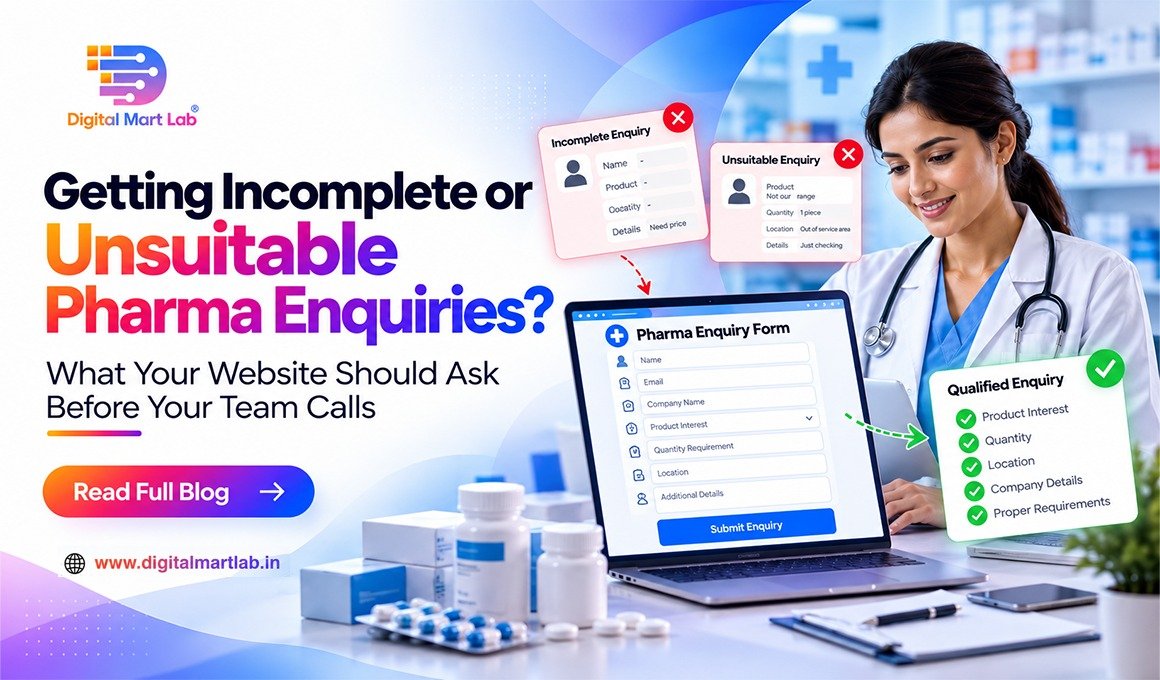
Getting Incomplete or Unsuitable Pharma Enquiries? What Your Website Should Ask Before Your Team Calls
Your salesperson opens a new enquiry. There is a name, a phone number and one message: “Send details.”
But details about what?
A PCD franchise? A distribution opportunity? Third-party manufacturing?
Your team calls to find out. The first few minutes go into basic questions. Sometimes the buyer wants a district you cannot offer. Sometimes the manufacturing quantity does not fit your order requirements. Other times, the buyer is interested but has not yet decided what they need.
These situations require different responses.
Well-planned pharma enquiry forms help your team understand the buyer’s requirement before calling. They collect enough information to prepare for a useful conversation while giving uncertain buyers a way to ask for guidance.
The aim is to ask the right questions at the right stage.

An incomplete enquiry is not always an unsuitable enquiry
A manufacturing buyer who has not mentioned quantity may still have a relevant requirement. A franchise applicant who has not selected a range may need help choosing one.
Missing information tells you that something needs clarification. It does not automatically tell you that the opportunity is poor.
An unsuitable enquiry is different. It may involve a capability your business does not provide or a confirmed requirement you cannot commercially support.
| Enquiry received | What it tells your team | Useful next step |
| “I need tablet manufacturing.” | The general requirement is known, but important details are missing. | Ask for the product requirement and approximate quantity. |
| “I want a franchise but have not selected a range.” | The person needs more information before deciding. | Ask about the preferred territory and explain relevant ranges. |
| A request for a dosage form you do not support | There is a clear capability mismatch. | Explain the limitation instead of preparing an unsuitable quotation. |
| A request for an unavailable district | The stated territory does not currently fit. | Confirm the position and ask whether another territory is relevant. |
This distinction helps your team avoid two mistakes: spending too long on confirmed mismatches and dismissing buyers who simply need clarification.
Start by asking what the buyer wants to discuss
A general contact form can mix franchise applicants, manufacturing buyers, existing customers and job seekers in the same inbox.
Begin with a simple question:
“What would you like to enquire about?”
Offer choices that reflect your actual business, such as:
- PCD franchise.
- Distribution or stockist opportunity.
- Third-party manufacturing.
- Existing order or support.
- Other enquiry.
The next questions should change according to the selection. Someone interested in a franchise should not have to answer manufacturing questions.
If your website already has separate franchise and manufacturing pages, each can have its own relevant form.
A clear starting point makes the form easier to complete and helps the enquiry reach the right person.
What should a PCD franchise enquiry form ask?
Your team needs enough context to discuss the opportunity. It does not need a complete application before making the first call.
Preferred business district and state
Ask where the applicant wants to operate.
Use a clear label:
“Which district and state are you interested in?”
This is more useful than asking only for the person’s current city. Someone living in Delhi may be exploring a franchise opportunity in Uttar Pradesh.
The answer helps your team prepare a territory discussion. It does not confirm availability or grant rights.
Product range of interest
Ask which range the prospect wants to discuss, using categories your company actually offers.
Include “Not decided—need guidance” as an option.
A new applicant may not know which range suits their plans. Forcing them to select something can give your salesperson misleading information.
If the enquiry comes from a page about a specific range, carry that information into the submission so the buyer does not have to repeat it.
Expected starting timeline
A simple timeline question helps your team understand the stage of the enquiry.
Possible answers include:
- As soon as the requirements are agreed.
- Within the next few months.
- Still exploring options.
Treat this as the buyer’s current plan, not a commitment. Someone researching today may still become a suitable partner later.
Starting a new business or expanding an existing one
This question helps your salesperson choose the right explanation.
A first-time applicant may need to understand the partnership process and responsibilities. An established distributor may want to discuss how your range fits their existing business.
Experience alone should not decide whether someone deserves a call.
Did You Know? Collecting only a phone number leaves your callers without franchise context. Questions about the preferred district, range and starting timeline can help your team begin with a more useful conversation.
What should a third-party manufacturing enquiry form ask?
Manufacturing enquiries need a different starting point. Your team must understand what the buyer wants produced before discussing suitability.
Product requirement and dosage form
Ask the buyer to describe the product requirement and identify the relevant dosage form.
A short text field lets them explain what they need in their own words. A separate dosage-form selection can help direct the enquiry.
Do not use the form to suggest that every submitted requirement is automatically supported.
Approximate quantity with a clear unit
“Quantity: 1,000” is incomplete if your team does not know whether the buyer means tablets, strips, boxes or bottles.
Ask for an estimated quantity and unit.
For example:
“What quantity are you considering? Please mention the unit, such as tablets, bottles or boxes, and the pack size if known.”
Where buyers are unsure, let them request guidance. Your team can then clarify the requirement before discussing feasibility.
Packaging preference, if known
Packaging can be important to the discussion, but it may not be decided at the first enquiry.
Provide a short field for the preference and an option such as “Need to discuss packaging.”
Do not require a detailed specification from someone who is still evaluating options.
Business name and contact details
Ask for a contact person and a reliable way to reach them. A business name and email address can also help with quotation-related communication.
Avoid requiring the same information repeatedly across different fields.
Expected timeline
Ask when the buyer would like to move forward, while making clear that the team must review the requirement.
A requested date helps prepare the discussion. It should not be treated as a confirmed production or delivery commitment.
A practical starting structure for pharma enquiry forms
Use the table below as a starting point. Adjust required fields to the information your team genuinely needs before calling.
| Franchise or distributor enquiry | Manufacturing enquiry |
| Contact name and number | Contact name and number |
| Preferred district and state | Product requirement and dosage form |
| Range of interest, including “Need guidance” | Estimated quantity and unit, including “Need guidance” |
| Expected starting timeline | Packaging preference, if known |
| New or existing business | Business name and email |
| Optional question or callback preference | Expected timeline and optional requirement notes |
Do not make every field compulsory simply because it may be useful later.
Begin with a manageable form. Review whether each question helps your salesperson prepare or merely adds another step for the visitor.
Explain order requirements before the buyer submits the form
If your manufacturing business has verified order requirements, explain the relevant ones near the enquiry form.
A buyer should not have to complete a long discussion before learning that the quantity they need cannot be supported.
However, avoid publishing one general minimum order quantity if it varies by product, dosage form or packaging.
A useful explanation could be:
“Order requirements depend on the product and packaging. Share your estimated quantity so our team can review the requirement and explain the applicable terms.”
Where a specific minimum is confirmed and current, state it with the correct unit and scope.
Your advertisement, landing page and salesperson should communicate the same information. This is one reason to review campaign messaging and lead generation alongside your website forms.
Keep requirements up to date
Assign someone to review published quantities, supported capabilities and relevant conditions.
Outdated information can discourage a suitable buyer or create an expectation your team cannot meet.
Clear requirements are useful only when they accurately represent the offer.
When should your team ask for missing information?
Ask for the information needed to decide the next step. Avoid sending a long questionnaire when one answer would move the discussion forward.
Illustrative example: A buyer submits “Need capsule manufacturing” with a phone number but no quantity.
A useful follow-up could be:
“Thank you for your enquiry. Could you share the product requirement and approximate quantity you are considering? If the quantity is not decided, let us know and our team can discuss the options with you.”
This gives the buyer a clear question and room to explain uncertainty.
For a franchise enquiry missing the territory, the next question might simply be:
“Which district and state would you like to discuss for the franchise opportunity?”
Did You Know? A manufacturing enquiry missing its quantity may need clarification rather than rejection. Asking for the missing detail helps your team assess the requirement with better information.
Ask technical follow-up questions when the team is ready to use the answers
Detailed specifications, artwork and further documentation may become necessary later. Explain why they are needed when that stage arrives.
The first enquiry form should open a useful conversation. Further questions should support the next business decision.
Make sure the website passes the answers to your salesperson
Collecting useful details achieves little if the caller sees only a phone number.
The enquiry notification or shared lead record should include the buyer’s answers and the page or range they enquired about.
Before calling, the salesperson should be able to see:
- What the buyer wants to discuss.
- Which details are already available.
- What still needs clarification.
- Whether another team member has contacted them.
This helps avoid asking the same questions again and gives the buyer a more consistent experience.
If you use an AI assistant or enquiry automation, it can help collect missing details and prepare a summary. It should use approved information and pass uncertain commercial or technical questions to a person.
The team remains responsible for confirming suitability.

How to tell whether your new enquiry form is helping
Do not judge the form only by the number of submissions.
A longer form may collect more details while discouraging useful enquiries. A shorter form may be easy to complete but leave your team with too much clarification work.
Review both the buyer experience and the sales outcome.
| Measure | What it helps you assess |
| Form completion | Whether visitors can finish the enquiry process |
| Useful details received | Whether answers help the team prepare |
| Clarification needed | Which questions remain unanswered or confusing |
| Relevant conversations | Whether the enquiries fit what your business can potentially serve |
| Progress to the next step | Whether discussions move towards territory review, requirement assessment or quotation |
Ask your salespeople which fields they actually use. If an answer never affects the conversation, consider whether it belongs on the initial form.
Test changes gradually so you can understand what helped.
How Digital Mart Lab can improve your pharma enquiry process
Digital Mart Lab can help plan your website around the information your buyers need and the questions your sales team must answer.
Through website design and development, the work can include:
- Separate enquiry forms for franchise and manufacturing buyers.
- Clear field labels and relevant answer options.
- Simple explanations of order and territory review requirements.
- Mobile-friendly layouts and useful confirmation messages.
- Delivery of enquiry details to the responsible team.
- Agreed tracking to review completed enquiries.
The process should begin with your current enquiries. Identify the details that are repeatedly missing and the questions that delay the first useful conversation.
For businesses also attracting visitors through search, SEO services can help align website content with the business requirements you serve.
The goal is a clearer connection between your offer, the buyer’s enquiry and the conversation your team needs to have.
Frequently asked questions about pharma enquiry forms
1. How many questions should a pharma enquiry form include?
There is no single number that suits every business. Ask for the details needed to prepare the first conversation. Keep further questions for the stage when your team needs those answers.
2. Should we reject a manufacturing enquiry without a quantity?
Not automatically. Ask whether the buyer has an estimate or needs guidance. Once the quantity and other requirements are clearer, your team can assess suitability.
3. Should budget be compulsory on a franchise enquiry form?
Only if it is genuinely necessary at that stage. If you ask, explain what the figure refers to and allow for buyers who need a discussion. A budget answer alone does not establish suitability.
4. Can franchise and manufacturing buyers use one form?
Yes, if the form first identifies the enquiry type and then shows relevant questions. Separate forms may be clearer when the website already has distinct pages for each service.
5. Should minimum order quantities appear on the website?
Publish accurate requirements when they help buyers assess fit. If minimums vary, explain the factors involved and ask for the details your team needs to confirm the applicable requirement.
6. Can an AI agent decide which pharma leads are suitable?
It can help collect information and organise enquiries for review. Your team should confirm technical and commercial suitability, especially when requirements are incomplete or uncertain.
Give your team a clearer starting point for every call
A phone number lets your team make contact. The right enquiry details help them prepare.
When your website asks relevant questions, explains important requirements and gives buyers room to request guidance, the first call can begin with a useful discussion.
Want your pharma website to collect clearer business enquiries?
Discuss Your Pharma Website Enquiry Forms with Digital Mart Lab
Share your current form and the questions your team repeatedly asks on calls. We can use them to plan a simpler enquiry process that gives your salespeople better information from the start.
Getting Pharma Ad Clicks but Few Enquiries? Your Landing Page Could Be the Problem
Your advertisements are getting clicks. People are visiting your website. But your phone is quiet, and the enquiries are fewer than you expected.
It is tempting to increase the budget or change the advertisement immediately. Before you do, check what happens after someone clicks.
Does the visitor find the product range or manufacturing service they were interested in? Can they understand your offer? Is it easy to ask a question?
Effective pharma landing pages continue the message in the advertisement and make the next step clear. If the advertisement promises one thing and the page opens with something general, the visitor has to search again.
Some buyers will make that effort. Others may leave before speaking with your team.
What is a pharma landing page?
A landing page is the page someone reaches after clicking your advertisement.
For a focused campaign, it should explain the specific offer that attracted the click. That could be a derma franchise opportunity, capsule manufacturing or another range or capability your business provides.
Your homepage introduces the wider company. A campaign landing page helps a particular buyer assess a particular requirement.
For example, someone clicking an advertisement about capsule manufacturing should quickly find relevant capability information and a way to share their requirement.
They should not have to search through franchise offers and unrelated product categories first.
Why ad clicks may not turn into enquiries
A click shows that something attracted attention. It does not tell you whether the visitor understood the offer, found a suitable match or decided to contact you.
Your landing page may lose that interest when:
- The headline does not match the advertisement.
- Relevant range or capability information is difficult to find.
- The page makes broad claims without useful details.
- The enquiry form asks too much too early.
- Buttons or forms do not work properly.
- The page is difficult to read or use on a phone.
The landing page is not always the only problem. Irrelevant traffic, unclear advertising or an unsuitable offer can also reduce enquiries.
Start by checking the complete journey: advertisement → page → enquiry → sales conversation.
First, confirm that enquiries are actually being received
Before rewriting the page, submit a test enquiry.
Check whether the form confirms submission, the message reaches the right person and any notification works. Test the call and WhatsApp buttons too.
Then compare your advertising report with actual form submissions, calls and messages. A reporting problem can make enquiries appear missing, while a delivery problem can prevent your team from receiving them.
Fix these issues before judging the content.
Make the landing page match the advertised offer
The visitor should recognise the offer immediately after the page opens.
If your advertisement mentions a derma franchise, the headline should explain that opportunity. If it promotes a manufacturing capability, the page should introduce that capability.
This does not mean copying the advertisement word for word. It means continuing the same conversation.
| Advertisement focus | What the visitor should find on the page |
| Derma PCD franchise | Relevant range information, actual partner support and a territory enquiry option |
| Capsule manufacturing | Supported capability details, information needed for review and a manufacturing enquiry form |
| A specific packaging capability | Accurate information about the supported format and how to discuss the requirement |
| Distributor opportunity for a particular range | Portfolio details, intended partnership and a clear business enquiry option |
Each page should reflect what the company actually offers.
Did You Know? Paying for a capsule-manufacturing click and sending the buyer to a general homepage creates an extra step. A matching landing page helps them assess the relevant capability and submit a clearer requirement.
Example: a franchise advertisement opening a general homepage
Imagine a buyer clicks an advertisement for a derma franchise.
The page opens with “Welcome to Our Pharma Company,” followed by a long company introduction and a catalogue covering every range.
The information may be accurate, but the visitor still needs to find the offer that interested them.
A more useful page would begin with the derma franchise opportunity, introduce the relevant portfolio and explain how to discuss territory and partnership details.
The company introduction can support that offer further down the page.
Give one clear offer enough space to be understood
A manufacturing advertisement covering tablets, capsules, liquids, ointments, packaging, franchise opportunities and exports may leave the buyer unsure what the message is about.
The same problem can continue on the landing page.
For a campaign built around one capability or range, keep that subject prominent. Include related information where it helps the buyer assess the offer.
A focused page does not need to hide the wider company. It should simply make the advertised requirement easy to understand first.
For a PCD franchise landing page
Answer the questions a potential partner is likely to bring:
- Which range is being offered?
- What information is available about the portfolio?
- What support does the company actually provide?
- How are territory requests reviewed?
- What should the applicant share to begin the discussion?
Do not imply that a district is available before your team has checked it.
For a manufacturing landing page
Explain the capability and what is needed to assess a request:
- Which dosage forms or relevant formats are supported?
- What product and packaging details should the buyer provide?
- Are there verified order requirements they should know?
- How does the requirement move towards a quotation discussion?
Where feasibility depends on specifications, explain that your team will review the details.
This helps buyers prepare a useful enquiry without treating the page as an automatic technical approval.
Explain what the photograph means for the buyer
A machine photograph may look impressive, but it cannot explain the manufacturing offer by itself.
The buyer still needs to understand what the equipment or facility image is showing and how it relates to their requirement.
Use genuine, authorised images with accurate explanations. Connect the visual to a supported capability, rather than expecting the buyer to make that connection.
For a franchise page, product images should also have a purpose. Show the relevant range with readable information instead of filling the page with unrelated boxes.
Illustrative example: A capsule-manufacturing advertisement uses a facility photograph. The destination page explains the relevant capability, identifies the information needed for a review and provides a requirement form.
The image now supports a business explanation. It is no longer carrying the whole message.
Did You Know? A machine photograph cannot explain your manufacturing offer on its own. Clear wording about the supported requirement helps buyers understand why the capability may be relevant to them.
What should appear at the top of the landing page?
The first visible part of the page should help visitors answer three questions:
Am I in the right place? What can I discuss here? What should I do next?
A practical starting layout includes:
- A headline matching the advertised offer.
- A short explanation of the relevant range or capability.
- An appropriate image.
- A clear enquiry button.
- A concise, factual reason to consider the company.
Avoid placing a long company history before the offer.
Example headline for a franchise page
“Explore Our Derma PCD Franchise Range”
Supporting text:
“Review our available range and speak with our team about your preferred district, partnership requirements and support.”
Button:
“Discuss Your Preferred Territory”
Example headline for a manufacturing page
“Discuss Your Capsule Manufacturing Requirement”
Supporting text:
“Share your product requirement, estimated quantity and packaging preference so our team can review suitability.”
Button:
“Send Your Manufacturing Requirement”
These are sample wording options. Use them only where they accurately represent the business.
If your campaign page makes the offer difficult to understand, Digital Mart Lab’s website design and development services can help organise the content and enquiry process around the buyer’s requirement.
Make the enquiry form useful and easy to complete
The form should collect enough information to start a worthwhile conversation.
For a franchise enquiry, that may include a name, contact number, preferred district and range of interest.
For a manufacturing enquiry, it may include company details, product requirement, estimated quantity and packaging preference.
Avoid demanding every possible detail at the first step. Allow buyers to indicate that something is undecided.
Someone unsure about packaging may still have a relevant manufacturing requirement. Your team can clarify it during the conversation.
Explain what happens after submission
A simple note can reduce uncertainty:
“Share your requirement. Our team will review the details and contact you to discuss the next steps.”
Only promise a response time if your team can consistently meet it.
The confirmation message should also tell the visitor that the enquiry was received. Behind the page, assign responsibility so it does not remain unattended.
Use WhatsApp with enough context
Where WhatsApp is an appropriate enquiry option, help the buyer start with a relevant message.
For example:
“Hello, I would like to discuss your derma franchise range for my preferred district.”
This gives the conversation a clearer starting point than a message saying only “Hi.”
Use a verified business number and test the link on a phone before publishing.
Check the mobile experience before increasing spending
Open the landing page on your phone using an ordinary mobile connection.
Can you read the headline without zooming? Does the main image delay access to the content? Can you use the form comfortably? Does a popup cover the enquiry button?
Check the full journey, including error messages and the confirmation screen.
Prioritise readable text, suitable image sizes and working buttons. Remove unnecessary elements that get in the way of understanding the offer.
A page that looks good on a large desktop screen may still be difficult to use during a quick mobile visit.
Measure useful enquiries, not just button clicks
A button click does not always become a completed enquiry. A completed enquiry does not always match your business.
Track these stages separately:
| Stage | What to review |
| Page visit | Did the visitor reach the intended campaign page? |
| Enquiry action | Did they submit a form, call or start a conversation? |
| Relevant requirement | Does the enquiry concern a range, territory or capability you can potentially support? |
| Sales progress | Did it move to a useful discussion, requirement review or quotation? |
For a basic page enquiry rate, divide completed enquiries by visits to the same page over the same period. Keep the definitions consistent and avoid counting one person repeatedly across channels.
Review sales feedback alongside the numbers. A page generating fewer but more suitable requirements may be more useful than one collecting many unrelated phone numbers.

How Digital Mart Lab can help improve pharma landing pages
Digital Mart Lab can review the advertisement and the page together to identify where the buyer’s journey becomes unclear.
The work can include:
- Matching the headline and page content to the advertised offer.
- Planning separate pages for relevant ranges or capabilities.
- Writing clear descriptions and enquiry instructions.
- Improving mobile layouts and forms.
- Setting up agreed enquiry tracking.
- Using sales feedback to guide further changes.
Through performance marketing services, campaign messaging and landing-page decisions can be reviewed together. The aim is to improve the connection between the people clicking and the business requirements your team can serve.
Where a page is also intended to attract relevant organic searches, SEO services can support its content and technical setup.
For businesses receiving repeated questions, AI-enabled marketing and automation may help collect initial details and pass them to a salesperson. Any assistant should use approved information and refer uncertain technical or commercial questions to the team.
The required pages, tracking and integrations should be agreed around your campaign and sales process.
Frequently asked questions about pharma landing pages
1. Should every pharma advertisement lead to a separate page?
Not necessarily. Advertisements promoting the same offer to similar buyers may use one page. Separate pages become useful when the range, capability or buyer requirement is meaningfully different.
2. Can we use our homepage for advertising?
Yes, if it clearly answers the visitor’s requirement. For a specific range or manufacturing campaign, a focused page may make the relevant information easier to find.
3. Should we use a form or a WhatsApp button?
Choose the option your buyers can use comfortably and your team can manage properly. A form can collect structured details. WhatsApp can support a conversation. If you offer both, explain the next step clearly and avoid losing context between them.
4. Should we mention minimum order quantities?
Include accurate, relevant requirements when they help buyers assess suitability. If quantities depend on the product or packaging, explain that rather than publishing one figure that may be misleading.
5. How do we know whether the problem is the advertisement or the landing page?
Review the message, incoming traffic, page experience and sales feedback together. Irrelevant visitors may point towards targeting or messaging problems. Relevant visitors who struggle to find information or submit a form may indicate page issues.
6. Will a new landing page guarantee more enquiries?
No. Results also depend on the audience, offer, campaign setup and buyer interest. A clearer page removes avoidable confusion and gives suitable visitors a better opportunity to contact your team.
Help the buyer continue the conversation they clicked for
Your advertisement creates the initial interest. The landing page needs to explain the offer and make the next step easy.
Before increasing your budget, open the page your advertisement leads to. Check whether a buyer can quickly find the promised range or capability, understand its relevance and submit a useful enquiry.
Getting clicks but too few meaningful pharma enquiries?
Discuss Your Pharma Landing Page with Digital Mart Lab
Share your advertisement, its destination page and the questions your sales team receives. We can use them to identify where the message, information or enquiry process needs improvement.

Pharma Website Design: Why Buyers Ask Only for Prices — and How to Show Your Value
If you run a PCD pharma company, you have probably heard this many times. Your team shares the catalogue and price list. Then comes another question: “Can you reduce the price?”
But did the buyer understand anything about your company beyond your rates?
They may not know what support you provide, which ranges suit their business or how your partnership process works. If your website does not explain these things, your salesperson has to introduce them in every conversation.
Good pharma website design brings your product information, actual strengths and enquiry process together so buyers can understand your offer before they call. It gives them more to discuss than price alone.
The starting point is understanding what your buyers need to know.
Why do pharma buyers compare only prices?
Price is a valid concern. A distributor needs workable margins. A franchise applicant needs to understand the investment. A manufacturing buyer needs a quotation that fits the requirement.
However, your website may unintentionally make price the main comparison.
Imagine a buyer visiting three pharma websites. All three promise “quality products,” “competitive prices” and “complete support.” Each displays product boxes and a catalogue download button.
How does the buyer tell them apart?
Your company may offer useful range-selection guidance, a clear ordering process or dependable partner communication. But if those strengths are missing from the website, buyers have little information to assess them.
Better communication helps a prospect decide whether your company deserves a detailed discussion.
It can also help your team identify the real objection. Once buyers understand the offer, their remaining concern may be price, availability, territory or another issue that needs a commercial discussion.

What should your pharma website explain before buyers ask for rates?
1. What your company does and whom you serve
A visitor should quickly understand whether you offer PCD franchise opportunities, seek distributors, provide third-party manufacturing or work across several of these areas.
Avoid making your introduction so broad that it could describe any pharma company.
“We offer complete pharmaceutical solutions” gives little direction.
For a company with the relevant offering, a clearer introduction would be:
“We work with franchise partners and distributors looking to expand their pharma product range. Explore our portfolio and speak with our team about your preferred territory and partnership requirements.”
The wording must reflect your actual business. If you are a marketing company working with manufacturing partners, describe that arrangement accurately.
2. Which product ranges match the buyer’s requirement
A complete catalogue is useful, but visitors should also be able to explore relevant ranges without opening a large file.
A prospect interested in a derma franchise should be able to find your derma range easily. An established distributor exploring another category should be able to see whether you offer it.
Organise your website around the ranges you actually supply. Use current product information and provide the relevant catalogue alongside each section.
This gives your salesperson a useful opening question: “Which products from this range are you considering?”
It also avoids sending every prospect a full catalogue when only one part is relevant.
3. What partner support actually includes
“Complete support” sounds positive, but it leaves the buyer to guess what is included.
Explain your support in practical terms. Depending on your business, this might include:
- Guidance on selecting an initial product range.
- Approved promotional materials.
- Assistance with the ordering process.
- A contact person for order-related questions.
- Updates about relevant additions to your portfolio.
Describe what you provide and any applicable conditions. If certain assistance is available only under a particular arrangement, explain that clearly.
Did You Know? Your product range may be strong, but your website may not explain why a distributor should choose you. Clear information about your range, actual support and partnership process gives buyers more to assess before the discussion becomes only about price.
4. What happens after the first enquiry
A new applicant may hesitate because they do not know what happens after requesting the price list.
Explain the steps in simple language. For example:
- Share your preferred district and product range.
- Discuss suitability and availability with the team.
- Review the commercial terms and responsibilities.
- Complete the agreed requirements before placing an order.
Use your company’s actual process. Explain how territory requests are assessed rather than allowing visitors to assume that an enquiry confirms availability.
A clear process helps the buyer prepare and reduces repeated basic questions for your team.
Replace broad claims with useful pharma website content
You do not need complicated language to make your website persuasive. You need specific information.
The examples below show how familiar statements can become more useful. Adapt them to your actual offering.
| Common website statement | A clearer explanation |
| “Wide product range” | “Browse our available product categories and request the catalogue relevant to your business.” |
| “Complete promotional support” | “Our team will explain the promotional materials available under your partnership arrangement.” |
| “Monopoly franchise available” | “Share your preferred district so we can check availability and discuss the applicable territory terms.” |
| “Third-party manufacturing services” | “Send your required dosage form, estimated quantity and packaging preference for review.” |
| “Excellent customer support” | “Contact the assigned team member with your order reference so your query reaches the right person.” |
These explanations give buyers something concrete to discuss.
They also make it easier for your salesperson to share a relevant page instead of typing the same explanation repeatedly.
Give different pharma buyers the information they need
A franchise applicant and a manufacturing buyer arrive with different questions. Your website should help each find the right information.
Separate pages within the same website can provide that clarity.
PCD franchise applicants
Explain your ranges, actual partner support, territory review process and steps for getting started.
A useful enquiry button is “Discuss Your Preferred Territory.”
A first-time applicant may need an explanation of partner responsibilities. Someone already running a pharma business may prefer to move directly to the range and commercial discussion.
Allow both to find what they need.
Distributors and stockists
An established distributor may want to understand how your portfolio fits their existing business.
Provide relevant range information, explain how to discuss ordering arrangements and ask about their current coverage.
A useful enquiry button is “Enquire About Distribution.”
Their questions may differ from those of a new franchise applicant. The page should recognise those differences.
Third-party manufacturing buyers
Explain the capabilities you actually offer, the information needed to review a requirement and how the quotation discussion begins.
A useful enquiry button is “Share Your Manufacturing Requirement.”
Ask for the product requirement, estimated quantity and packaging preference. If the buyer has not decided something yet, allow them to say so.
An incomplete requirement may need a helpful follow-up question rather than immediate rejection.
Did You Know? An established stockist and a first-time distributor may need different information before enquiring. Relevant messages and website pages help each understand the opportunity that fits their business.
Show your business strengths with real details
Buyers need reasons to believe what your website says.
Use accurate company information, genuine business photographs and a clear explanation of how your team works. Where credentials are relevant, explain which entity, facility or activity they cover.
For a manufacturer, this may include factual information about supported capabilities and the requirement-review process.
For a pharma marketing company, it may include portfolio management, manufacturing arrangements, partner assistance and order communication.
Illustrative example: A PCD company already helps applicants select a relevant range, explains available promotional materials and assigns a contact for order questions. Yet its website says only “complete support.”
A page describing those services makes the existing offer easier to understand. It also gives the sales team a consistent reference to share with applicants.
Start by explaining the useful work your company already does.
If your website leaves these strengths unclear, explore Digital Mart Lab’s website design and development services. Your current catalogue and recurring buyer questions provide a useful starting point.
Make your advertisement and landing page tell the same story
The conversation often starts before the buyer reaches your website.
If an advertisement focuses entirely on “lowest prices,” enquiries are likely to begin with rates. Where your company has other relevant strengths, include them in the message.
An advertisement for established distributors could introduce a relevant product range. A message for new franchise applicants could explain the opportunity and available support.
The page they visit should continue that discussion.
Imagine an advertisement promoting your derma franchise. If it opens a general homepage, the buyer has to search again for the information that interested them.
A focused landing page can explain the derma range, partnership process and territory enquiry option together.
This is why performance marketing and landing-page planning should work together. Review the relevance of enquiries and their progress after contact, alongside the number of leads.
Make it easy to start a useful business conversation
Your contact form should help your team prepare for the first call.
For a franchise enquiry, useful starting details may include:
- Name and contact information.
- Preferred business district.
- Product range of interest.
- Whether the person is starting or expanding a business.
Keep the form manageable. Your team can collect further information during the conversation.
Give visitors a clear reason to contact you. “Discuss Your Territory” or “Request Details About This Range” tells them more than a general “Submit” button.
Then test the process yourself. Open the page on a phone, find a range and send an enquiry. Check whether the right person receives it and can see what you asked about.
A useful page needs a working handover to your sales team.

How Digital Mart Lab can improve your pharma website
Digital Mart Lab can help organise your business information into a website that is easier for pharma buyers to understand and use.
The discussion starts with your offer and the questions your team hears most often.
Clear website content and page structure
Your company information, product ranges, partner support and enquiry process should be organised into clear pages.
The purpose is to make your strengths visible and help buyers find answers before contacting your team.
Pages designed around your buyers
Franchise applicants, distributors and manufacturing buyers need relevant information and clear next steps.
The website can bring these together through straightforward navigation, mobile-friendly layouts and suitable enquiry forms. A dedicated landing page can also support a campaign focused on one range or service.
A B2B catalogue or ordering portal may be useful for repeat buyers, depending on your business needs and agreed project scope.
SEO that supports relevant business searches
Once the information is useful and accurate, SEO services for your business website can help improve how pages are organised and discovered.
The focus should be on the business requirements you serve. Content should help the right visitor understand your offering, rather than simply repeat broad pharma keywords.
AI assistance for suitable enquiry tasks
Where repeated questions or enquiry volumes justify it, AI-enabled marketing and automation can support initial conversations.
An assistant can explain approved information, collect requirements and pass the discussion to your team. It needs maintained information and clear human handover. Pricing, territory decisions and technical commitments should remain subject to authorised confirmation.
The required features and integrations should be agreed before implementation.
How to measure whether your website changes are helping
Start with feedback from your sales team.
Are buyers mentioning a specific range? Do they understand the support? Are more enquiries including a preferred territory or a useful manufacturing requirement?
Track progress from enquiry to discussion, quotation and first paid order. Record the source where available so you can connect website activity with business conversations.
A catalogue download alone does not tell you whether someone is suitable or ready to buy.
If enquiries become clearer but discussions still stop, investigate pricing, availability, response time and follow-up.
Your website supports the sale. The complete buying experience affects the final decision.
Frequently asked questions about pharma website design
1. Can a better pharma website reduce price-only enquiries?
It can give buyers more information to consider before contacting you. Some will still focus mainly on price. Look for improvement in enquiry relevance and the quality of discussions rather than expecting negotiation to disappear.
2. Should we display our pharma price list on the website?
That depends on how your business shares commercial information. If you offer a download, place useful range and company details alongside it. If prices require discussion, explain what information buyers should share to receive the relevant details.
3. What should a pharma marketing company show if it does not own a factory?
Explain your actual role, product portfolio, manufacturing arrangements and partner support. Buyers should understand what your company manages. Avoid presenting a partner’s facility as your own.
4. Do we need a complete website redesign?
Not always. Better wording, separate range pages and clearer enquiry options may address the main gaps. A redesign becomes more relevant when the existing website is difficult to use, maintain or organise.
5. Should experienced distributors and new applicants receive different information?
Yes, where their questions differ. A newcomer may need the process explained. An established distributor may want to discuss portfolio fit and ordering arrangements sooner. Let both access the information relevant to them.
6. Will a new pharma website guarantee more orders?
No. Orders also depend on your offer, commercial terms and sales handling. A well-planned website helps buyers understand the business and gives your team a better starting point for the discussion.
Give buyers a reason to discuss more than your rates
Your price list answers one question: “What does it cost?”
Your website can answer the questions around it: “Does this range fit my business? What support is available? How does the partnership work? Who should I speak with?”
When those answers are clear, buyers have a stronger basis for deciding whether to continue the conversation.
Want your pharma website to explain your business more clearly?
Discuss Your Pharma Website Requirements with Digital Mart Lab
Share your current website, product catalogue and the questions buyers ask repeatedly. We can use them to identify the pages, content and enquiry options your business needs.