
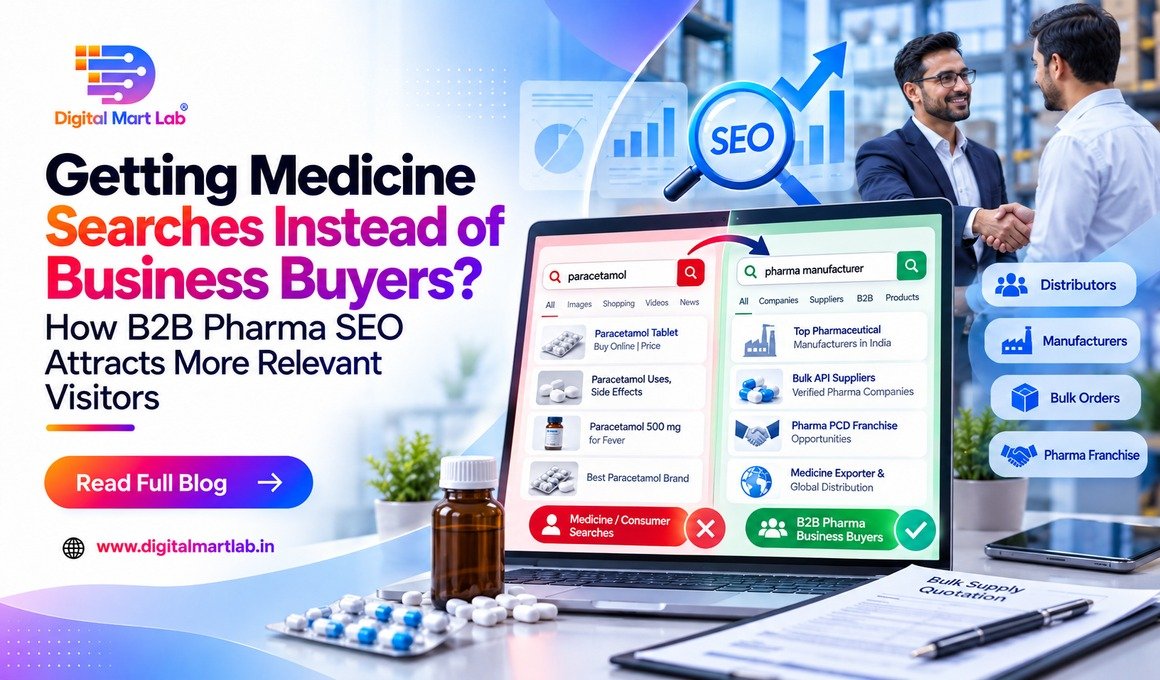
Your website is receiving visitors, but the questions reaching your team are not the ones you expected.
“Where can I buy one strip?”
“What is this medicine used for?”
“Can you deliver a bottle to my address?”
Meanwhile, your business wants enquiries from franchise applicants, distributors or companies looking for third-party manufacturing.
The traffic report may look encouraging, but your sales team is spending time explaining that you do not handle individual medicine purchases.
B2B pharma SEO helps organise your website around the business relationships and requirements you actually serve. It connects product information with franchise opportunities, distribution discussions and manufacturing capabilities.
The aim is to make your intended audience clear and give relevant buyers useful reasons to contact you.
Why can a pharma website attract the wrong searches?
A product name alone does not explain what your company offers to the person searching for it.
The same name may interest a patient, a retailer, a distributor or a manufacturing buyer. If your page mainly discusses medicine uses and displays a price, visitors may understand it as a consumer product page.
Your company may operate entirely in B2B markets, but that business context needs to appear in the content.
Common gaps include:
- Product pages that do not explain the business enquiry available.
- A homepage that lists products without describing whom the company serves.
- Blog topics focused mainly on general medicine questions.
- One large catalogue with little supporting range information.
- Manufacturing pages that do not explain capabilities or requirements.
- Contact forms that treat every enquiry in the same way.
Adding “B2B” to the footer will not resolve all these issues. The page itself needs to explain its purpose.

Understand the difference between a medicine search and a business search
The wording of a search can provide clues about what someone wants. However, it does not prove who the person is or whether they are suitable for your business.
For example, a broad product search may come from several types of visitor. A search mentioning a franchise range or manufacturing service gives more business context.
| Search theme | Possible requirement | Useful website content |
| Medicine uses or individual purchase | Consumer information or retail purchase | Usually outside the main acquisition focus of a B2B-only business |
| Derma PCD franchise | A range-specific partnership opportunity | Derma range and franchise information |
| Tablet third-party manufacturing | A manufacturing service | Supported capabilities and requirement-review process |
| Pharma distribution opportunity | A business relationship | Portfolio, partnership information and an enquiry route |
| Manufacturing for a stated export market | Market-specific supply or manufacturing discussion | Verified market information and a suitable enquiry process |
Use these differences to plan content. Then compare the resulting enquiries with what your sales team can actually support.
Check which pages are attracting unrelated visitors
Before deleting content or changing the whole website, identify where the mismatch begins.
Review available search-query information, the pages receiving visits and the questions reaching your team.
Ask:
- Which pages appear for medicine-information searches?
- Which pages attract searches about franchises or manufacturing?
- Do product pages explain the intended business offering?
- Are useful business pages difficult to find?
- What do visitors repeatedly misunderstand?
Available search data will not explain every visit. Combine it with sales feedback.
Separate traffic volume from commercial relevance
A page receiving many visits may contribute little to your business goals. A more specific service page may receive fewer visits but produce more suitable discussions.
Do not assume either outcome without checking.
Record whether enquiries concern a supported range, territory or manufacturing requirement. This gives your SEO strategy a more useful direction than traffic growth alone.
Make your business offering clear on important pages
Visitors should quickly understand what kind of conversation your company wants to have.
For a PCD company, that may mean explaining franchise ranges and the territory enquiry process.
For a manufacturer, it means describing actual capabilities and how buyers can submit requirements.
For a pharma marketing company, it may involve explaining the portfolio and distributor relationship.
Use page titles that describe the offer
A heading such as “Our Derma Products” identifies a category but may leave the business purpose unclear.
Where accurate, a more useful heading could be:
“Explore Our Derma Range for PCD Franchise Enquiries”
A manufacturing page might use:
“Tablet Manufacturing: Capabilities and Enquiry Requirements”
These headings tell visitors more about what they can discuss. Use wording that reflects the actual page rather than inserting business keywords into unrelated content.
Keep product information accurate
Business-focused content still needs useful product details.
Retain approved information buyers need to identify the range or product. Add the relevant partnership or manufacturing context around it.
Do not remove necessary information simply to avoid consumer searches, and do not add unsupported commercial or medical claims to make the page sound more persuasive.
Create range pages that answer franchise buyers’ questions
A prospect researching a specific franchise range needs more than a general company introduction.
If your company genuinely offers that range, a dedicated page can explain:
- The relevant portfolio.
- Available catalogue information.
- Actual partner support.
- How territory requests are assessed.
- What details the applicant should share.
- The next step in the discussion.
This helps connect the range with the business opportunity.
Example: a derma franchise search
Illustrative example: A company offers a derma range, but its website lists every product on one general portfolio page.
A relevant derma franchise page could bring together the range information, support details and territory enquiry option.
The buyer can assess the offering without searching through unrelated categories or guessing how to begin.
Did You Know? A distributor seeking a derma franchise may overlook a website that only describes a general pharma portfolio. Useful pages about your actual ranges help buyers find partnership information matching their requirement.
Avoid producing pages without meaningful differences
Do not create a separate page for every possible keyword if the information is effectively the same.
Start with the ranges your business prioritises and explain each properly. Expand when you have useful information to add.
The objective is a clear website, not a large collection of repetitive pages.
Make the catalogue easier for business buyers to explore
If your portfolio sits only inside one long PDF, buyers may struggle to shortlist relevant products.
An organised digital catalogue can help them browse by range, category or other useful characteristics.
The website can show the approved details needed to identify a product, then offer a relevant next step.
For example:
- Enquire about this range.
- Discuss distribution.
- Request relevant catalogue details.
- Add products to a business enquiry.
Make the action match what your team actually provides. A button should not imply immediate retail purchase if that is not your service.
Did You Know? A large product portfolio becomes harder to explore when everything sits inside one long PDF. An organised digital catalogue helps distributors shortlist relevant ranges before asking your team for commercial details.
Keep downloadable files and website information consistent. Buyers should not find different pack details or discontinued items in an older catalogue.
Build manufacturing pages around requirements buyers need reviewed
A manufacturing buyer is assessing whether your business could support a requirement.
Your content should help them understand:
- Supported dosage forms.
- Relevant packaging options.
- Information needed for technical review.
- Quantity details required for a commercial discussion.
- How the quotation process begins.
A product list alone may not explain these points.
Connect the capability with a clear enquiry
For example, a capsule-manufacturing page can describe the actual supported work and ask the buyer to share their product requirement, estimated quantity and packaging preference.
This gives the page a business purpose beyond the medicine or product name.
The form should also allow a buyer to say that a detail is undecided. Your team can clarify it during the discussion.
Be precise about your role
If your company arranges manufacturing through partners, explain that accurately.
Do not imply ownership of a facility or availability of a capability that your team has not confirmed.
Clear positioning helps both search visitors and salespeople understand what can reasonably be discussed.
Give domestic and export buyers relevant enquiry routes
Domestic and export enquiries may need different starting information.
A domestic manufacturing buyer may begin with a product, quantity and packaging requirement. An export enquiry also needs the intended destination market identified so your team can review the appropriate capability and documentation questions.
Do not assume that a product or service suitable for one market can automatically be supplied to another.
| Enquiry type | Useful starting details |
| Domestic manufacturing | Product requirement, dosage form, estimated quantity and packaging |
| Export manufacturing or supply | The same starting details, plus destination market and known documentation or labelling requirements |
Explain what your team will confirm
A useful export enquiry message could say:
“Share your intended market and product requirement so our team can review the relevant manufacturing, packaging and documentation details.”
This starts the appropriate discussion without promising market eligibility before review.
Create separate pages where you have enough verified information to make them useful. Otherwise, a clear choice within the enquiry form can direct the request appropriately.
Do not publish country-specific claims or pages simply to attract searches for markets you have not assessed.
Use educational content that prepares a business enquiry
Blog topics should support the decisions your intended customers need to make.
Useful subjects may include:
- What to prepare before requesting a manufacturing quotation.
- Questions to ask when discussing a franchise range.
- How to share quantity and packaging requirements.
- What a distributor should clarify before selecting a portfolio.
- Which initial details an export enquiry should contain.
These topics give business buyers information they can use.
They also connect naturally to relevant service and range pages.
This does not mean every article must sell a service. It means the educational content should help the audience your business wants to serve.
What should you do with existing consumer-focused articles?
Review them individually.
Some may provide useful information or serve an existing purpose. Others may be outdated, unrelated to your business or attracting visits that your team cannot help.
Assess their accuracy, audience, links and contribution before deciding whether to update, retain, combine or remove them.
Avoid changing or deleting many URLs without a plan. The decision should reflect the value of each page and the structure of the website.
Where a page remains, make its purpose clear and link to relevant business information only when the connection is useful.
You cannot prevent every unrelated visitor from reaching your website. You can make the intended offer easier to understand.
Measure whether your audience is becoming more relevant
Do not judge B2B pharma SEO only by the total number of visits.
Review the enquiries alongside search and page data:
- Are more visitors reaching franchise or capability pages?
- Do enquiries mention relevant ranges?
- Are manufacturing requests aligned with supported work?
- Can domestic and export enquiries be identified clearly?
- Do useful discussions progress to a requirement review or quotation?
Keep a simple record of unrelated enquiries too. They can reveal confusing page wording or a content gap.
Look beyond the first contact
A relevant enquiry is still only the beginning.
Commercial terms, availability, response time and follow-up affect whether it becomes business. Use sales feedback to separate a traffic problem from a later sales-process issue.

How Digital Mart Lab can help attract more relevant pharma visitors
Digital Mart Lab can help organise your SEO and website content around the buyers and requirements your business actually serves.
The proposed work can include:
- Reviewing search intent and existing page content.
- Planning relevant franchise range and manufacturing pages.
- Improving catalogue structure.
- Explaining domestic and export enquiry requirements.
- Connecting useful articles with the appropriate service pages.
- Reviewing enquiry relevance with your sales team.
Through website design and development, the content, navigation and enquiry forms can work together.
Where you also run eligible campaigns, performance marketing planning can use the same clear audience definitions and relevant destination pages.
The aim is to make your business offering easier to discover, understand and discuss.
Frequently asked questions about B2B pharma SEO
1. Can B2B pharma SEO stop all consumer medicine searches?
No. Search intent can overlap, and some unrelated visitors may still arrive. Clear business content helps communicate whom you serve and provides more relevant information for intended buyers.
2. Should we remove product names from our website?
No. Business buyers need accurate product information too. Explain the range or service context around the product instead of relying on the name alone.
3. Do we need separate pages for each franchise range?
Where you offer distinct ranges and can provide useful information, separate pages may help. Avoid repetitive pages that add little beyond a different heading.
4. Is a searchable catalogue enough for SEO?
It can improve product discovery, but buyers also need useful range, company and service information. The catalogue should be part of a clear website structure with appropriate enquiry options.
5. Should domestic and export enquiries use separate forms?
They can use separate forms or one form that asks the intended market and then shows relevant questions. Choose the arrangement that makes the requirement clear without unnecessary steps.
6. How do we know whether our SEO is attracting better buyers?
Compare page visits and available search information with actual enquiries. Look for supported requirements, useful business conversations and progress towards quotations or orders.
Make your website clear about the business you want
A visitor should not have to guess whether your company sells individual medicines, appoints franchise partners or handles manufacturing enquiries.
Explain your actual offering through organised ranges, useful capability pages and relevant enquiry options.
That gives business buyers a clearer route from discovering your company to discussing their requirement.
Want your pharma website to attract more relevant business enquiries?
Discuss Your B2B Pharma SEO Strategy with Digital Mart Lab
Share your website, priority services and the kinds of enquiries your team currently receives. We can use that information to identify where the content and search strategy need better alignment.