
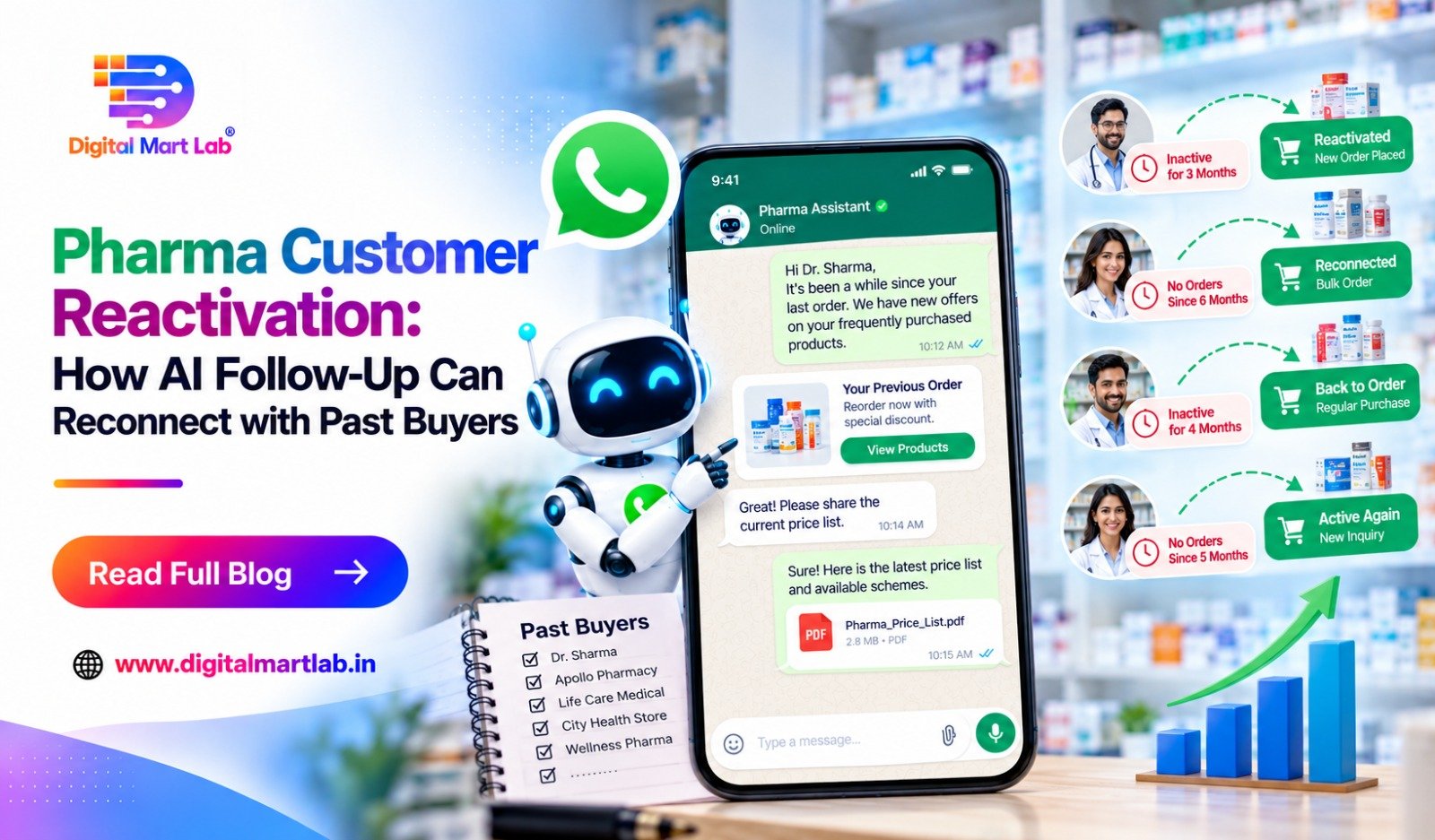
A distributor used to order regularly. Now the orders have become smaller—or stopped.
A manufacturing buyer completed a project with your company but has not discussed another requirement.
Your team considers sending a new price list or a discount offer. But first, there is a more useful question:
What changed?
Pharma customer reactivation starts with understanding why a previous buyer is no longer ordering. AI-assisted follow-up can help your team identify changes in order patterns, prepare relevant questions and reconnect with buyers who have appropriate contact permission.
The conversation may reveal a new requirement. It may also uncover slow-moving stock, changed business priorities or an unresolved service problem.
Order history can show that something changed. Your team still needs the buyer’s perspective to understand why—and decide what to do next.
A Buyer Who Stops Ordering Is Not Always a Lost Customer
A gap between orders can have several explanations.
A distributor may still be selling the previous stock. A franchise partner may have changed their product focus. A manufacturing customer may purchase in project-based cycles rather than every month.
The buyer may also be unhappy about an earlier issue that never reached the right person.
Before labelling someone inactive, check:
- Their usual ordering pattern.
- The products or services they previously purchased.
- Any open complaint or commercial discussion.
- The last meaningful conversation.
- Whether your team agreed to contact them later.
- Whether recent purchases were recorded under another account or contact.
A single inactivity rule will not suit every customer.
A distributor who previously ordered monthly needs a different review from a manufacturing buyer whose last project covered a much longer requirement.

Use Order History to Identify Conversations Worth Reviewing
A connected system can flag changes such as longer gaps between orders, lower quantities or a previously purchased range disappearing from the order mix.
These are signals for review, not proof of dissatisfaction.
Compare buyers with their own history
Instead of treating every customer with no order in 60 days as equally inactive, consider their normal pattern.
Useful records include:
| Information | Why it matters |
| Last order date | Establishes the most recent purchase |
| Previous order intervals | Helps your team judge whether the gap is unusual |
| Products or ranges purchased | Supports a relevant conversation |
| Changes in quantity or frequency | Identifies something worth checking |
| Open service issues | Prevents a sales message from ignoring an unresolved problem |
| Last discussion and agreed timing | Helps avoid premature contact |
| Contact preferences | Guides appropriate outreach |
Your team should decide which changes deserve attention. AI can help summarise those changes, but the underlying records must be accurate.
Measure how many alerts lead to a useful review. Too many irrelevant alerts can create another list your team stops checking.
Did You Know?
A partner ordering less may need support rather than another offer. A change in purchasing can be a reason to ask about range suitability, demand or an unresolved service concern.
Ask What Changed Before Offering a Discount
A discount cannot resolve every reason for reduced ordering.
If the buyer had difficulty getting a dispatch update, a lower price does not address communication. If their current stock is moving slowly, another large order may not fit their needs.
Start with an open, relevant question.
Illustrative message:
Hello Mr Sharma, we wanted to check how the range you previously ordered is working for your business. Have your requirements changed, or is there anything from our side that needs attention?
This gives the buyer space to describe the situation without being pushed towards an immediate purchase.
Avoid questions that assume a cause:
“Have you stopped ordering because our prices are high?”
Unless the buyer raised pricing, that is only a guess.
Record the answer in practical terms: changed range requirement, existing stock, service issue, future buying date or no current need.
Approach Distributors and Franchise Partners with Relevant Questions
For a distributor or franchise partner, the conversation may concern the range they handle, local demand, available stock or the support they receive.
Focus on the products they actually purchased
An appropriate question could be:
“Are the products you previously selected still relevant to your current requirement, or has your focus changed?”
If the buyer says their focus has changed, ask what they are now looking for.
Do not automatically send the entire catalogue. First establish whether your available range is relevant.
Understand whether support is missing
A partner may need clarification about an earlier order, approved product information or the right support contact.
The assistant can collect the concern and direct it to the responsible employee. It should not invent partner benefits, promise exclusivity or change commercial terms.
Your team must maintain accurate range and support information. Track whether the conversation identifies a clear requirement or resolves an issue—not just whether the buyer replies.
Reconnect with Manufacturing Buyers Around Actual Capabilities
A former manufacturing buyer may not know that your company can now handle a relevant requirement.
An update can be useful when the capability is verified and the buyer has appropriate permission to receive it.
For example, a previous packaging discussion may make a newly confirmed packaging option relevant. But the connection should be genuine.
Illustrative email:
Subject: An update relevant to your earlier packaging enquiry
Hello Ms Verma,
You previously asked about a packaging option that was unavailable at the time. Our team has since confirmed that this option can be considered, subject to reviewing the product and order requirements.
Is this still relevant to your plans? If so, we can arrange a discussion.
Only use a message like this when the original question and the new capability are documented.
A pharma marketing company working with manufacturing partners should describe that arrangement accurately. It must not imply that it owns a facility or controls capacity that belongs to another business.
Technical feasibility, quantities, quotations and production commitments still need authorised review.
Share Relevant Range Updates Instead of Repeated Full Catalogues
Your customers may not know about every relevant product already available in your range.
AI-assisted selection can help your team identify possible matches between recorded interests and approved catalogue information. A person should review the match where context is uncertain.
Explain why the update may matter
A useful update refers to an expressed interest or previous requirement:
“You previously asked about expanding this range. We have an approved product list that may be relevant. Would you like our team to share it?”
It should not claim that the buyer will sell more or earn a particular margin.
A previous purchase also does not establish permanent interest. Ask whether the requirement still applies.
Keep the update accurate and manageable
Use the current approved catalogue. Check availability separately where necessary.
Avoid sending an extensive attachment when a short, relevant selection would answer the question more clearly.
Did You Know?
A previous buyer may be unaware of a relevant existing product or a newly verified capability. A permission-based update connected to their recorded interest can provide a useful reason to reconnect.
Resolve Service Problems Before Restarting the Sales Pitch
If the buyer reports an unresolved issue, the conversation should change direction.
Do not continue a product promotion while the person is explaining a shortage, delayed response or unresolved commercial concern.
A useful process is to:
- Acknowledge the reported issue.
- Collect the relevant reference and missing details.
- Assign a responsible employee.
- Pause routine promotional follow-up.
- Record the action taken and the buyer’s response.
The assistant can organise this handover. It should not decide who was at fault or promise an unapproved refund, replacement or concession.
Closing a support record does not automatically mean the relationship has recovered. Your salesperson may need to check whether the buyer considers the matter addressed before discussing future requirements.
What AI-Assisted Reactivation Looks Like in Practice
The following examples are hypothetical, not Digital Mart Lab client results.
Example: A distributor’s order frequency falls
A distributor previously placed orders regularly but has recently ordered less often.
The system flags the change. A salesperson reviews the record and approves an appropriate check-in.
The buyer explains that a previous order issue remains unresolved. The assistant records the concern and passes it to the responsible employee. Promotional messages pause.
The useful outcome is identifying the issue that needs attention. A new order remains the buyer’s decision.
Example: A manufacturing buyer has a changed requirement
A previous customer is contacted with permission about a verified capability relevant to an earlier discussion.
The buyer replies that the original project is complete but another requirement may arise later.
The assistant records the new context and preferred follow-up timing. Your team can then prepare for the right conversation instead of repeatedly pursuing the old requirement.
Use Permission-Based Follow-Up and Clear Stop Rules
Having an old phone number does not mean every type of future message is welcome.
Use appropriate contact permission, respect channel preferences and make it easy for the buyer to decline further follow-up.
Keep separate records for:
- Buyers who welcome relevant updates.
- Buyers who request contact at a later time.
- Buyers with an unresolved issue.
- Buyers who decline further contact.
- Contacts whose details or role need verification.
Do not use artificial urgency or repeated “last chance” messages to force a response.
If the buyer remains silent, follow an agreed pause or review process. AI should not turn an old customer list into an endless automated sequence.
How Digital Mart Lab Can Help Reopen Relevant Conversations
Digital Mart Lab’s AI-enabled services include conversational marketing and chatbots. A customer-reactivation workflow can be discussed around your order records, approved information and sales responsibilities.
The proposed work can connect specific problems to clear actions:
| Business problem | Proposed work | What to assess |
| Changes in ordering go unnoticed | Define order-history alerts and review summaries | Relevant alerts and completed reviews |
| Every past buyer receives the same message | Prepare follow-up based on recorded interests and current status | Useful replies and changed needs identified |
| Service concerns remain mixed with sales chats | Create a support handover and pause promotional contact | Issue ownership and resolution |
| Buyers cannot find current range or capability details | Improve website catalogue and capability information | Clarity of follow-up discussions and repeated questions |
Connections to order systems, CRM records, WhatsApp or email require separate scope and feasibility checks. AI cannot identify reliable patterns from incomplete or disconnected information.
Discuss an appropriate reactivation process through Digital Mart Lab’s AI-enabled digital marketing services. Bring your existing follow-up process, the records you maintain and common reasons buyers stop ordering.
Measure More Than the Number of Replies
A polite reply is not the same as a returning customer.
Track outcomes separately:
- Buyers whose current requirements were clarified.
- Service problems identified and assigned.
- Relevant discussions arranged.
- Quotations requested.
- New orders actually placed.
- Subsequent purchases over an appropriate period.
- Opt-outs and complaints about contact.
Also record why a buyer did not proceed. “No current requirement” is different from “unresolved service issue.”
Do not attribute every later order entirely to the AI message. Your team’s work, the buyer’s timing and other interactions may also have contributed.

A Practical Checklist Before Contacting Past Buyers
- Check the buyer’s normal purchasing pattern.
- Confirm that order history is complete enough to use.
- Review open complaints and pending commitments.
- Verify that the contact still handles the requirement.
- Check appropriate contact permission and preferences.
- Select one relevant reason to reconnect.
- Use approved, current range or capability information.
- Assign a salesperson to handle the reply.
- Pause promotion when a service issue emerges.
- Record the outcome and respect stop requests.
Start with a manageable group and review the conversations before expanding the process.
Frequently Asked Questions About Pharma Customer Reactivation
1. When should we consider a pharma buyer inactive?
Compare the gap with their usual purchasing pattern and business context. A fixed period will not suit every distributor or manufacturing buyer. Review the history before deciding to contact them.
2. Can AI explain why a buyer stopped ordering?
It can highlight changes and ask relevant questions. It cannot reliably determine the reason without evidence from the buyer or the business record.
3. Should we offer a discount in the first message?
Not automatically. First understand whether the issue involves pricing, range suitability, stock, timing or service. Any offer should follow authorised commercial decisions.
4. Can we send product updates to previous customers?
Use appropriate permission and relevant, approved information. A previous purchase does not mean the buyer wants every catalogue or promotional message.
5. What should happen when a buyer reports an old complaint?
Pause the sales sequence, collect the necessary details and assign the issue to a responsible employee. Address the concern before pushing for another order.
6. Does AI follow-up guarantee repeat orders?
No. It can help your team maintain records and reopen appropriate conversations. Repeat orders depend on the buyer’s needs, your offer, service experience and commercial fit.
Rebuild the Conversation Before Asking for the Next Order
A past buyer already has experience with your company. Understanding that experience is a useful starting point.
A relevant follow-up can reveal a changed requirement, an overlooked product interest or a problem your team needs to resolve.
AI can help your team notice the change and organise the response. The relationship improves through accurate information, useful support and responsible follow-through.
Discuss how Digital Mart Lab can help you reconnect with past pharma buyers. Bring your customer follow-up process and the points where repeat-order conversations commonly stop.