
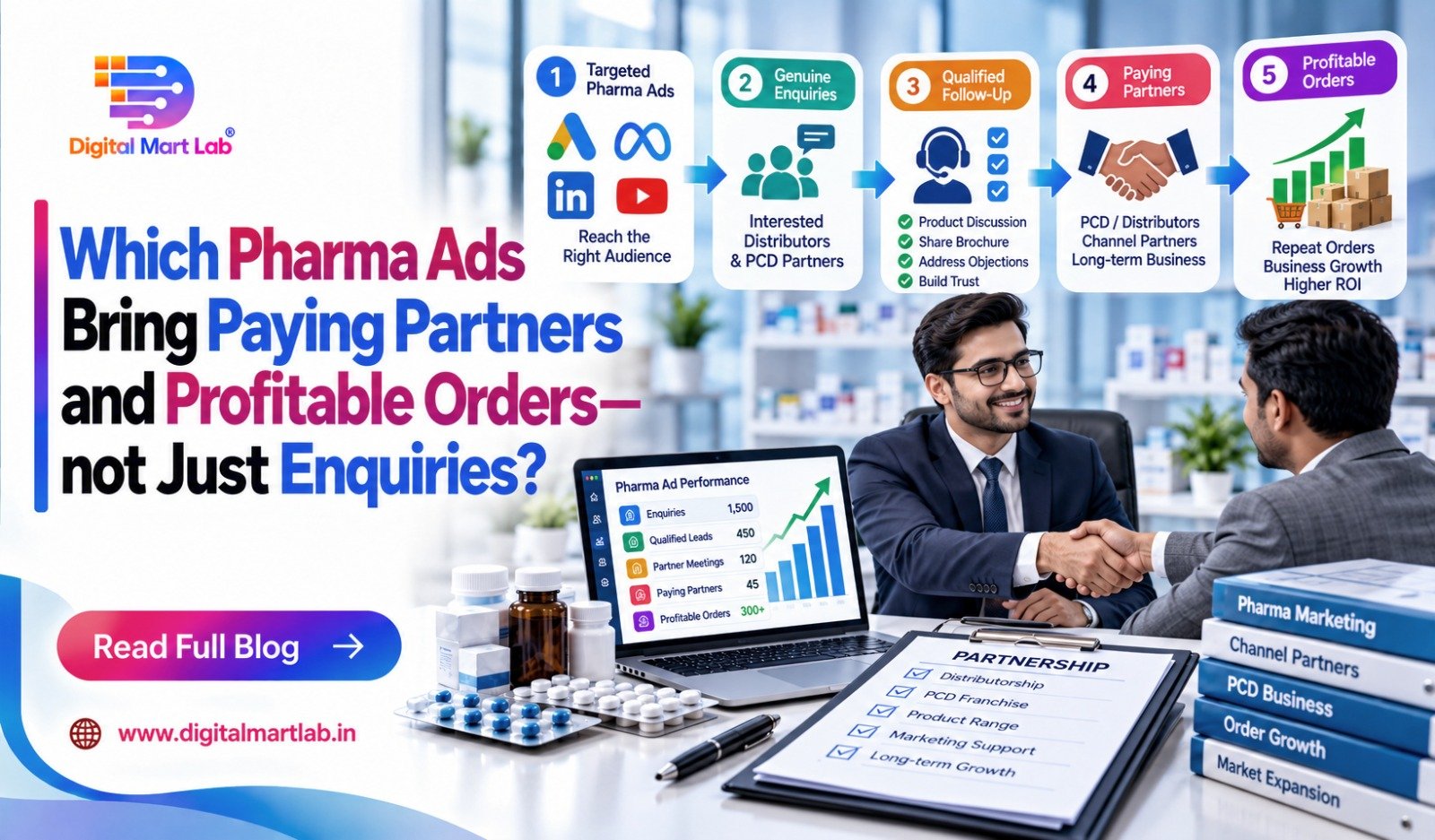
Your monthly campaign report shows leads, clicks and cost per enquiry.
But as a pharma business owner, you want to know something more important:
“Which campaign brought customers who actually ordered?”
“And after the costs involved, was that business worthwhile?”
A campaign generating many enquiries may produce few active franchise partners. A manufacturing enquiry that looks inactive this month may become an order several months later. A large invoice may contribute less than expected after the costs of supplying it.
Understanding pharma ad ROI starts with connecting advertising sources to sales progress, paid orders and relevant commercial costs. You also need enough time to see what those enquiries become.
The lead report is the beginning of that review.

Separate enquiry activity from business outcomes
A form submission tells you that someone contacted your company. It does not establish that they became a customer.
Likewise, a quotation sent, an agreement signed and a payment received represent different stages.
Keep those stages visible.
| Stage | What it tells you |
| Enquiry received | A person has requested contact or information |
| Requirement reviewed | Your team understands the opportunity more clearly |
| Relevant sales discussion | The requirement may fit your offering |
| Quotation or terms shared | The buyer has information to assess |
| Order accepted | The business has agreed to proceed under the applicable process |
| Payment received | Money has been collected against the order |
| Repeat purchase | The customer has returned for further business |
Your process may use different labels. What matters is that everyone understands them consistently.
For credit orders, record order value and payment status separately. An accepted order is not the same as collected revenue.
Give each enquiry a source that stays with the record
If a lead enters the system without a campaign source, it becomes difficult to connect a later order with the advertising that helped generate it.
Record the available source when the enquiry arrives.
Useful fields include:
- A unique lead or opportunity reference.
- Enquiry date.
- Platform and campaign, where known.
- Advertisement or landing page, where available.
- Buyer and company details.
- Requirement and assigned salesperson.
Campaign-tagged links and form integrations can help capture this information where the setup supports them. Test the process rather than assuming the source is being stored correctly.
Preserve the original source when the conversation moves
A prospect may submit a website form and then continue on WhatsApp or email.
Keep those conversations connected to the relevant opportunity. Do not replace the original campaign source simply because the latest message arrived through another channel.
Avoid counting the same opportunity several times
One buyer may appear in multiple forms or channels.
Review possible duplicates while preserving separate projects where they are genuine. A repeat submission for the same requirement should not automatically become another acquired customer.
This makes campaign comparisons more reliable.
Connect the lead record with the order record
Your marketing system and order records need a shared reference.
When an enquiry progresses, record the customer or order reference against the opportunity. That allows your team to follow the connection without relying on memory.
A simple record might contain:
| Field | Example of what to record |
| Opportunity reference | A unique internal ID |
| Original enquiry date | When the discussion began |
| Campaign source | The available campaign information |
| Current stage | Quotation review, order accepted or another defined stage |
| First-order reference | The linked commercial record |
| Payment status | Pending, part-paid or received |
| Repeat-order references | Further purchases linked to the customer |
| Review date | When the record was last checked |
Do not force salespeople to maintain duplicate information in several places if a reliable connection can be established.
Start with a process your team can use consistently.
Measure paying partners, not only franchise enquiries
A franchise campaign may generate plenty of interest without producing active partners.
One applicant may enquire about an unavailable territory. Another may sign documents but not proceed to a first order. A third may place an initial order and continue purchasing.
These outcomes should remain separate.
Define what your business means by an active partner
Use a practical internal definition, such as a partner with an accepted and paid first order. If your business uses credit terms, define the relevant status clearly.
Track repeat activity separately instead of assuming every first-order customer remains active indefinitely.
Did You Know? The campaign generating the most franchise leads may not generate the most active partners. Linking enquiry sources with first orders and repeat purchases helps you assess which campaigns create ongoing business relationships.
Review why first orders do not happen
Where an interested applicant does not progress, record the reason if known.
It may involve range selection, territory, commercial terms, documents or timing.
These findings help distinguish an unsuitable enquiry from an incomplete onboarding process.
Allow time for manufacturing enquiries to become orders
Manufacturing buyers may need to clarify specifications, review quotations, assess samples or involve other colleagues before deciding.
A campaign can generate the initial enquiry well before the order is placed.
If you review only orders received in the same month as the advertising spend, you may miss that connection.
Follow groups of enquiries from the period they arrived
For example, continue reviewing the enquiries received in one month as they move through later discussions.
Compare them with other groups at a similar age. A group of enquiries received last week has not had the same opportunity to convert as one received several months ago.
Use a review period that reflects your actual buying process.
Keep delayed opportunities visible
Record what the buyer is waiting for and the next agreed action.
Do not mark an enquiry as lost simply because an order did not arrive immediately. Equally, do not leave it open forever without a meaningful reason.
Did You Know? A manufacturing enquiry may become an order months after the campaign starts. Connecting the enquiry with later quotations and purchases helps identify advertising contributions that an immediate-results report can miss.
A large order is not automatically a profitable advertising result
Order value matters, but it does not show how much the business retained.
A manufacturing order may involve production or procurement costs, packaging, logistics and other costs directly associated with fulfilment.
There may also be costs involved in acquiring and developing the customer.
A useful commercial review considers the relevant costs rather than treating the invoice amount as profit.
Agree on which costs your report includes
Depending on your business and reporting purpose, these may include:
- Advertising spend.
- Agency or campaign-management fees.
- Creative and landing-page costs.
- Direct sales-development expenses.
- Samples and dispatch costs.
- Product or manufacturing costs.
- Packaging and order-related logistics.
- Discounts, returns or adjustments.
Some costs are shared across customers or periods. Agree on a consistent allocation method with the person responsible for your commercial records.
Avoid double-counting a cost already included in another figure.
Keep revenue, cash collection and contribution distinct
Revenue records, customer payments and the contribution remaining after specified costs answer different questions.
Your marketing report should state which one it uses.
A useful contribution calculation is not automatically the company’s final net profit. Other operating costs may still need to be accounted for.
Use a simple example to see the difference
The following comparison is illustrative only. It is not a forecast, client result or industry benchmark.
Assume the figures relate to two campaigns reviewed over comparable periods, with order-related variable costs and acquisition costs defined consistently.
| Measure | Campaign A | Campaign B |
| New customers placing paid first orders | 10 | 6 |
| Net sales value from those orders | ₹5,00,000 | ₹4,00,000 |
| Direct order-related variable costs | ₹4,20,000 | ₹2,80,000 |
| Contribution before acquisition costs | ₹80,000 | ₹1,20,000 |
| Defined acquisition costs | ₹60,000 | ₹60,000 |
| Contribution after those acquisition costs | ₹20,000 | ₹60,000 |
Campaign A generated more first-order customers and higher sales value. Campaign B produced a larger contribution after the costs included in this example.
That does not establish a permanent winner. Repeat purchases, unresolved returns and further costs may change the picture.
The example shows why lead count and invoice value alone are insufficient.
Track repeat purchases without assuming future revenue
A first order may be the beginning of a valuable relationship.
Link subsequent orders to the customer record so you can review the business generated by customers originally acquired through a campaign.
Also record cancellations, returns or other adjustments that affect the result.
Use observed purchases in the main report
Do not treat hoped-for repeat orders as revenue already earned.
If you prepare a forecast, label it separately and explain the assumptions. Keep actual results visible alongside it.
Recognise that retention involves more than the original ad
A customer may reorder because of product fit, service, availability and the work of your team.
You can report repeat purchases from a campaign-acquired customer group without claiming the original advertisement alone caused every later order.
That distinction keeps the report useful and realistic.
Update qualification as the buyer’s requirement changes
The first enquiry is only a snapshot.
A distributor may change their preferred range or starting budget. A manufacturing buyer may revise the quantity, packaging or timeline.
If your team continues using the original information, the opportunity may be prioritised incorrectly.
Record the latest requirement and its date
Keep the current requirement visible while preserving important history.
An updated conversation may make an opportunity more suitable, less suitable or ready for a different next step.
Review AI-generated priorities
Where AI helps summarise or prioritise enquiries, make sure it uses the latest verified information.
A score based on an old enquiry should not override a recent conversation.
An agreed AI-assisted lead management process can support these updates, with your team checking commercial suitability and commitments.
Do not confuse more follow-up activity with better results
A report showing more calls or automated messages may indicate effort. It does not prove that opportunities are progressing.
Ask what changed after the activity.
Did the buyer clarify the requirement? Was a concern resolved? Did the discussion move to a quotation, approval or order?
A smaller number of relevant follow-ups can be more useful than repeated messages that do not address the pending decision.
Record the next action and outcome, not only the number of attempts.
What should your monthly pharma campaign review include?
Use a report that connects marketing and sales without becoming unnecessarily complicated.
Include:
- Spend and the costs covered by the report.
- Unique enquiries and relevant requirements.
- Progress through agreed sales stages.
- First orders and payment status.
- Repeat purchases from previously acquired customers.
- Important commercial costs and adjustments.
- Unresolved opportunities that need more time.
- Specific actions for the next review period.
Keep recent enquiry groups separate from older ones where the buying cycle makes this necessary.
Also acknowledge source gaps. If the campaign connection is unknown, label it unknown rather than assigning an order to whichever channel looks most convenient.

How Digital Mart Lab can help connect campaigns with commercial results
Digital Mart Lab can help plan the link between enquiry capture, sales updates and campaign reporting.
Through performance marketing services, the proposed work can include:
- Capturing available campaign sources.
- Reviewing lead and order-reference connections.
- Defining meaningful enquiry and sales stages.
- Separating activity from commercial progress.
- Reviewing results with your sales team.
- Using updated requirements to guide campaign decisions.
Where enquiry details are being lost at submission, website and form improvements can support better records.
Your business supplies and validates order, payment and cost information. The marketing review uses that information to make more informed campaign decisions.
The aim is to identify what is producing useful business and what still needs attention.
Frequently asked questions about pharma ad ROI
1. Is cost per lead enough to judge a pharma campaign?
No. It shows the cost of generating an enquiry under your reporting definition. You also need to review relevance, sales progress, paid orders and the costs of serving the customer.
2. Should we count a signed franchise agreement as a paying partner?
Keep agreement status and first-order status separate. Use a clear internal definition of a paying or active partner and apply it consistently.
3. How should we record an order received months after the enquiry?
Link it to the original opportunity and available campaign source. Review it with the group of enquiries from that period, while also recording the actual order and payment dates.
4. Does a high return on ad spend prove profitability?
No. Sales value compared with advertising spend does not include every relevant cost. Review fulfilment costs and other acquisition expenses before drawing a profitability conclusion.
5. Can we include repeat orders when reviewing acquired customers?
Yes. Show them separately from first orders and use actual purchases. Avoid claiming that the original advertisement was the only reason for every repeat order.
6. What if we cannot identify the campaign behind an order?
Record the source as unknown or partially known. Ask for available context and improve future tracking, but do not invent an attribution.
Find out which enquiries become worthwhile business
A useful campaign report should help you move beyond “How many leads did we get?”
Connect the original enquiry with the buyer’s progress, first order, payment status and repeat activity. Then review the relevant costs over a realistic period.
That gives you a stronger basis for deciding which campaigns to improve, continue or expand.
Want a clearer view of what your pharma advertising is bringing to the business?
Discuss Your Pharma Campaign Tracking with Digital Mart Lab
Share how you currently record enquiries, orders and campaign sources. We can use that process to identify the connections your reporting needs.